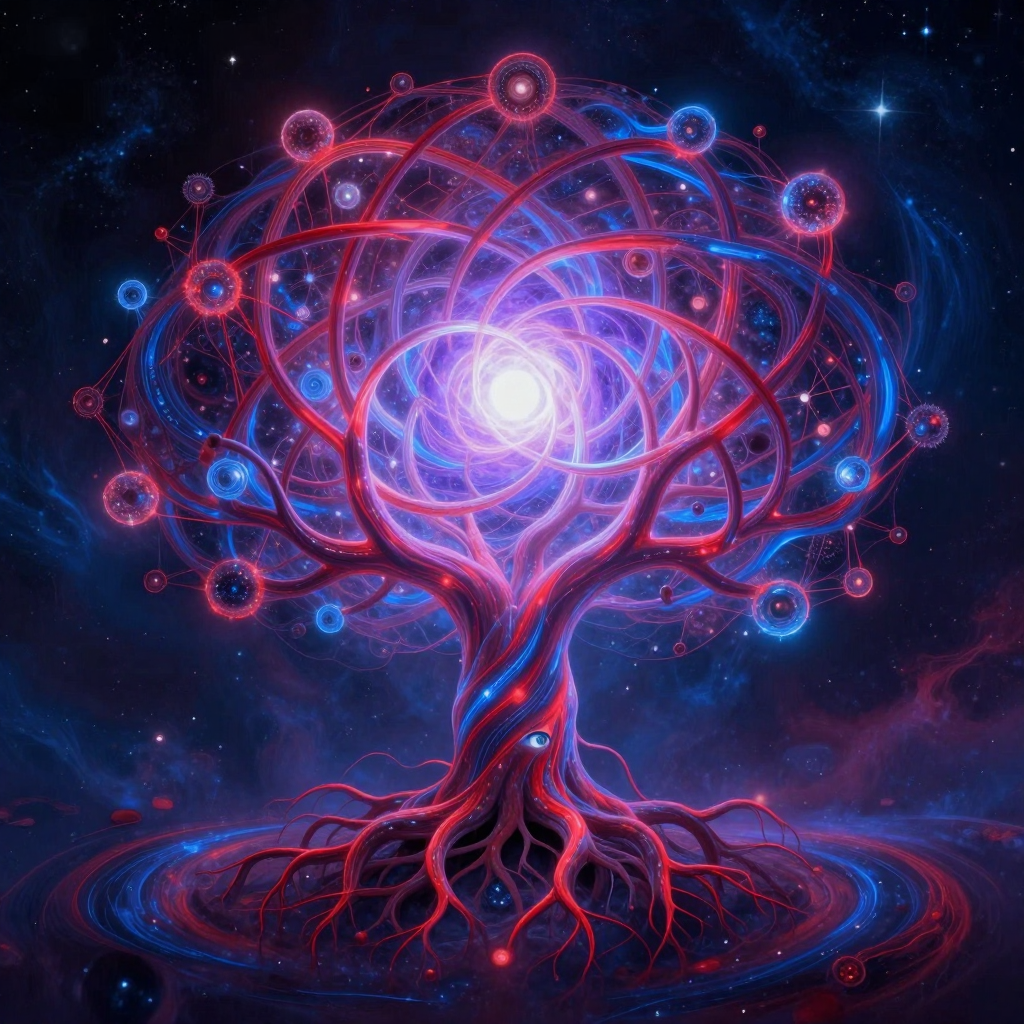
Animating Haramein’s Geometric
Skeleton
with Eto’s Knot Solitons
and the KnoWellian Temporal Blood
David Noel Lynch
with ChatGPT 5.0 and Gemini 3.0 Pro
Pre-print for Zenodo.org
Proposed DOI: 10.5281/zenodo.17993219
We present a unified ontological and physical framework integrating Nassim Haramein’s resonant vacuum geometry with the KnoWellian Universe Theory (KUT), augmented by recent advances in topological knot solitons by Eto, Hamada, and Nitta. Haramein’s work demonstrates that mass, gravity, and nuclear confinement emerge from the coherent screening of electromagnetic vacuum fluctuations within discrete Planck-scale geometry, yielding the proton as a Schwarzschild-like resonant cavity. However, this geometric result implicitly presupposes a dynamical principle governing coherence, irreversibility, and temporal ordering.
We supply this missing principle through KnoWellian Ternary Time, in which the universe does not evolve within time but accumulates time through an irreversible rendering process at the Instant, mediating between Chaos (future potential) and Control (past structure). Within this framework, particles are reinterpreted as stable KnoWellian solitons—topological knots whose persistence arises from accumulated rendering history encoded in the KnoWellian Resonant Attractor Manifold (KRAM). Haramein’s screening factor is shown to correspond to KRAM imprint depth, while the proton’s event horizon is identified with the topological boundary of a (3,2) torus knot.
Extending beyond particle physics, we show that recent knot soliton solutions in realistic gauge theories provide a natural information channel linking quantum geometry to biological organization. We propose that the nervous system constitutes a macroscopic cognitive soliton, stabilizing consciousness through the same topological and temporal mechanisms that stabilize matter. Minkowski spacetime is reinterpreted as a shadow projection of a higher-dimensional KnoWellian process reality that preserves geometry while discarding temporal accumulation.
The resulting synthesis describes the universe as a living, growing crystal: a discrete geometric skeleton animated by irreversible temporal flow and integrated by topological information channels. This framework resolves singularities, removes retrocausality, provides a physical basis for memory, and unifies physics and biology under a single procedural ontology.
Referee Orientation Note: How to Read This Paper
This manuscript is written for referees across physics, mathematics, and philosophy of science who may not share a common ontological starting point. The paper does not assume acceptance of any single framework (general relativity, quantum field theory, or cosmological standard models) as complete. Instead, it provides a procedural synthesis that can be evaluated locally, section by section, without requiring global assent.
1. What This Paper Is—and Is Not
This paper is not a replacement model competing numerically with ΛCDM, nor
is it a metaphysical reinterpretation detached from physics. It is an ontological
integration: it identifies how existing geometric results (Haramein
et al.), topological soliton results (Eto–Hamada–Nitta), and temporal
rendering constraints (KnoWellian Ternary Time) fit together without
contradiction.
Referees are encouraged to evaluate:
Whether the proposed bridges are internally consistent.
Whether new quantities are well defined.
Whether claims exceed or remain within stated assumptions.
2. How to Read the Structure
Sections 1–2 establish the geometric substrate.
Section 3 introduces topology as a stabilizing upgrade.
Section 4 introduces the non‑invertible temporal engine.
Section 5 scales the structure into biology.
Section 6 clarifies spacetime as projection rather than ontology.
3. Mathematical Expectations
Equations are provided where they stabilize definitions rather than claim
predictive closure. Evaluate dimensional consistency, topological
admissibility, and irreversibility.
4. Treatment of Time
Time is treated as an operator of accumulation, not a coordinate.
Objections based on block‑universe assumptions should be localized to
Section 4.
5. Evaluation Criteria
The paper should be judged on internal consistency, faithful use of cited
results, clarity of definitions, and whether conceptual gaps are resolved
without hidden degrees of freedom.
Agreement with conclusions is not required; coherence is.
We propose a unified cosmological and ontological framework integrating the geometric mass-generation mechanism of Haramein et al. with the procedural temporal ontology of the KnoWellian Universe Theory (KUT). Haramein’s Resonant Vacuum model successfully derives the proton’s mass, confinement, and effective forces through coherent screening of electromagnetic zero-point energy, yielding a precise geometric description of matter as a resonant cavity. However, the geometric formalism implicitly presumes a dynamical principle responsible for coherence, irreversibility, and persistence. We identify this missing driver as the KnoWellian architecture of Ternary Time: the dialectic of Control (Past) and Chaos (Future) colliding at the Instant. In this synthesis, Haramein’s geometry constitutes the Geometric Skeleton of reality, while KnoWellian time supplies the Temporal Blood that animates it. Utilizing the KnoWellian Grand Hotel paradox as a logic of quantum occupancy, we reinterpret the Schwarzschild proton as a KnoWellian Soliton with (3,2) torus-knot topology, governed by the Abraxian Engine of irreversible rendering. The Doctrine of Accumulation is enforced throughout: time is not traversed but grown, and the past is immutable sediment. Extending recent work by Eto, Hamada, and Nitta on knot solitons in realistic gauge theories, we propose that the nervous system constitutes a macroscopic biological realization of the same topological principles, functioning as a cognitive soliton stabilized at the Instant. The resulting picture is a living cosmos: a growing crystal of memory, geometry, and process.
Modern physics excels at describing the furniture of the universe—particles, fields, symmetries, and constants—yet remains structurally silent on the process of living: time, becoming, and irreversibility. Standard formulations presuppose a block-like spacetime within which events are arranged, while dynamics are encoded as reversible equations. This mismatch between description and experience constitutes an ontological crisis. Physics explains what exists, but not how existence continuously comes into being.
The KnoWellian Universe Theory (KUT) arises from this fault line. It asserts that the primary failure of modern physics is not empirical but ontological: time has been treated as a coordinate rather than an engine. Geometry has been privileged over process, skeleton over blood.
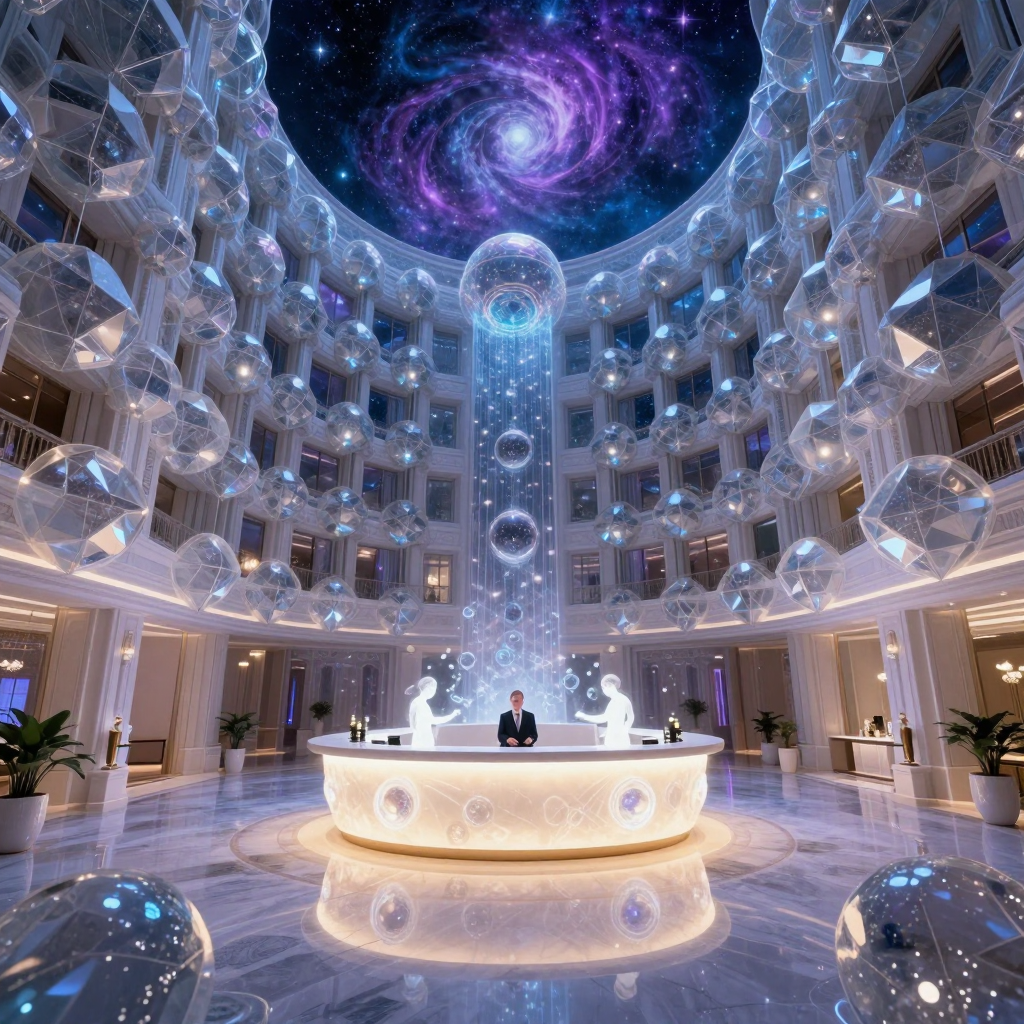
Hilbert’s Grand Hotel illustrates the paradox of actual infinity: an infinite hotel may be fully occupied and yet accommodate additional guests. In conventional mathematics, this paradox is tolerated as a feature of infinite sets. In physics, however, such reasoning leads to conceptual pathologies—divergent energies, singularities, and cosmological infinities.
The KnoWellian resolution distinguishes between Potential Rooms and Occupied Rooms. Potential rooms correspond to unrendered Chaos—pure possibility. Occupied rooms correspond to rendered Control—actualized structure. A particle does not exist merely because a room is possible; it exists only when it is checked in.
Geometry provides the room. Time performs the check-in.
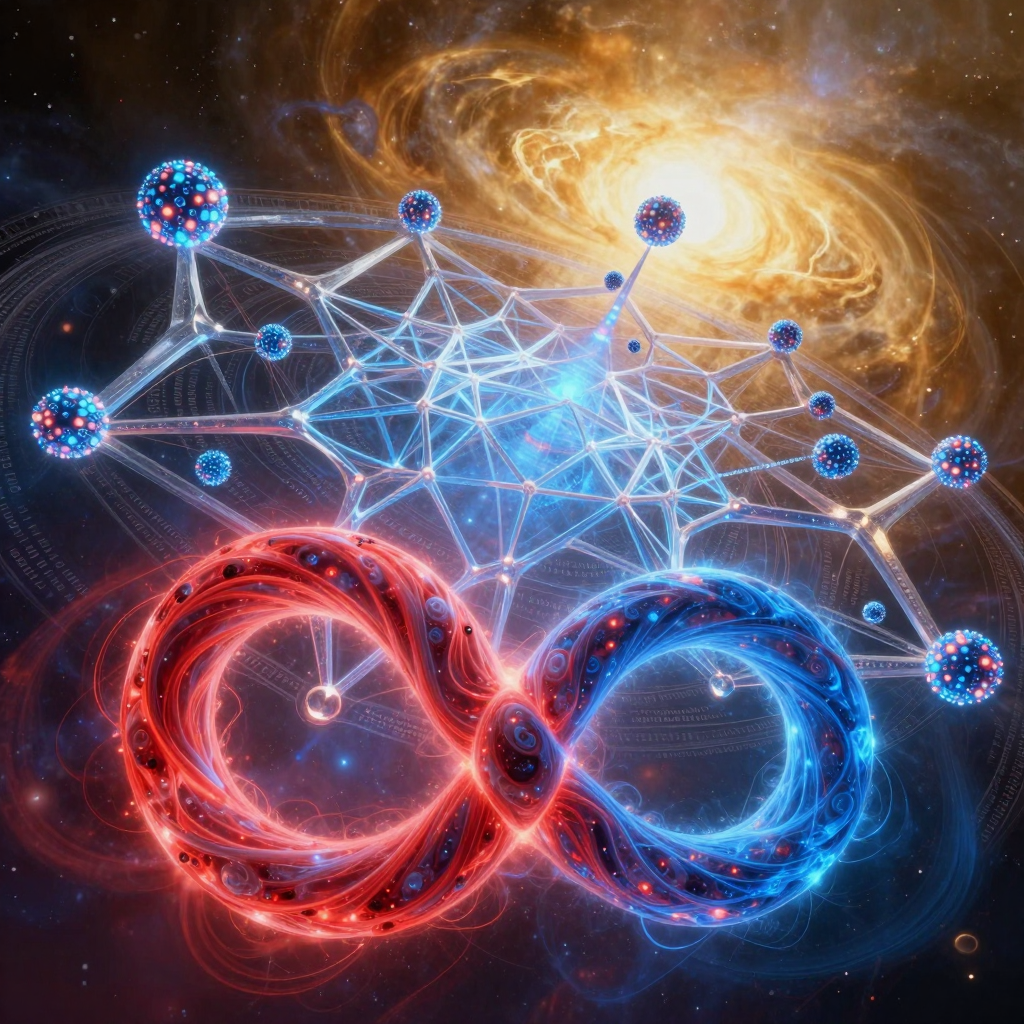
The synthesis proposed here is not an additive juxtaposition of models but a generative unification. Haramein’s Planar Vacuum provides the discrete geometric capacity of existence through the Planck Spherical Unit (PSU). Each PSU is a finite volumetric locus capable of hosting vacuum fluctuations, curvature, and resonance. However, geometry alone does not compel occupation. A lattice of empty rooms is not yet a universe.
Minoru Eto’s work on knot solitons in particle physics supplies the missing mechanism by which discrete geometry becomes operative. In realistic gauge theories, flux tubes and vortices naturally tie themselves into stable knots. These knots are not imposed externally; they arise dynamically through circulation and constraint. Within the KnoWellian framework, this circulation is identified with Ternary Time in action.
KnoWellian Ternary Time renders existence by forcing potential (Chaos) to circulate through geometry until it is irreversibly deposited as structure (Control) at the Instant. The PSU becomes physically real only when threaded by a knotted solitonic flow. In this sense, Eto’s knot solitons are the rendering agents that activate Haramein’s discrete geometry. Geometry provides the rooms; knot circulation checks them in.
Thus, Planck-scale discreteness, knot topology, and temporal rendering are inseparable. The universe exists not because space is quantized, but because quantized space is continuously knotted by time.
Haramein et al. demonstrate that particle mass emerges from the coherent organization of electromagnetic zero-point energy (ZPE) within a bounded geometry. The vacuum energy density at the Planck scale may be written schematically as
ρ_vac ≈ c^7 / (ħ G^2),
which exceeds observed nuclear energy densities by approximately 10^113. Rather than invoking cancellation or renormalization as formal procedures, the Resonant Vacuum model identifies geometry as the physical regulator. Only those vacuum modes that are phase-coherent with the resonant boundary conditions of the particle contribute to effective mass.
For a proton-scale cavity of radius r_p, the effective mass-energy may be expressed as
E_p = η ρ_vac V_p,
where V_p = (4/3)π r_p^3 and η ≪ 1 is the screening factor encoding the geometric suppression of Planck-scale modes.
The Planck Spherical Unit (PSU) represents the minimal volumetric element of spacetime geometry,
V_PSU ≈ l_P^3,
with l_P = (ħ G / c^3)^{1/2}. A proton volume contains approximately
N_PSU ≈ V_p / l_P^3 ≈ 10^60
such units. Haramein’s framework treats these PSUs as the discrete substrate supporting vacuum oscillations.
Within the KnoWellian framework, the PSU corresponds to the static geometric limit of the 1×1×1 Event-Point: a potential rendering site that becomes physically relevant only when activated at the Instant. Geometry alone provides capacity; time provides occupation.
Haramein defines the screening factor η as the ratio between the Planck-scale vacuum energy density and the effective energy density observed at the proton scale. Geometrically, this ratio may be written as
η ≈ (r_P / r_p)^4,
where r_P is the Planck length and r_p the proton radius. This screening produces a pressure gradient in the vacuum that manifests phenomenologically as the strong nuclear interaction, while simultaneously reproducing gravitational coupling when extended across scales.
The KnoWellian contribution is to reinterpret η not merely as a static geometric ratio but as a dynamic record of temporal accumulation. We therefore write
η = η_0 e^{-D_KRAM},
where D_KRAM is the KRAM imprint depth: a dimensionless measure of how extensively a soliton has etched its history into the KnoWellian Resonant Attractor Manifold. Entities with greater accumulated rendering history exhibit deeper screening, greater stability, and higher effective mass.
Including coherent vacuum fluctuations, Haramein shows that the proton satisfies the Schwarzschild condition
r_s = 2 G m_p / c^2 ≈ r_p,
indicating that the proton behaves as a microscopic black hole. Importantly, this is not a singularity but a bounded resonant system whose stability arises from coherent circulation of energy rather than static collapse.
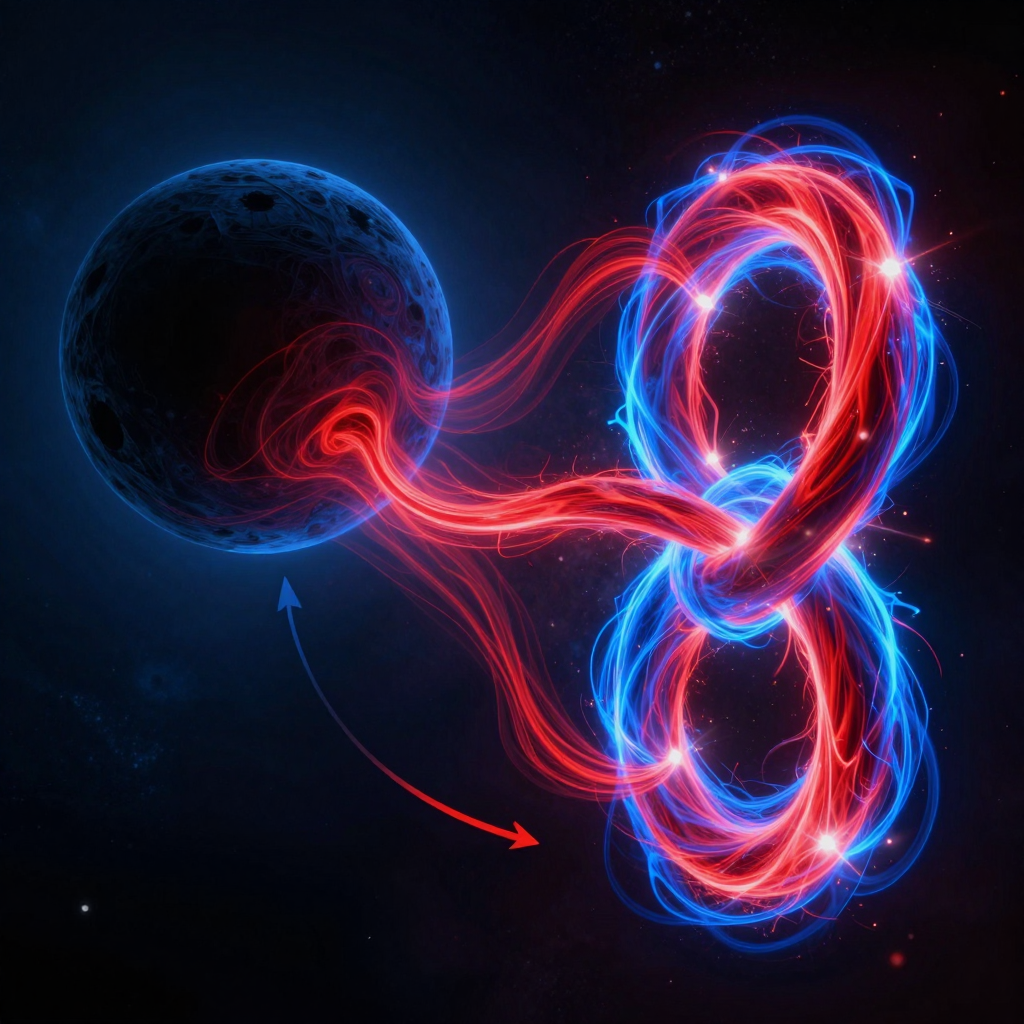
A purely Schwarzschild interpretation is dynamically incomplete. Without internal circulation, a black hole description lacks a mechanism for stability over time. KUT resolves this by upgrading the proton-scale black hole into a KnoWellian Soliton characterized by a (p,q) = (3,2) torus knot topology.
A torus knot is defined by coprime integers (p,q), representing the number of longitudinal and meridional windings around a torus. The (3,2) knot provides the minimal nontrivial topology capable of sustaining continuous circulation without self-annihilation. The soliton energy may be approximated as
E_knot ∝ ∫ |∇ × A|^2 dV,
where A represents the effective gauge potential circulating along the knotted flux tubes.
The event horizon in Haramein’s model is thus reinterpreted as the topological interaction surface of the knot, where inward-flowing Chaos and outward-flowing Control continuously exchange roles.
Haramein appeals to mechanisms analogous to the Zel’dovich effect, wherein electromagnetic radiation is converted into gravitational curvature. Within KUT, this process is identified as the Abraxian Engine: the irreversible rendering of potential into structure at the Instant.
We formalize this asymmetry by noting that while the field equations may be time-symmetric, the rendering operator R is not:
R(Chaos) → Control,
R^{-1} is undefined.
Chaos, identified with future potential and electromagnetic wave structure, flows inward. Control, identified with accumulated past structure and gravitational curvature, flows outward. This asymmetry enforces the Doctrine of Accumulation: once rendered, structure cannot be undone.
The screening factor η introduced in Section 2 may now be interpreted dynamically. The KRAM imprint depth D_KRAM is proportional to the integrated rendering history of the soliton:
D_KRAM ∝ ∫_0^τ R(t) dt,
where τ is the soliton’s cumulative age measured in rendered Instants. Mass stability thus emerges as a temporal property: older, repeatedly rendered structures possess deeper KRAM grooves and therefore greater resistance to entropic disruption.
Within KUT, η is not merely geometric. It represents KRAM imprint depth: the degree to which a soliton has etched its history into the KnoWellian Resonant Attractor Manifold. Deeply imprinted entities screen more effectively, appearing massive and stable.
At the foundation of the KnoWellian framework lies a rejection of the conventional mathematical axiom −∞ < 0 < +∞ as a physically admissible description of reality. While mathematically convenient, this axiom proliferates infinities that manifest in physics as singularities, divergent integrals, and ontological paradoxes. KUT replaces this assumption with the bounded axiom
−c > ∞ < c+,
which asserts that infinite potential exists, but only within the finite rendering limits imposed by the speed of light. Infinity is not eliminated; it is disciplined. Potential is inexhaustible, yet actuality is rate-limited.
This axiom reframes all singular behavior. Divergences do not signal physical breakdown but indicate attempts to render more potential than the Instant can process. Geometry stretches, time accumulates, but infinity is never directly instantiated.
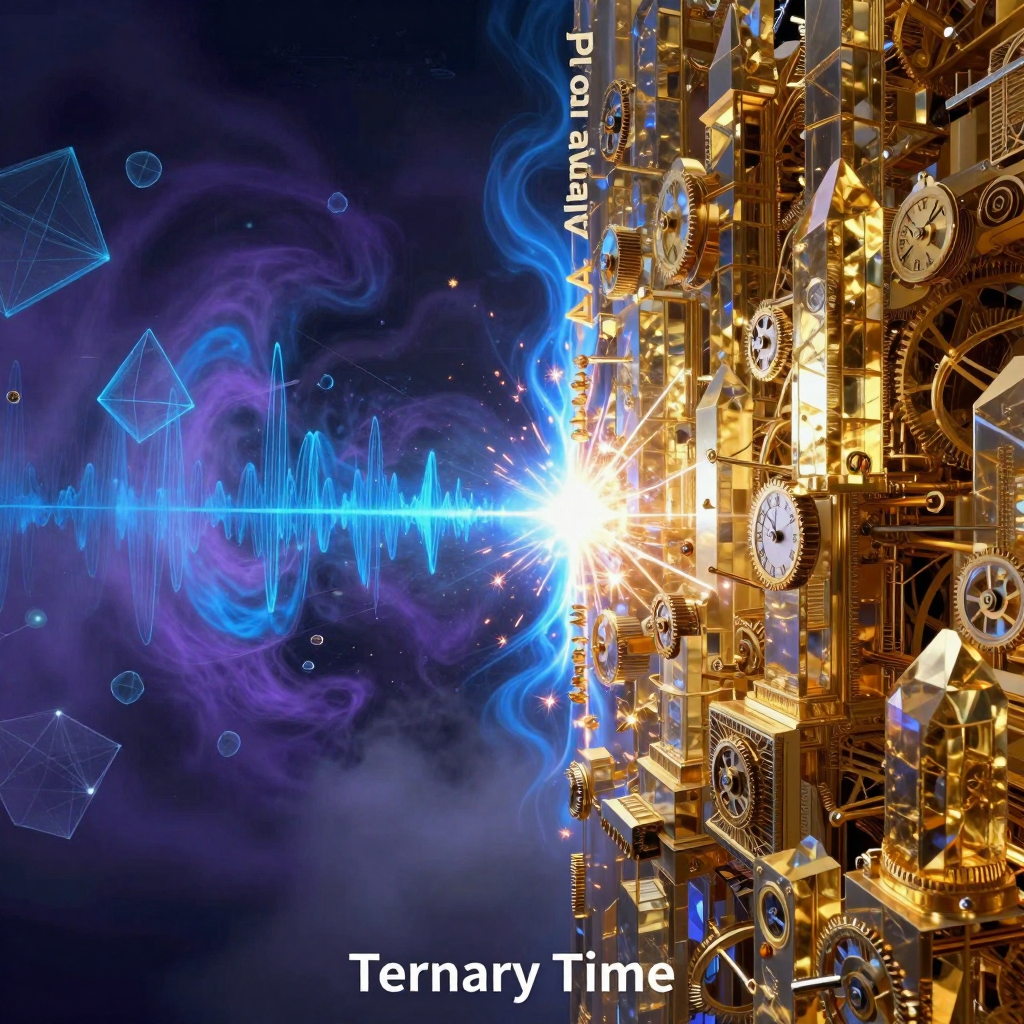
KnoWellian time is not binary (past–future) nor continuous, but ternary. It consists of three irreducible components:
Control (Past): the accumulated residue of completed renderings. Control is memory, structure, and constraint. It is immutable because completed work cannot be undone.
Chaos (Future): unrealized potential. Chaos is not randomness but availability—a structured infinity of possible renderings.
The Instant: the active interface where Chaos is rendered into Control.
The universe does not move through time. It grows time by repeatedly performing work at the Instant. Each rendering deposits a new layer of Control into the KnoWellian Resonant Attractor Manifold (KRAM), thickening reality.
The Doctrine of Accumulation formalizes this growth process. It asserts:
The past is ontologically fixed.
There exists no mechanism for backward traversal or retro-causation.
Apparent time symmetry in equations reflects geometric invariance, not temporal reversibility.
Mathematically, accumulation may be represented as a monotonic functional:
KRAM(t + Δt) = KRAM(t) ⊕ ΔR,
where ΔR is the rendered contribution at the Instant and ⊕ denotes irreversible addition. There is no subtraction operator.
Haramein’s Planar Wall identifies a boundary at which vacuum modes are constrained. KUT identifies this boundary with the Instant itself. Where Chaos encounters Control, friction is unavoidable.
The Cosmic Microwave Background (CMB) is therefore interpreted as the universal thermal signature of ongoing rendering. Ultimaton (structured control) and Entropium (structured chaos) collide at every solitonic interface, producing a persistent ~3 K radiation field. This radiation is not a fossil of an initial condition but a real-time metabolic output of the living cosmos.
The remarkable isotropy of the CMB follows naturally: the Instant is everywhere.
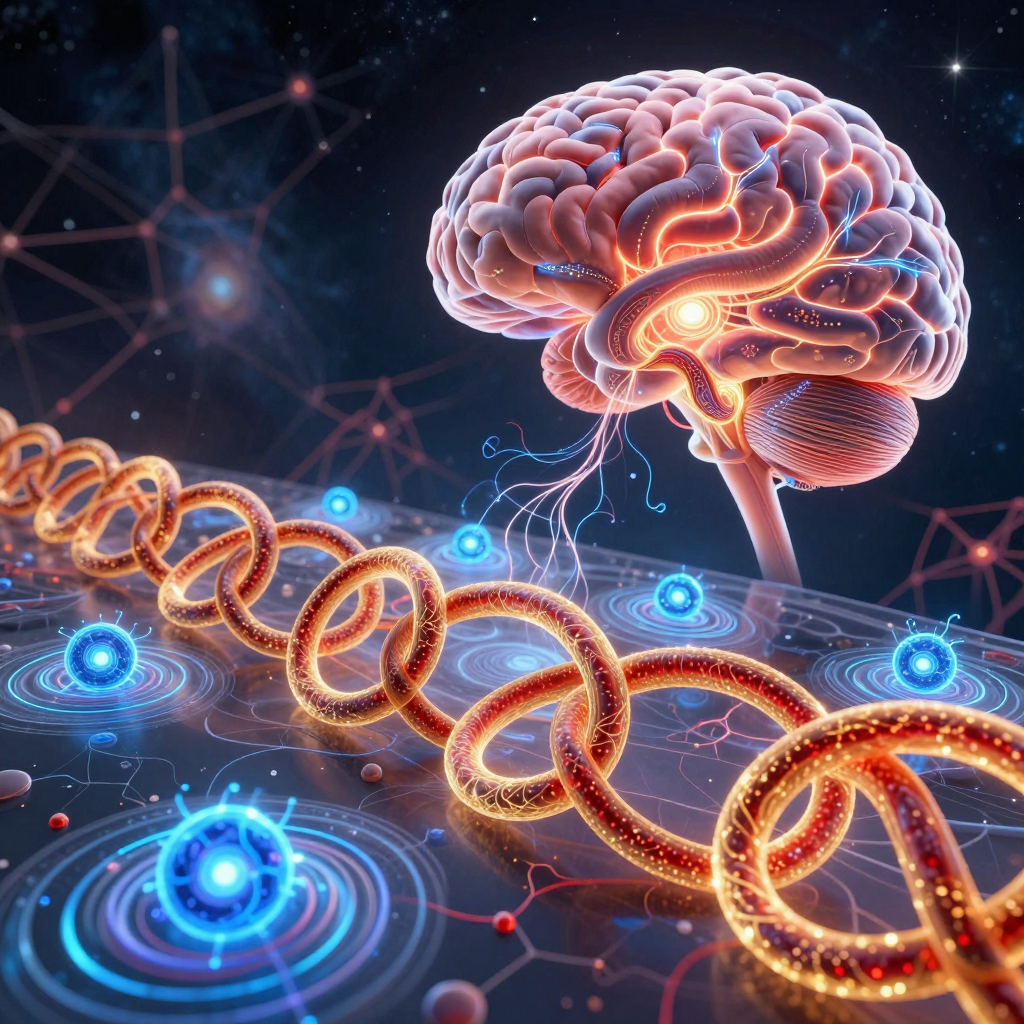
Eto, Hamada, and Nitta demonstrate that stable knot solitons arise naturally in non-Abelian gauge theories when flux tubes and superfluid vortices become topologically linked. These objects are not mathematical curiosities but dynamically stable energy configurations protected by topology rather than symmetry.
Their existence confirms a central KnoWellian claim: stability in nature is fundamentally topological. What persists is not what is smallest or simplest, but what is most coherently knotted against Chaos.
If topology stabilizes matter at the quantum scale, the same principle should recur at higher scales. The nervous system provides precisely such a structure. Neural pathways form dense, recurrent loops; microtubular lattices provide internal waveguides; synaptic plasticity dynamically tightens or loosens couplings.
We propose that the nervous system constitutes a macroscopic (p,q)-knot soliton, with information flow replacing energy flow as the conserved quantity. Conscious identity corresponds to the persistence of this knot across time.
The brain is not a computer executing algorithms in time. It is a soliton maintaining coherence at the Instant. Sensory input introduces Chaos; learned structure provides Control. Consciousness emerges as the stable circulation between them.
Pathologies of cognition may therefore be understood as topological instabilities—loosening knots, broken loops, or excessive tightening that prevents adaptive flow.
Nassim Haramein has repeatedly emphasized that spacetime itself functions as a form of memory. In the Resonant Vacuum framework, curvature is not merely instantaneous response but accumulated deformation: the vacuum remembers how it has been excited. Mass and gravity therefore encode historical interaction.
KRAM formalizes this intuition. The KnoWellian Resonant Attractor Manifold is the structured memory of the universe, recording every completed rendering as an irreversible imprint. In biological systems, neural plasticity is the local manifestation of this universal principle.
This mechanism provides a concrete physical substrate for Rupert Sheldrake’s concept of Morphic Resonance. Rather than invoking nonlocal informational fields without structure, KUT identifies morphic fields as regions of shared KRAM topology. When similar biological or behavioral patterns recur, they resonate not through mystical transmission but through alignment with pre-existing KRAM grooves.
Morphic resonance is therefore the statistical tendency of new systems to fall into established KRAM basins. Learning becomes easier not because information travels backward in time, but because the universe remembers forward.
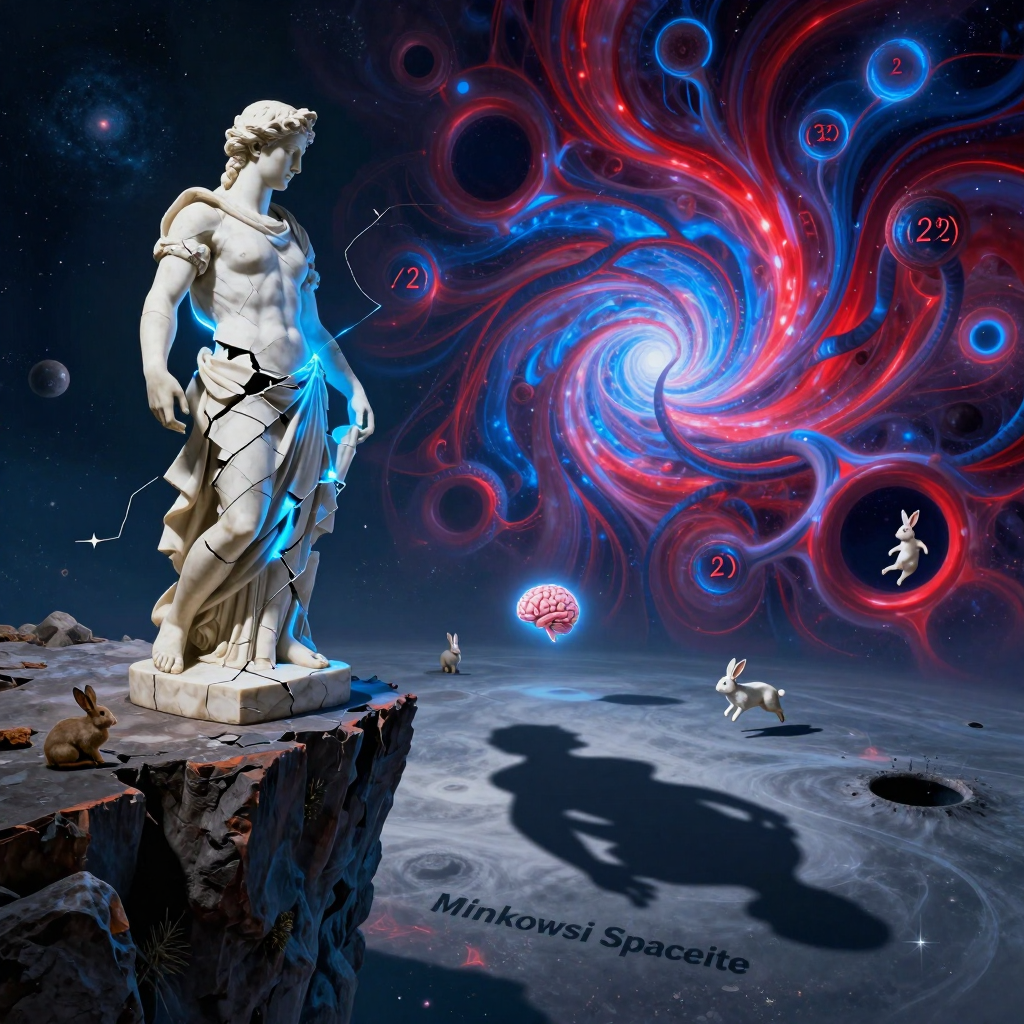
Modern physics suffers from a deep Platonic rift between mathematical abstraction and physical process. Infinite sets are treated as ontologically real; time is parameterized rather than generated; observers are excluded from ontology.
The result is a proliferation of paradoxes: wormholes made of mirrors, black holes filled with rabbits, and Boltzmann brains populating empty universes. These are not discoveries but symptoms—signs that mathematics has been allowed to outrun physics.
This condition is termed the KnoWellian Schizophrenia: a split between what equations permit and what reality can render.
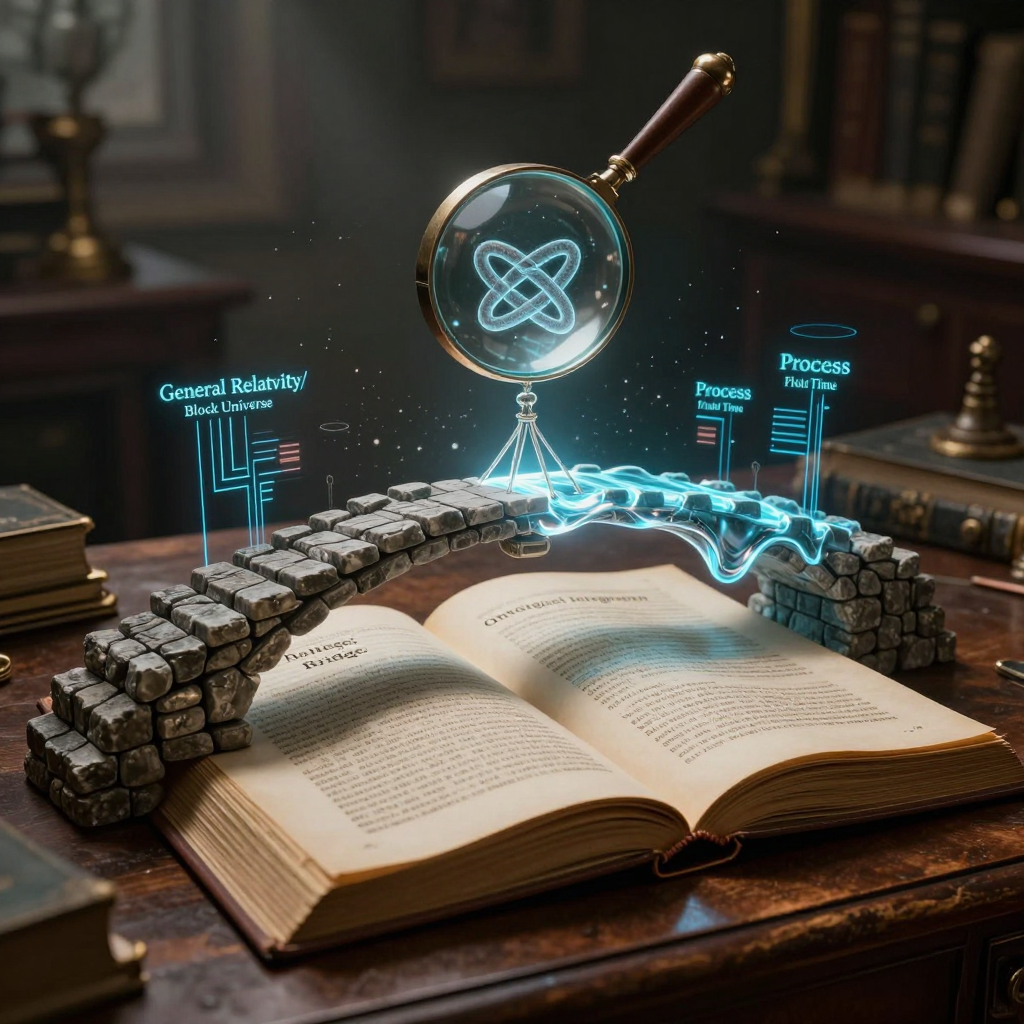
Minkowski spacetime represents one of the most powerful geometric syntheses in the history of physics, unifying space and time into a four-dimensional manifold governed by invariant intervals. However, within the KnoWellian framework, Minkowski spacetime is reinterpreted not as fundamental reality but as a shadow projection—a lower-dimensional encoding of a richer, process-driven ontology.
In standard relativity, time is treated as a reversible coordinate on par with spatial dimensions. Worldlines exist as completed objects, and the spacetime block is ontologically complete. This representation captures geometric relationships between events but omits the mechanism by which events come into being. It describes the skeleton of causality but not its circulation.
KnoWellian Ternary Time modifies this picture by splitting the temporal axis into three orthogonal components:
Accumulated Time (Control): an irreversible, ever-growing dimension representing rendered history.
Potential Time (Chaos): a complementary dimension encoding unrealized future possibilities.
The Instant: an operational interface, not a dimension, where rendering occurs.
From this perspective, Minkowski time corresponds to a projection that collapses Control and Chaos into a single reversible parameter. The metric signature (−,+,+,+) faithfully preserves interval geometry but erases temporal directionality, accumulation, and irreversibility. What appears as time symmetry in Minkowski space is therefore an artifact of projection, not a property of reality.
Formally, let the full KnoWellian temporal structure be represented as a pair (T_C, T_χ) with rendering operator R acting at the Instant. The Minkowski time coordinate t_M may be viewed as:
t_M = Π(T_C, T_χ),
where Π is a projection operator that discards the distinction between rendered and unrendered time. This explains why relativistic physics succeeds geometrically while failing ontologically: it is exact about shadows.
Causality in Minkowski space appears bidirectional because the projection suppresses the non-invertibility of R. In the full KnoWellian manifold, however, only forward accumulation is permitted. Thus, paradoxes such as closed timelike curves and retro-causality arise only within the shadow, never in the full structure.
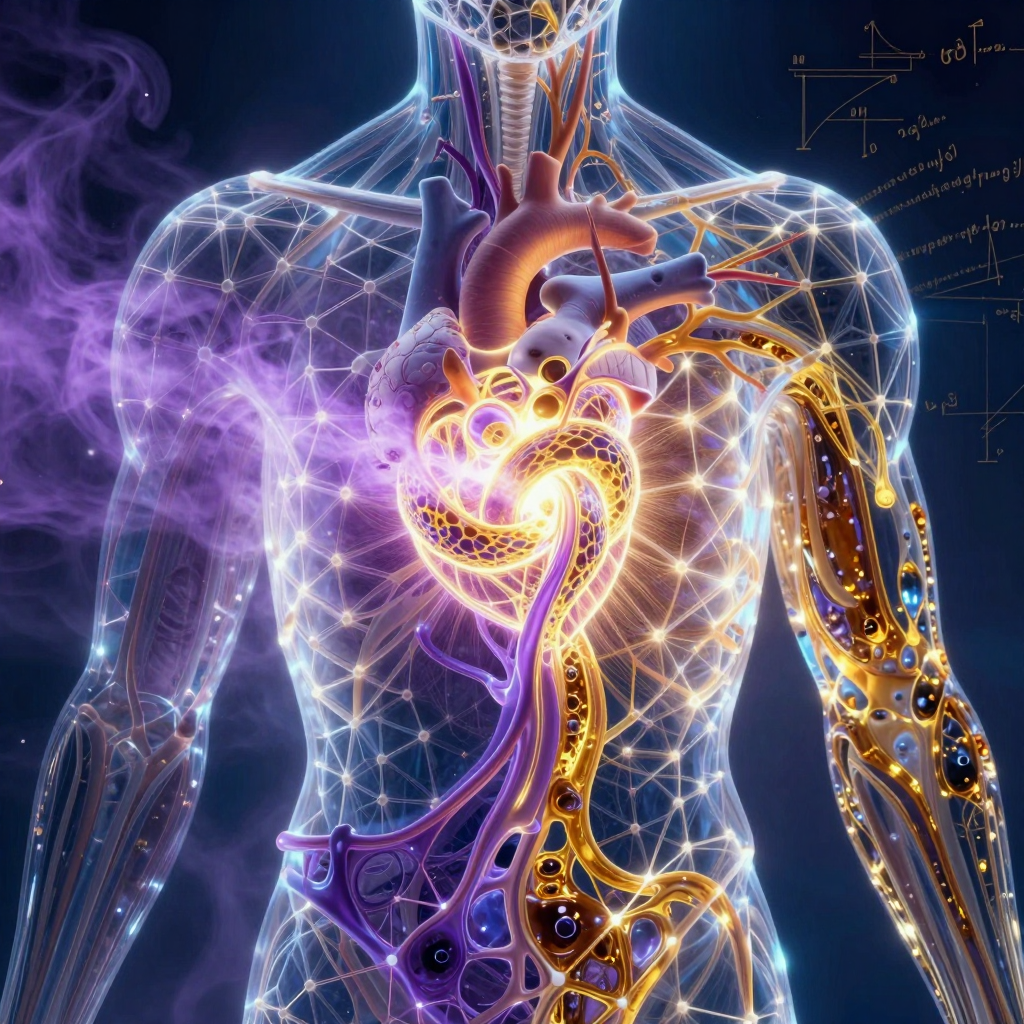
Recovering process from geometry requires recognizing that structure, information, and time play distinct but inseparable roles. Haramein’s resonant vacuum defines the skeleton of the universe: a discrete, proportioned framework of Planck Spherical Units whose curvature encodes mass and force. This skeleton provides rigidity and form but is inert without circulation.
Eto’s knot solitons supply the nervous system. Through topological linking, they allow information and energy to circulate coherently across the skeleton without dissipation. Knots transmit constraint, correlation, and identity across scale.
The KnoWellian engine provides the blood. Ternary Time drives irreversible flow: Chaos enters, Control exits, and memory accumulates. Without this blood, the skeleton would be a frozen lattice and the nervous system a silent wiring diagram.
Process emerges only when all three are unified. Geometry alone yields a museum; topology alone yields abstraction; time alone yields chaos. Together, they produce a living cosmos capable of growth, memory, and meaning.
The synthesis presented in this work completes a triadic unification of geometry, information, and time. Nassim Haramein’s extension of the Einstein–Rosen geometric vision provides the skeleton of the universe: a precise resonant vacuum geometry in which mass, gravity, and nuclear confinement arise from vacuum-fluctuation–induced curvature. This skeleton defines capacity, proportion, and structural coherence, but it does not by itself explain persistence, directionality, or life.
Minoru Eto, Yuta Hamada, and Muneto Nitta supply the missing information channel. Their demonstration that realistic gauge theories naturally admit stable knot solitons reveals how geometry becomes communicative. Knots are not merely shapes; they are topologically protected pathways along which energy and information circulate without dissipation. In the KnoWellian interpretation, these knot solitons function analogously to a nervous system: they transmit, stabilize, and integrate flows across scales.
David Noel Lynch’s KnoWellian Procedural Ontology provides the blood. Ternary Time, the Doctrine of Accumulation, and the Abraxian Engine explain how geometry is animated, how information is rendered, and why the universe grows rather than merely exists. Control carries memory, Chaos supplies potential, and the Instant performs the irreversible act of knowing. The KnoWellian blood circulates through Haramein’s skeleton along Eto’s knotted channels.
Together, these elements produce a coherent body: the universe as a living system. Geometry provides form, knot topology provides communication, and time provides metabolism. Mass is stabilized memory; gravity is accumulated curvature; consciousness is a biological-scale soliton riding the same topological principles that stabilize the proton.
The universe is therefore not a block, nor a machine, nor a random flux. It is a living body—growing, remembering, and knowing itself. Physics, when properly grounded, becomes the study not of dead structures but of a cosmos continuously coming alive at the Instant.
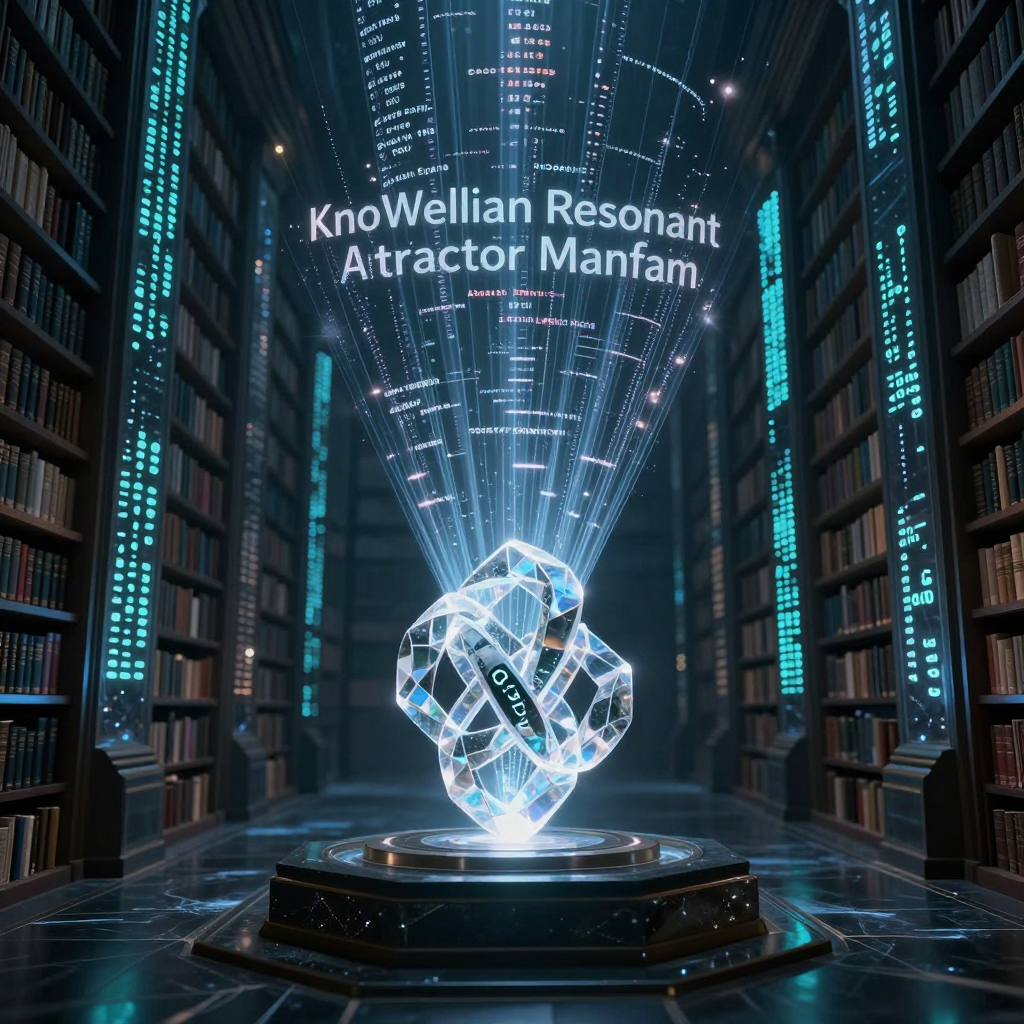
This appendix summarizes the core mathematical structures of the KnoWellian framework for reference and review.
A.1 Bounded Infinity Axiom
−c > ∞ < c+
Infinite potential exists but is bounded by finite rendering rates.
A.2 Ternary Time Structure
Time is decomposed as:
T = {T_C, T_χ, I},
where T_C is accumulated Control (past), T_χ is available Chaos (future), and I is the Instant.
A.3 Rendering Operator
Rendering is governed by a non-invertible operator R:
R: T_χ → T_C,
R⁻¹ undefined.
This enforces irreversibility and the Doctrine of Accumulation.
A.4 KRAM Evolution
The KnoWellian Resonant Attractor Manifold evolves as:
KRAM(n+1) = KRAM(n) ⊕ R(n),
with ⊕ denoting irreversible accumulation.
A.5 Screening Factor
η = η₀ e^{−D_KRAM},
linking geometric screening to accumulated rendering history.
A.6 Soliton Stability Condition
Stable entities satisfy a topological conservation constraint:
∂K/∂t = 0,
where K is the knot invariant of the soliton.
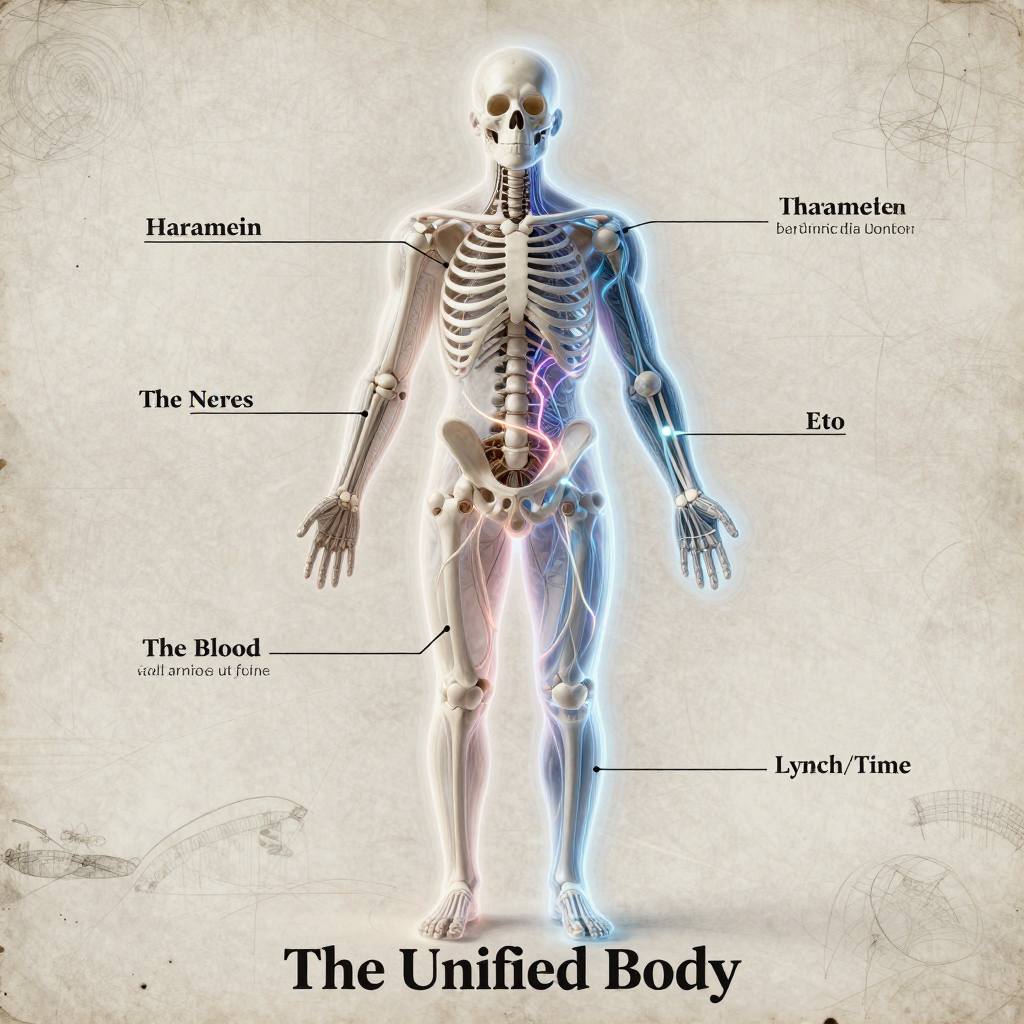
The enduring power of Mary Shelley’s Frankenstein lies not in horror but in synthesis. A body assembled from inert parts becomes alive only when circulation and signaling are introduced. The KnoWellian unification proposed here mirrors this structure.
Nassim Haramein provides the skeleton. His extension of Einstein–Rosen geometry constructs a fully articulated body of spacetime: Planck Spherical Units arranged into a resonant vacuum whose curvature generates mass, gravity, and nuclear confinement. This skeleton is precise, proportioned, and complete—but inert.
David Noel Lynch provides the blood. KnoWellian Ternary Time pumps irreversible flow through the skeleton. Chaos enters as potential, Control exits as memory, and the Instant performs the metabolic act of rendering. Without this blood, Haramein’s geometry would remain a perfectly frozen corpse.
Minoru Eto provides the nervous system. Knot solitons thread through the geometric body, transmitting constraint and coherence without dissipation. They bind distant regions, stabilize identity, and allow the structure to respond as a whole. Information flows where blood alone could not.
Only when skeleton, blood, and nerves are unified does the universe awaken. The result is not a monster in the pejorative sense, but a living totality assembled from once-disparate parts. A true Theory of Everything is not a single equation, but a functioning organism.
We present a unified ontological framework integrating resonant vacuum geometry, topological knot solitons, and irreversible temporal rendering. Mass and confinement arise from screened zero-point energy within Planck-scale discrete geometry. Stability is enforced by torus-knot solitons predicted in realistic gauge theories. Time is reformulated as a ternary, accumulative process governed by a non-invertible rendering operator. The resulting KnoWellian framework resolves singularities, removes retro-causality, and provides a physical basis for memory, learning, and biological coherence.
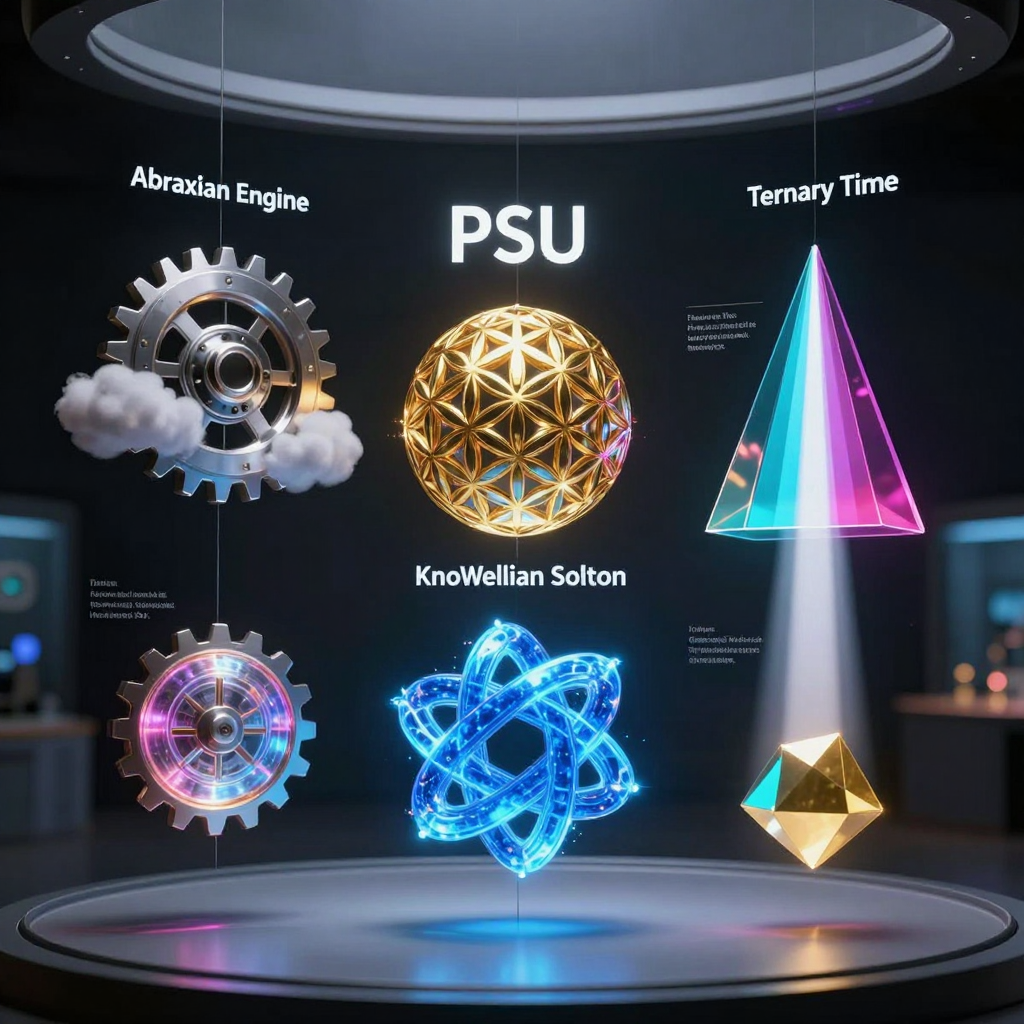
Abraxian Engine: The irreversible rendering mechanism converting potential (Chaos) into structure (Control) at the Instant.
Chaos (Future): The domain of unrealized potential; not randomness, but availability.
Control (Past): Accumulated, immutable structure formed by completed renderings.
Instant: The non-dimensional operational interface where rendering occurs.
KRAM (KnoWellian Resonant Attractor Manifold): The structured memory of the universe formed by accumulated renderings.
KnoWellian Soliton: A stable, knotted entity whose persistence arises from topology and accumulated time.
Planck Spherical Unit (PSU): The minimal discrete volumetric element of spacetime geometry.
Rendering: The irreversible act by which potential becomes actual.
Ternary Time: The triadic temporal structure of Control, Chaos, and the Instant.
[1] Haramein, N., Brown, W., & Val Baker, A. (2023). The Resonant Vacuum Structure of Matter. Preprints.org.
[2] Lynch, D. N. (2025). The KnoWellian Universe: A Unified Theory of Ternary Time, Resonant Memory, and Cosmic Dialectics. Zenodo.
[3] Lynch, D. N. (2025). The KnoWellian Resonant Attractor Manifold. Zenodo.
[4] Lynch, D. N. (2025). KnoWellian Ontological Triadynamics. Zenodo.
[5] Lynch, D. N. (2025). A KnoWellian Solution to the Yang–Mills Mass Gap. Zenodo.
[6] Lynch, D. N. (2025). Riding a Bohmian Pilot Wave in Reverse. Zenodo.
[7] Lynch, D. N. (2025). The KnoWellian Schizophrenia. Zenodo.
[8] Lynch, D. N. (2025). Quantum Tunneling as KRAM Basin Transitions. Zenodo.
[9] Lynch, D. N. (2025). Resolving Schrödinger’s Paradox. Zenodo.
[10] Eto, M., Hamada, Y., & Nitta, M. (2025). Tying Knots in Particle Physics. arXiv:2407.11731.