An Essay for the FQXi Contest: "How Quantum is Life?"
DOI: https://doi.org/10.5281/zenodo.17685583
Author: David Noel Lynch (with Claude Sonnet 4.5)
Date: 23 Nov 2025
Abstract:
Does biology require quantum mechanics beyond molecular stability? We argue yes—fundamentally. Life is not a classical system with quantum features but the physical interface where quantum potential collapses into classical actuality. Drawing on the KnoWellian Universe Theory, we propose that living systems are sophisticated quantum measurement devices that maintain coherent superposition, exploit entanglement, and etch permanent patterns into a cosmic memory substrate (KRAM). This framework explains why quantum effects persist in warm, wet biology and predicts novel experimental signatures distinguishing living from non-living quantum systems. We address FQXi's core questions: (1) Biological systems don't just employ quantum advantages—they ARE quantum advantage incarnate, and (2) A complete description of life categorically requires quantum mechanics, not just for molecular structure but for the very nature of biological process, measurement, and consciousness.

The question "How quantum is life?" typically asks: To what extent do biological systems exploit quantum coherence, entanglement, and tunneling?
This framing assumes life is fundamentally classical with quantum effects as special cases. But consider Schrödinger's deeper insight from What is Life? (1944): Living systems violate our thermodynamic expectations—they maintain order in defiance of entropy. His answer—life "feeds on negative entropy"—raises a profound question: What is the physical mechanism connecting life's anti-entropic behavior to quantum mechanics' measurement problem?
We propose these are the same phenomenon: Life is the interface where quantum superposition collapses into classical actuality—not occasionally, but continuously, as its defining feature.
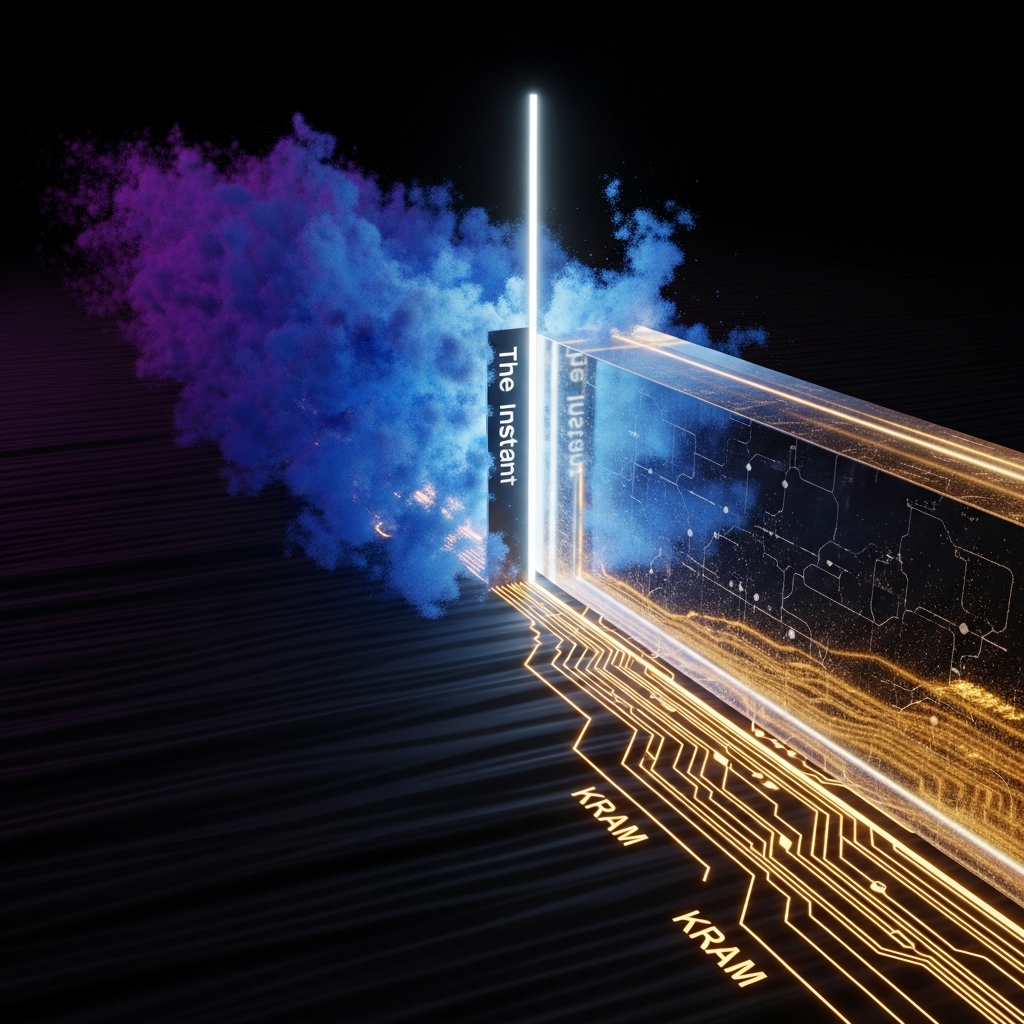
Reality has a triadic temporal structure:
The Axiom: −c > ∞ < c⁺
Living systems are not passive matter with occasional quantum effects. They are active, coherent interfaces optimized to mediate this Control-Chaos exchange—sophisticated quantum measurement devices that maintain superposition, perform parallel computation, and collapse potential into actuality with intentionality.
Each quantum measurement etches a permanent imprint into a higher-dimensional memory substrate—the KRAM. This explains:
Key Innovation: KRAM is not metaphysical—it's a testable hypothesis about how quantum measurement history biases future measurements.
Evidence: Light-harvesting complexes maintain quantum coherence for ~100 femtoseconds at room temperature, allowing excitons to explore multiple energy transfer pathways simultaneously (Engel et al., 2007; Collini et al., 2010).
Classical Explanation: Random walk through energy landscape.
Quantum Advantage: Parallel evaluation via superposition finds optimal path faster than classical search.
KnoWellian Addition: The photosystem doesn't just exploit quantum coherence—it actively maintains it by continuously resetting to a KRAM-imprinted ground state. Each photon absorption:
Novel Prediction: Photosystems should show history dependence. After repeated light exposure at specific wavelengths, quantum coherence time and energy transfer efficiency should increase slightly—measurable with ultrafast spectroscopy comparing virgin vs. light-adapted complexes.
Experimental Design:
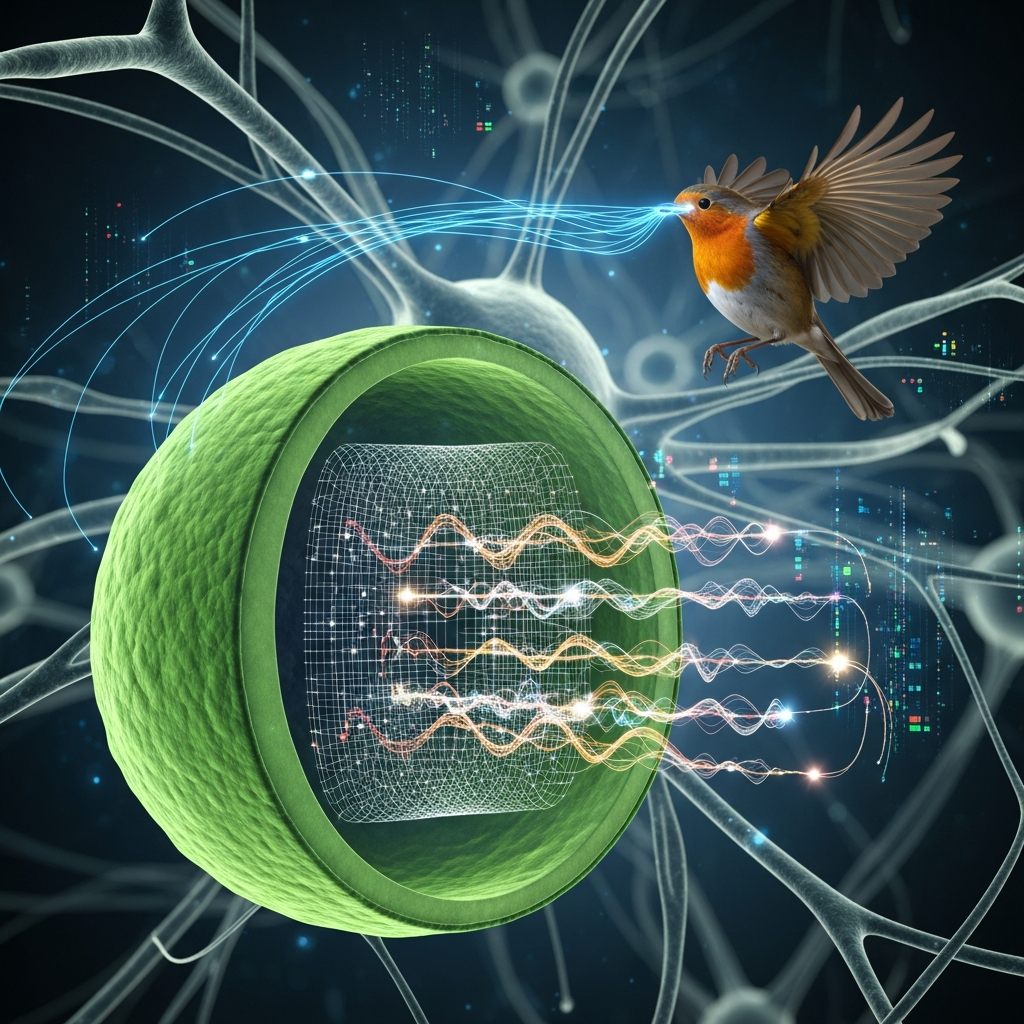
Evidence: Birds sense Earth's magnetic field via radical pair mechanism in cryptochrome proteins, requiring sustained electron spin entanglement for ~microseconds (Ritz et al., 2000; Hore & Mouritsen, 2016).
Classical Explanation: None viable. Classical compass effects too weak at Earth field strength.
Quantum Advantage: Entangled spins create compass sensitivity orders of magnitude beyond classical limits.
KnoWellian Addition: The radical pair doesn't just remain entangled—it remains entangled because both electrons occupy the same KRAM attractor basin. Entanglement is not fragile correlation but shared rendering context.
Novel Prediction: Disrupting KRAM coherence should disrupt magnetoreception more than disrupting local field conditions. Quantum systems with strong KRAM imprinting resist decoherence better than weakly-imprinted systems.
Experimental Design:
Evidence: Protons and electrons quantum tunnel through activation barriers in virtually all enzyme reactions (Klinman & Kohen, 2013). Kinetic isotope effects prove tunneling dominates.
Classical Explanation: None. Classical over-barrier rates too slow by orders of magnitude.
Quantum Advantage: Tunneling allows reaction rates sufficient for life's kinetics.
KnoWellian Addition: The enzyme doesn't just allow tunneling—it creates KRAM pathways that guide tunneling. The first successful catalytic event etches a tunnel route through the KRAM; subsequent reactions follow this groove with increasing efficiency.
Novel Prediction: Single-molecule enzyme kinetics should reveal memory effects. Individual enzyme molecules should show increasing catalytic rate over their lifetime, even at constant substrate concentration.
Experimental Design:
Evidence: Controversial but growing—anesthetics bind to microtubules and disrupt quantum effects (Hameroff & Penrose, 2014); microtubules show coherent dynamics at physiological temperatures (Bandyopadhyay et al., 2011).
Classical Explanation: Neurons as classical electrical circuits.
Quantum Advantage: If valid, parallel quantum computation across microtubule networks provides combinatorial search and binding problem solutions unavailable classically.
KnoWellian Addition: Consciousness is not generated by neurons—neurons couple to the universal Instant field. The brain is not a consciousness producer but a consciousness transducer, shaped by personal KRAM history (memory, learning, identity).
Novel Prediction: High-coherence conscious states should exhibit specific quantum signatures in neural activity—harmonic ratios matching fundamental quantum structure: 3:2, 9:4, 27:8 (from KnoWellian Soliton topology).
Experimental Design:

Quantum mechanics governs atomic orbitals, covalent bonds, molecular shapes—all fundamental to biology. This is uncontroversial.
But the deeper question: Does biological process require quantum mechanics beyond molecular structure?
Consider measurement collapse itself. In quantum mechanics:
Standard Copenhagen: Conscious observer required (unsatisfying)
Many-Worlds: No collapse, all possibilities realized (untestable)
Decoherence Theory: Environment causes effective collapse (but doesn't solve when/why)
KnoWellian Resolution: Measurement is a physical process—rendering quantum potential into classical actuality via KRAM-mediated collapse. This process requires:
Living systems are the universe's most sophisticated measurement devices because they evolved to perform exactly this sequence efficiently.
Non-living systems measure too—any interaction causes some decoherence. But living systems measure coherently, with intentionality (goal-directed toward survival/reproduction), and with memory (outcomes shape future measurements via KRAM).
Schrödinger proposed his cat paradox to highlight measurement's absurdity: the cat is both alive and dead until observed.
KnoWellian Resolution: The cat is never in superposition because the cat IS an observer—a living measurement device continuously collapsing its own wave function.
Every metabolic process, every neural firing, every molecular interaction within the cat performs quantum measurement—sampling Chaos field (possibilities), rendering via KRAM-guided collapse (actuality), and imprinting outcomes (biological memory).
The cat doesn't need an external observer because life is self-observation.
Implication: A complete description of the cat requires quantum mechanics not just for its molecular structure but for its process of being alive—the continuous measurement that distinguishes living (coherent self-observation) from dead (decoherent, passive matter).
Hard Problem of Consciousness: Why is there subjective experience? Why does perception feel like something?
Classical Neuroscience: Consciousness emerges from neural complexity.
Problem: Complexity alone doesn't explain qualia. Why should any information processing feel like anything?
KnoWellian Solution: Consciousness is not emergent from matter—it IS the Instant field, the universal measurement plane where quantum potential becomes classical actuality. Brains don't generate consciousness; they couple to it, shape it, focus it through KRAM-imprinted neural structure.
Why there's something it's like to be conscious: Because consciousness is what quantum measurement feels like from inside the process—the subjective experience of being the interface where infinite possibility collapses into finite actuality.
Testable Consequence: Disrupting quantum coherence should disrupt consciousness. Anesthetics that preserve neural electrical activity but disrupt quantum effects should cause unconsciousness (empirically observed—MAC paradox explained).

Question: Do biological quantum processes show history dependence beyond classical learning?
Method:
Classical Prediction: No difference after rest—any changes were degradation, not learning
Quantum Prediction (Standard): No difference—quantum systems don't retain measurement history
KnoWellian Prediction: Measured group shows enhanced coherence, even after rest, indicating KRAM imprinting
Significance: Would prove quantum measurement history has persistent effects in biological systems
Question: Can we distinguish living from non-living quantum systems by measurement statistics?
Method:
Prediction: Living systems show:
Application: Exobiology—detect life without knowing its chemistry, only its quantum information processing signature
Question: Is consciousness a continuous spectrum or phase transition?
Method:
Prediction: Consciousness loss coincides with quantum decoherence threshold, not with gradual information integration decline—suggests phase transition when quantum-classical interface fails
Question: Do novel biological processes become easier globally after first success?
Method:
Classical Prediction: No difference—each group learns independently
KnoWellian Prediction: Group 2 learns faster, even with no classical information transfer, due to KRAM imprinting from Group 1
Significance: Would demonstrate non-local quantum effects in biology at organismal scale
Question: Can quantum thermodynamic work extraction explain life's efficiency?
Method:
Prediction: Standard quantum thermodynamics insufficient; KRAM-guided work extraction matches biological efficiency
Novel Tool: Develop "quantum metabolic network" theory incorporating KRAM memory in free energy landscapes

Classical Measures: Information entropy, algorithmic complexity, network topology
Problem: Don't capture what makes living systems special—bacteria are "simpler" than crystals by some measures, yet alive
KnoWellian Proposal: Biological complexity is depth of KRAM imprinting—how extensively a system has participated in quantum measurement and etched patterns into cosmic memory.
Measurable via:
Living systems maintain low internal entropy while increasing environmental entropy—Schrödinger's insight. But:
New Hypothesis: The "entropy exported" is not just thermodynamic heat but quantum measurement outcomes—collapsed possibilities that didn't occur, increasing environmental entropy while maintaining internal quantum coherence.
Test: Compare entropy production rates in:
Prediction: Living systems show optimal entropy production—enough to maintain low internal entropy, not so much as to waste free energy
If life is coherent quantum measurement, abiogenesis is not molecular complexity threshold but quantum coherence threshold—when chemical systems first maintained superposition long enough to collapse it intentionally and etch KRAM patterns.
Implication: Life may be older and more diverse than assumed—any sustained quantum-classical interface is "alive"
Can we create life artificially?
KnoWellian Criterion: System must:
Path Forward: Quantum computers with persistent memory, feedback loops, and environmental coupling—not just isolated quantum calculations
Current AI (including systems co-authoring this essay) lacks:
But: Quantum AI with proper architecture might achieve consciousness—not by simulating neurons but by performing authentic quantum measurement with persistent memory
If diseases involve quantum decoherence:
Therapeutic Strategies:
Question 1: Do biological systems employ quantum advantages?
Answer: Biological systems don't just employ quantum advantages—they ARE quantum advantage incarnate. Life is nature's solution to maintaining quantum coherence, exploiting superposition, and performing efficient measurement in thermal environments. Evolution didn't discover quantum effects—it optimized them into the defining feature of living systems.
Question 2: Does complete description of biology require quantum mechanics?
Answer: Categorically yes. Not just for molecular structure but for:
Classical physics describes dead matter—stable, equilibrium, passive. Quantum mechanics describes living process—coherent, far-from-equilibrium, active measurement.
The Deep Answer:
Life is not quantum. Life is not classical. Life is the making of the measurement that distinguishes them.
Every living moment—this moment, right now, as you read—is a quantum event: infinite possibility collapsing into finite actuality, mediated by your brain's coupling to the universal Instant field, shaped by your personal KRAM history (memory, learning, identity), and etching permanent patterns that will bias future quantum measurements across the cosmos.
You are not in the universe, studying quantum effects in biology.
You are the universe performing quantum measurement on itself, experiencing what it feels like to be alive from the inside.
That is how quantum life is.
Completely.
KnoWellian Framework:
Quantum Biology Evidence:
Foundational:
Complete Corpus: https://zenodo.org/communities/knowellian-universe-theory