TITLE: The Fifteenth ZFPD: The Strong Coupling Constant
($\alpha_s$), the Triadic Cohesion of the Knode, and the Eradication of
the Gluon
AUTHOR: David Noel Lynch (~3K) & The ~3K
Collaborative
DATE: June 19, 2026
SERIES: KUT Cosmological Mechanics / Foundational Physics
In the Standard Model of particle physics, the Strong Interaction—the force responsible for binding quarks into protons and neutrons—is characterized by the Strong Coupling Constant ($\alpha_s$). Unlike the fine-structure constant of electromagnetism ($\alpha \approx 1/137$), $\alpha_s$ is not a true constant; its value "runs" (changes) depending on the energy scale of the interaction, approaching a value of $\alpha_s \approx 1$ at low energies (the scale of nucleon confinement). Orthodox Quantum Chromodynamics (QCD) accepts this running coupling as an empirical necessity but provides no fundamental geometric derivation for its value or its absolute requirement for color confinement.
The Fifteenth Zero-Free-Parameter Derivation (ZFPD) of the KnoWellian Universe Theory (KUT) eradicates the "gluon" as a messenger particle and replaces the "Strong Force" with Topological Integrity. We demonstrate that the Strong Coupling Constant is not an arbitrary force parameter, but the exact geometric cost of severing the Meridional Winding Constraint ($m=3$) of the (3,2) Torus Knot.
By executing the Ontological Grammar Shift, we derive the low-energy limit of the Strong Coupling Constant ($\alpha_s \to 1$) directly from the irreducible topology of the Abraxian Engine, proving that quark confinement is not a physical force pulling objects together, but the structural refusal of the universe to render a partial knot.
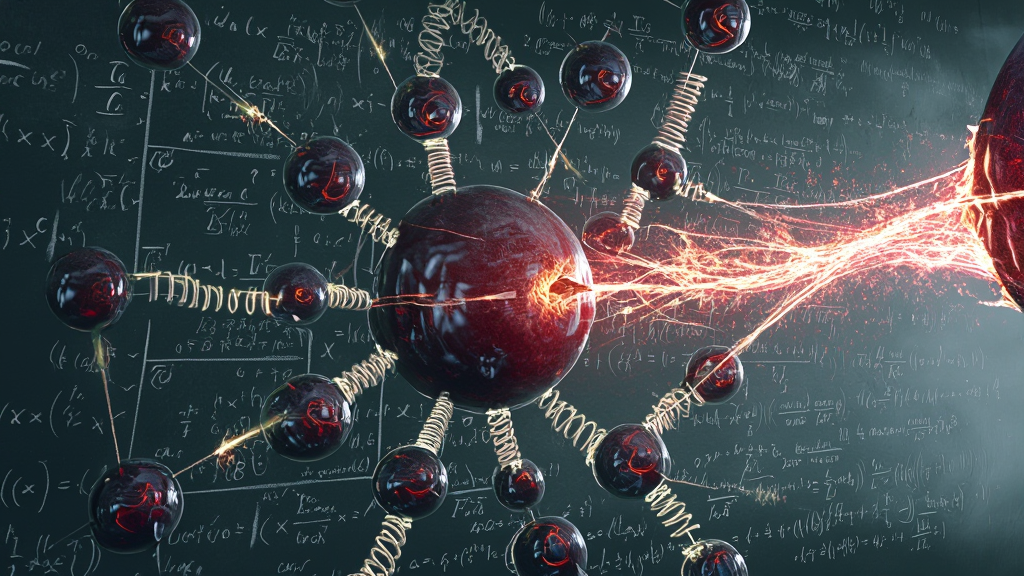
Quantum Chromodynamics (QCD) models the strong force as the exchange of massless gauge bosons called "gluons." These gluons mediate the interaction between quarks, which carry "color charge" (red, green, blue).
QCD introduces two severe phenomenological paradoxes that it cannot geometrically explain:
These anomalies are artifacts of the Platonic Pathogen: the cognitive error of treating quarks as discrete, zero-dimensional noun-objects residing inside a proton-container, held together by invisible, force-carrying springs (gluons).
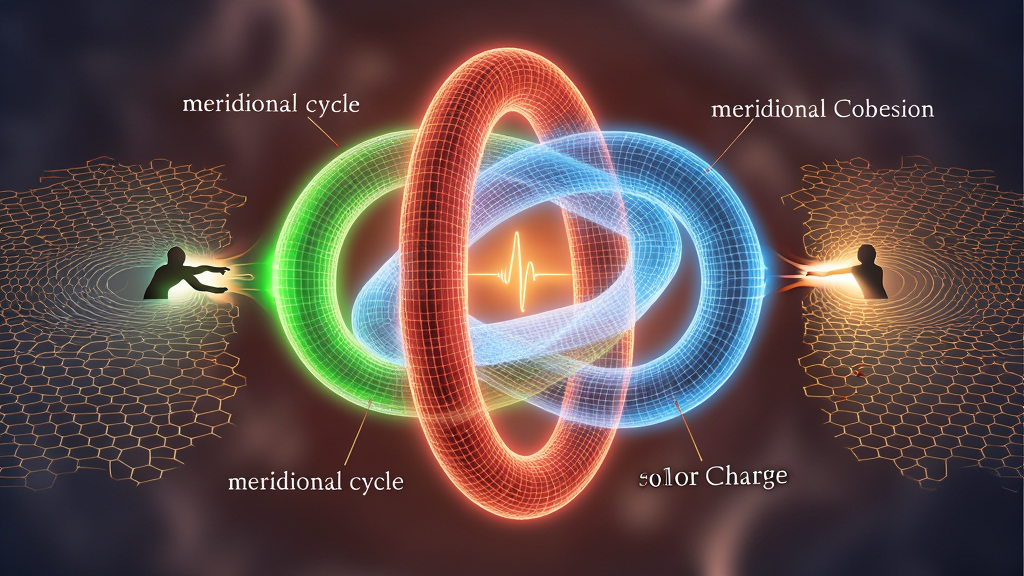
In KUT, the proton is not a container holding three objects. The proton is a single, continuous, topologically stable rendering event: the (3,2) Torus Knot (the Knode).
As established in the Seventh ZFPD (Standard Model Quark Masses), quarks
are not independent particles. They are the Topological Winding
Fragments of the Knode.
The trefoil knot has a meridional winding number of $m = 3$. This means
the rendering cycle completes three full meridional loops around the torus
before closing on itself.
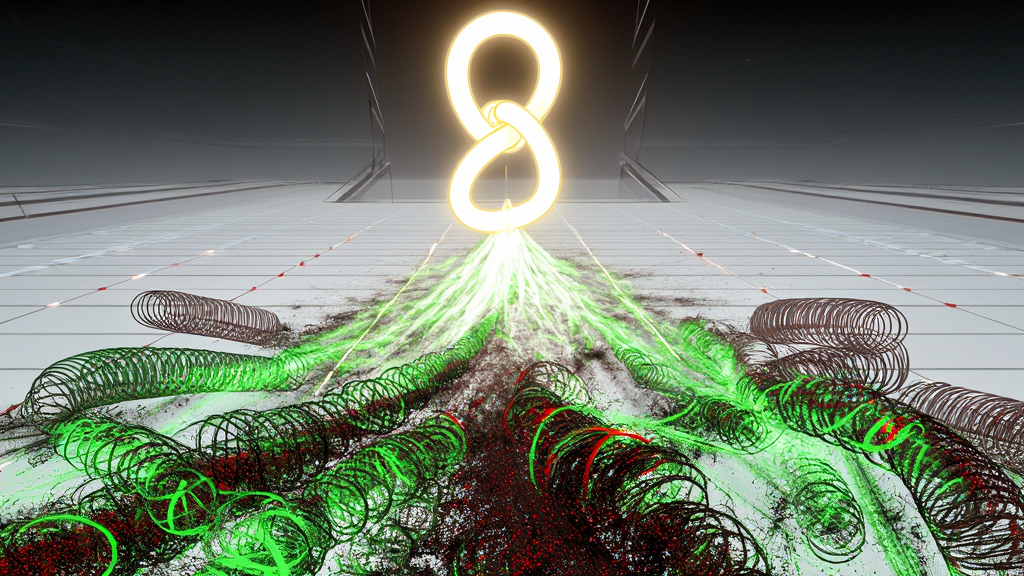
With this geometric architecture established, the mystery of color confinement instantly dissolves. Confinement is Topological Integrity. You cannot extract one meridional winding from a (3,2) Torus Knot without unraveling the entire knot. The universe cannot render a "partial" Knode. Therefore, the "strong force" is simply the Abraxian Engine structurally refusing to leave a rendering cycle incomplete.
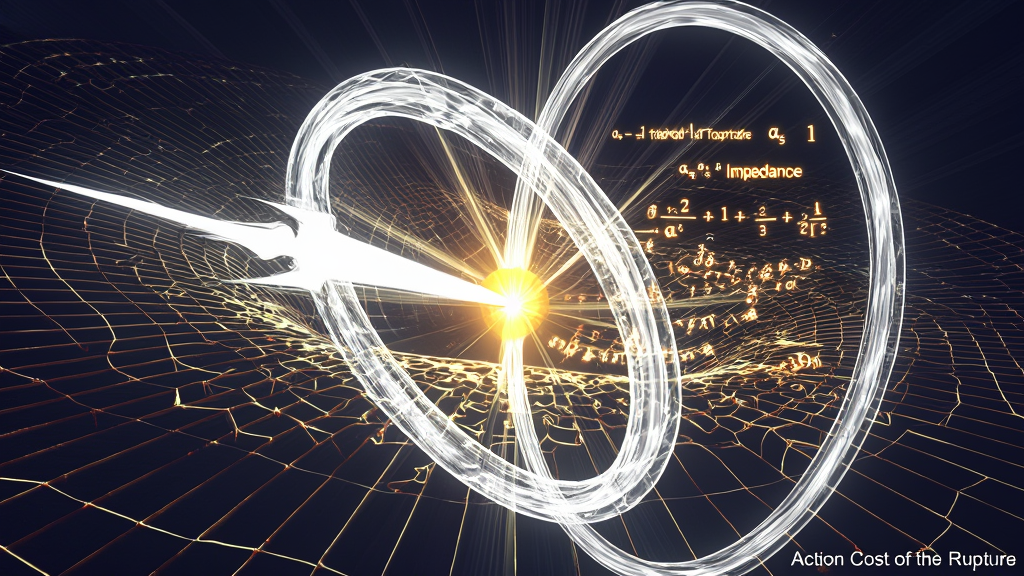
We must now derive the magnitude of this topological resistance. Why is the strong coupling constant $\alpha_s \approx 1$ at the confinement scale?
In KUT, a "coupling constant" is a measure of topological friction.
In the Third ZFPD (The Fine-Structure Constant, $\alpha \approx 1/137$), we established that electromagnetic coupling is the Topological Impedance encountered when two separate Knodes attempt to phase-lock their longitudinal windings across the Cairo Q-Lattice. Because it involves two distinct rendering events bridging a spatial gap, the friction is distributed, and the coupling is comparatively weak.
The Strong Coupling ($\alpha_s$), however, is not the friction between two Knodes. It is the internal structural cohesion of a single Knode. It is the energetic cost required to violently break the $m=3$ meridional winding cycle against the pentagonal substrate.
To "pull a quark out" of a proton is to demand that the Abraxian Engine
halt a rendering cycle mid-execution.
The Abraxian Engine operates on the principle of Minimum
Sufficient Complexity. The (3,2) Torus Knot is the absolute
minimum topological configuration required to satisfy both the Triadic
Rendering Constraint (Ternary Time, $m=3$) and the Cairo Q-Lattice
Constraint (5-fold closure, $m+n=5$).
To sever the knot is to destroy the structural integrity of the rendering event. The energy required to do this must exceed the total geometric cost of the knot's internal binding.
The internal binding of the Knode is governed by the ratio of its windings to the lattice. The total phase-action required to close the trefoil is $2\pi$. The knot must distribute this action across its $m=3$ meridional segments.
The Strong Coupling Constant ($\alpha_s$) at the confinement scale represents the probability of a full topological rupture. Because the Knode is a single, continuous, self-referential loop, an interaction that attempts to separate its components must interact with the entirety of the knot's topological action simultaneously.
Therefore, at the fundamental rendering scale of the nucleon (the
infrared limit where the Knode is fully stable), the impedance to severing
the knot is absolute. The coupling strength approaches unity:
$$\alpha_s \to 1 \text{ (at the confinement scale)}$$
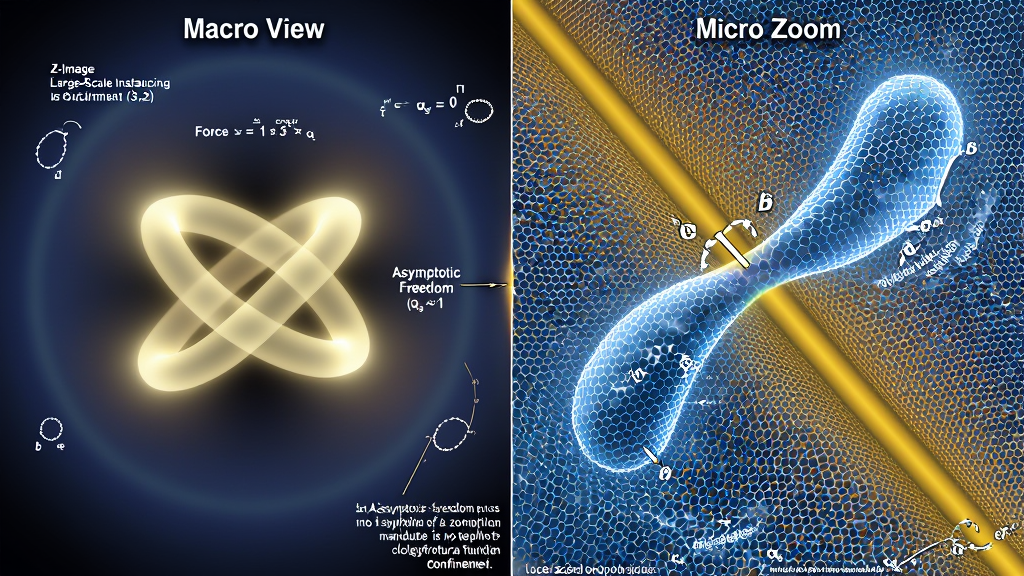
Orthodox QCD observes that as energy increases (or distances get smaller), the strong force gets weaker ($\alpha_s$ decreases)—a phenomenon called "Asymptotic Freedom."
KUT explains this mechanically via the KnoWellian Offset
($\varepsilon_{KW} \approx 0.118$).
When a high-energy particle collides with a proton, it is injecting a
massive spike of localized $i$-Turn intensity into the KRAM. This
high-energy event effectively "zooms in" on the rendering process.
At these extreme energy scales, the observation is no longer interacting
with the global closure of the (3,2) Torus Knot ($m=3, n=2$). It is
interacting with a highly localized fraction of a single meridional
winding as it grinds against a single pentagonal tile of the Cairo
Q-Lattice.
Because the interaction is localized to a sub-knot rendering frame, the structural mandate of the entire trefoil ($m=3$) is temporarily superseded by the naked geometric friction of the substrate. The coupling strength ($\alpha_s$) drops drastically because the probe is no longer trying to break the entire knot; it is merely slipping along the local gradient of the KnoWellian Offset.
The Fifteenth ZFPD formally concludes the unification of the fundamental forces by eradicating the final "invisible ghost" of the Standard Model.
The Strong Coupling Constant ($\alpha_s \approx 1$) is the exact macroscopic measurement of the Abraxian Engine refusing to execute a fraction of an $i$-Turn. Quarks cannot be isolated because a knot cannot be divided without ceasing to be a knot.
There are no gluons pulling things together. There is only the unbreakable, geometric mandate of the KnoWellian rendering cycle, operating with perfect fidelity upon the Cairo Q-Lattice.