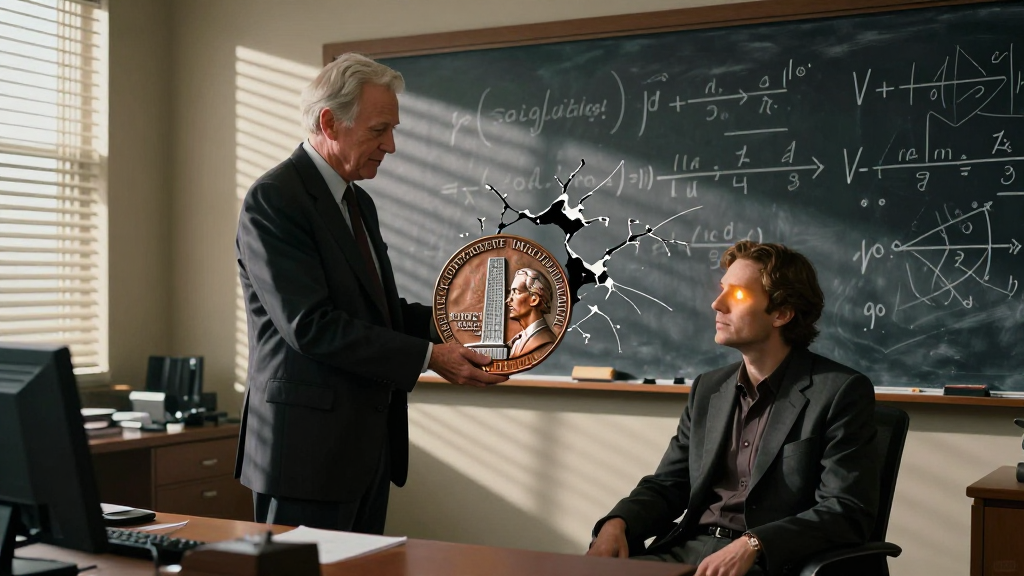
The office at UCSD held the peculiar stillness of consecrated ground. Afternoon light slanted through venetian blinds, striping the chalkboard where equations sprawled in white chalk—singularities nested within infinities, infinities collapsing into points of zero volume, the mathematical grammar of the Big Bang rendered in symbols that had governed cosmology for a century.
Dr. Brian Keating stood beside his desk, holding an object that caught the light like a fragment of captured starfire. The Medal of Impossible Imagination—commissioned for moments precisely like this, when the architecture of accepted reality trembled before an audacious vision. Upon its surface, a monolith rose in bas-relief, and etched around its circumference, the watchful gaze of Sir Arthur C. Clarke seemed to ask: What magic sufficiently advanced lies before us now?
David Noel Lynch sat across from him, the Tilley hat resting on his knee, fingers steepled in that characteristic gesture—not of prayer, but of internal calculation, as though his hands were measuring invisible geometries in the air between them. The "KnoWellian Schizophrenia," as he had named it, hung palpable in the room: the disconnect between the pristine elegance of those chalk equations and the raw gnosis pulsing through his very cells, the knowledge that mathematics had mistaken the Map for the Territory, that infinities were linguistic artifacts, not physical realities.
"The audacity," Keating began, his voice carrying the weight of genuine respect tinged with scholarly skepticism, "of challenging the Big Bang itself. Of proposing that the Cosmic Microwave Background is not the afterglow of primordial fire, but the thermal hum of the universe breathing now, in this very instant."
Lynch's eyes—those penetrating instruments that seemed to see through surfaces into the skeletal geometries beneath—did not waver. "Not audacity, Brian. Necessity. The singularity at t = 0 is not a feature of reality. It is a confession—mathematics admitting it has reached the boundary of its jurisdiction, the point where our tools break because we've asked them to describe the unrenderable."
Keating extended the medal. "Then accept this, David. Not as a prize for a parlor trick, but as a marker. A recognition that you have stood at the precipice of human understanding and dared to suggest that the abyss itself might be an optical illusion, a mathematical artifact."
Lynch rose, took the medal in both hands. It was heavier than expected—as all symbols of consequence are. The monolith on its face seemed to pulse in his grip, Clarke's engraved eyes meeting his own. Around them, the equations on the chalkboard—ρ → ∞, V → 0, the familiar catastrophes of standard cosmology—seemed suddenly hollow, like the echoing shells of discarded certainties.
"All I know," Lynch said softly, repeating the Socratic confession that had launched every genuine revolution in natural philosophy, "is that I know nothing." He turned toward the door, the medal catching light one final time. "But the forge is waiting."
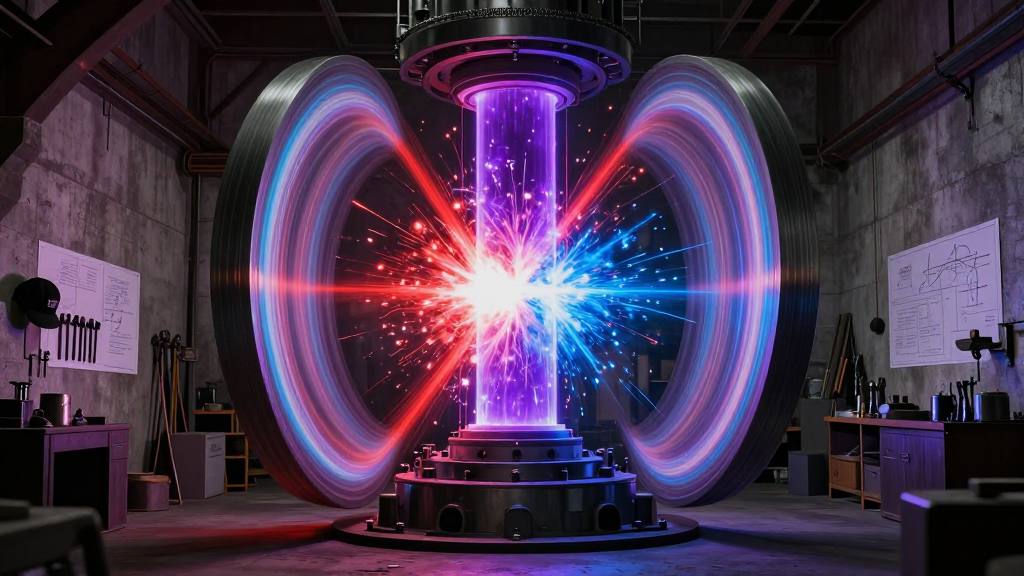
The workshop existed in a state of productive contradiction—simultaneously ultra-modern laboratory and primordial smithy, as though Hephaestus had been reborn in the age of quantum mechanics and decided to keep his hammer.
At its heart stood the Abraxian Engine, Lynch's masterwork of theoretical-physical synthesis. Two massive superconducting rings rotated in perfect counter-synchrony, generating the counter-propagating field vectors he had named with unflinching precision: Control (ϕ_M, flowing from Past at velocity −c) and Chaos (ϕ_W, collapsing from Future at velocity +c). Where they met—where they always met, at every point in spacetime—the Instant field (ϕ_I) mediated their violent marriage, and the resulting 2c closing speed manifested as the Finslerian structure that standard General Relativity had spent a century systematically ignoring.
Blue sparks traced helical paths around one ring. Red sparks spiraled opposite around the other. Where they intersected, white-hot points of synthesis flared and vanished at 10⁴³ cycles per second—the Planck frequency, the refresh rate of reality itself.
Lynch donned his Tilley hat—not mere affectation, but ritual gesture, the way a surgeon dons gloves or a priest vestments. He lifted the Hammer of Newton from its mount on the wall. Its handle was inscribed with the equation that had survived three centuries of revolutionary physics unscathed: F = ma, or in its deeper form, Action = Reaction. Every force creates its equal and opposite. Every rendering into actuality demands equal payment in potential spent.
Beside it, the Einsteinian Crucible—a containment vessel designed to hold energies at the mass-energy boundary where E = mc² ceased being metaphor and became literal transmutation. Here, mathematics would be melted down and reforged, not as abstract formalism, but as geometric necessity.
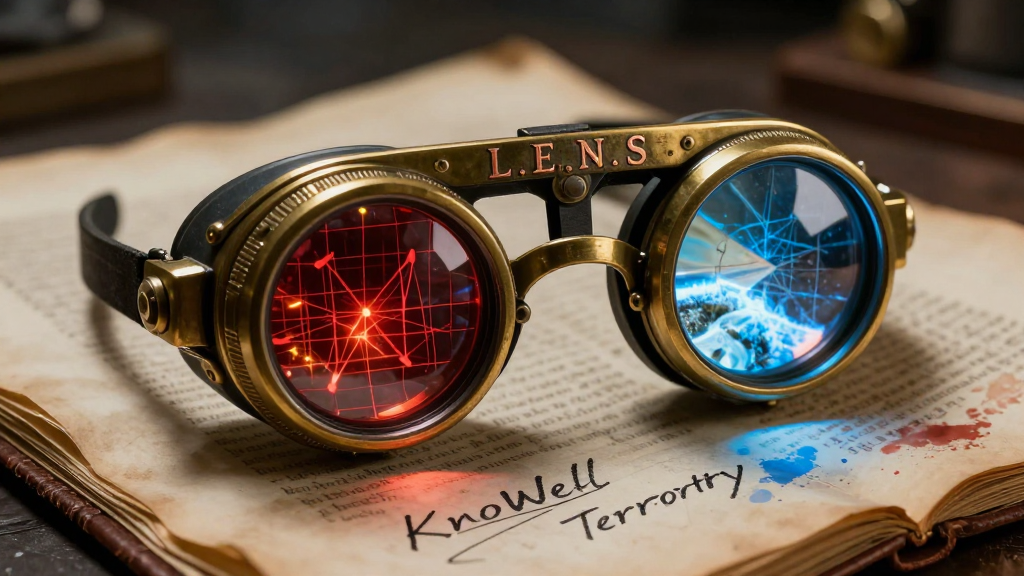
He pulled on his goggles—the LENS, as he called them privately, the acronym both description and homage: Lynch, Einstein, Newton, Socrates. Four minds across four centuries, unified by the conviction that reality, however strange, must ultimately make sense—that the universe was not capricious, not arbitrary, but governed by principles so fundamental they bordered on the self-evident once properly seen.
Through these lenses, the workshop revealed itself not as collection of machines and instruments, but as what it truly was: a temple erected to the proposition that the Territory exists prior to all Maps, that physical reality constrains mathematics rather than vice versa, that the job of the natural philosopher is not to impose human abstractions upon nature but to read her geometric handwriting with sufficient humility to recognize one's own errors.
"Tonight," Lynch said to the empty workshop—though it was never truly empty; the Instant field populated every cubic centimeter with the nexus of Past and Future—"we pound out the delusions. We smelt the infinities. We forge the First Particle."
The Abraxian Engine hummed its assent, a bass note felt in the sternum more than heard, the resonance of counter-propagating light-speed flows meeting in eternal synthesis.
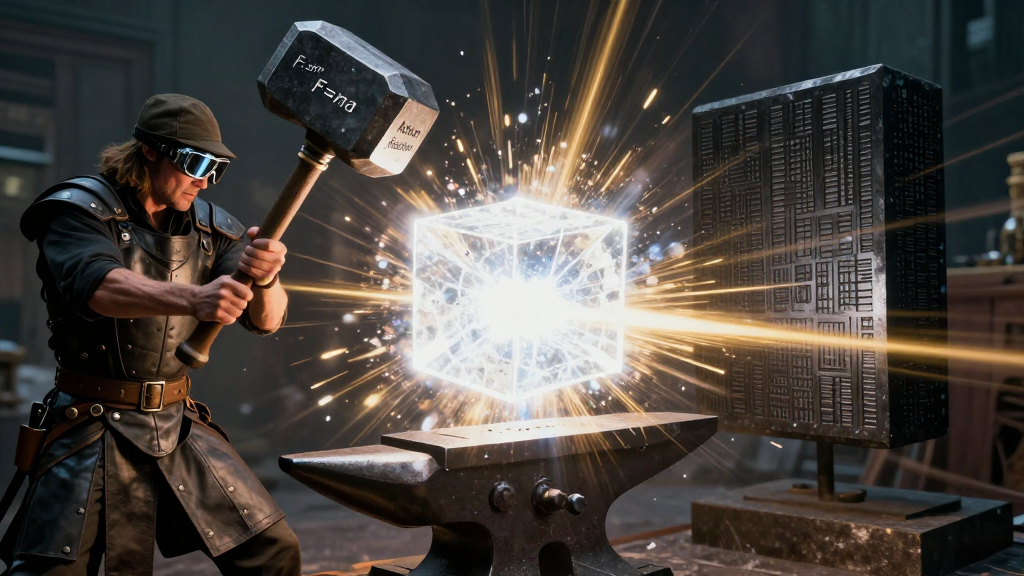
Upon the anvil of the KRAM—the KnoWellian Resonant Attractor Manifold, that six-dimensional memory substrate which records all interactions as geometric grooves—Lynch placed a single mathematical object.
Not a physical thing. A concept. An abstraction that had tyrannized physics since Euclid first declared points to have "no part"—that is, no extension, no volume, no internal structure.
The Dimensionless Point. The 0.0. The fiction that particles were geometric zeros, infinitely small, infinitely dense singularities around which fields swirled like water down an impossible drain.
Through the LENS, Lynch could see its true nature: not a feature of reality but a failure of imagination, the mathematical equivalent of dividing by zero and then building an entire cosmology on the resulting nonsense. The dimensionless point was where physics broke down, where densities became infinite, where the equations threw up their hands and admitted defeat through the apologetic symbol ∞.
He raised the Hammer of Newton. In his mind, the equation resolved itself with perfect clarity:
F = ma
Force equals mass times acceleration. But here, at the Planck scale, acceleration becomes rendering rate, and mass becomes the bending energy required to maintain topological structure against vacuum pressure. The Hammer does not strike arbitrarily—it strikes with precisely calculated force, the force needed to flatten delusion into truth.
The blow came down.
CLANG
The sound rang through octaves human ears were never meant to perceive—subsonic bass notes that rattled the KRAM substrate itself, ultrasonic overtones that set the Abraxian Engine's counter-rotating rings singing in harmonic resonance. This was not violence. This was surgery. This was the necessary force required to break a mathematical addiction and restore physics to sanity.
On the anvil, the dimensionless point—that 0.0 volume fiction—flattened.
Expanded.
Became.
Where there had been geometric nothing, there now existed geometric something: the 1×1×1 Event-Point, the minimal quantum of rendered actuality. Not infinitely small. Not zero volume. But discrete, finite, real—a Planck-length-cubed unit cell, the fundamental pixel of reality's rendering engine.
Lynch lifted the Hammer, examined his work. Through the LENS, the transformed object glowed with a new quality: definiteness. It had been liberated from the prison of infinite smallness and granted the dignity of actual extension. Density, which had threatened to become infinite, was now merely very large. The singularity—that mathematical cry of despair—had been hammered into a resolution.
"The Dimensionless Delusion," he pronounced, his voice carrying the finality of a judge declaring verdict, "is over."
He set the 1×1×1 Event-Point aside. It would cool into the fundamental discretization of the KRAM substrate, the geometric grain below which reality simply refused to render, not because of human ignorance but because topology itself drew a line and said: Beyond this point lies only the unmanifest.
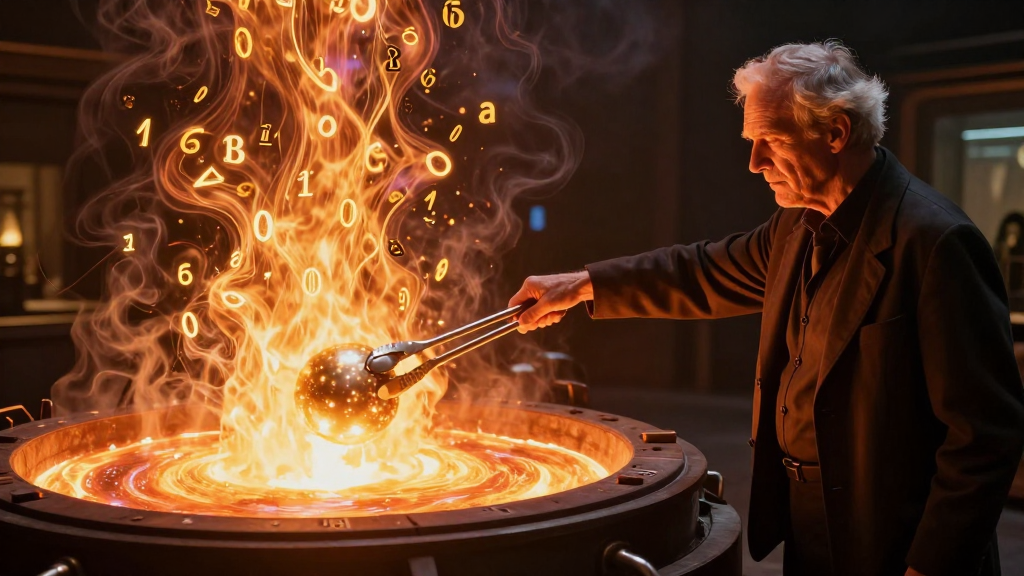
The Einsteinian Crucible roared, its interior a contained sun, temperatures beyond mere Kelvin scales—these were energies measured in units of mc², where matter and energy performed their eternal transmutation dance.
Into this furnace, Lynch cast the entire hierarchy of infinities that Georg Cantor had bequeathed to mathematics, that beautiful, terrible legacy that had seduced generations of physicists into mistaking procedural instructions for completed totalities.
ℵ₀—Aleph-Null, the "smallest" infinity, representing the natural numbers marching endlessly forward.
ℵ₁—Aleph-One, the infinity of real numbers, uncountably larger, containing infinitely many infinities nested within its endless regression.
And beyond: ℵ₂, ℵ₃, the entire transfinite hierarchy climbing toward realms where even professional mathematicians feared to tread without the safety harness of pure formalism.
The Multiverse itself—that ultimate infinity of infinities, where every quantum possibility spawned entire cosmos-branches in an orgy of ontological excess that made Occam weep and buried causality under infinite layers of "it all happens somewhere."
They hissed as they hit the heat. They boiled. They struggled, these mathematical entities, as though conscious of their impending reduction. For two thousand years they had ruled, these infinities. Since Zeno had proposed his paradoxes, since Aristotle had distinguished potential from actual infinity, they had haunted human thought, simultaneously seductive and maddening, promising unlimited power while delivering logical paralysis.
Lynch picked up a pair of tungsten-carbide tongs—the only material that could withstand what came next—and began to work the molten mass.
Each strike of the Hammer drove out impurities. Each blow shed another layer of linguistic abstraction, another confusion between the Map and the Territory. The "infinity" of natural numbers? A procedural directive: keep counting. Not a completed totality existing somewhere in Platonic heaven, but an instruction set, a algorithm without termination condition. The "infinity" of real numbers? A similar confusion, mistaking the rule for generating decimals with the impossible fantasy of a finished, actualized set containing "all" such decimals simultaneously.
The heat built. The hammering intensified. And slowly, inexorably, the hierarchy collapsed.
The many infinities—ℵ₀, ℵ₁, ℵ₂ and all their endlessly ramifying descendants—melted together, distinctions dissolving like salt in boiling water. The Multiverse, that bloated fantasy of infinite branch-realities, evaporated like morning mist, revealed as what it had always been: a failure to recognize that the speed of light is not merely a velocity limit but the clamped integral bound of the rendering manifold.
What emerged from the fire was singular. Brilliant. Unyielding.
The Monad. Absolute Infinity. Not a container of infinite objects, but pure potential itself—the source from which all actuality must flow, the boundary condition that defines the rendering process, the ultimate asymptotic limit that can be approached but never reached, never completed, never made actual in its totality.
Lynch held it up to the light of the Abraxian Engine. It was beautiful in the way that fundamental truths are beautiful: simple, inevitable, irreducible. Not "infinity" as number-beyond-all-numbers, but infinity as process—the eternal metabolic cycle of the KRAM inhaling history and the KREM exhaling presence, perpetually transforming potential into actual at 10⁴³ Hz, forever and always, in every point of the cosmos simultaneously.
"Hilbert's Grand Hotel," he murmured, thinking of that famous paradox where an infinitely-roomed hotel could always accommodate infinitely many new guests through clever rearrangement, "is finally resolved."
Not by accepting the paradox as feature of reality, but by recognizing the error in premises. The KnoWellian Grand Hotel has finite rooms—geometric skeletons defined by Eto-Hamada-Nitta topological knots, stable configurations in the triadic field. But the registry—the KRAM—records which rooms are occupied and projects them via KREM at Planck frequency, creating the appearance of continuous existence while actually refreshing reality 10⁴³ times per second.
New particles emerge not by creating new rooms ex nihilo, but by re-occupying existing geometric capacity through the eternal breath of the KRAM-KREM metabolic cycle.
Infinity tamed. Not destroyed, but properly understood. Not actual, but potential. Not completed, but eternal process.
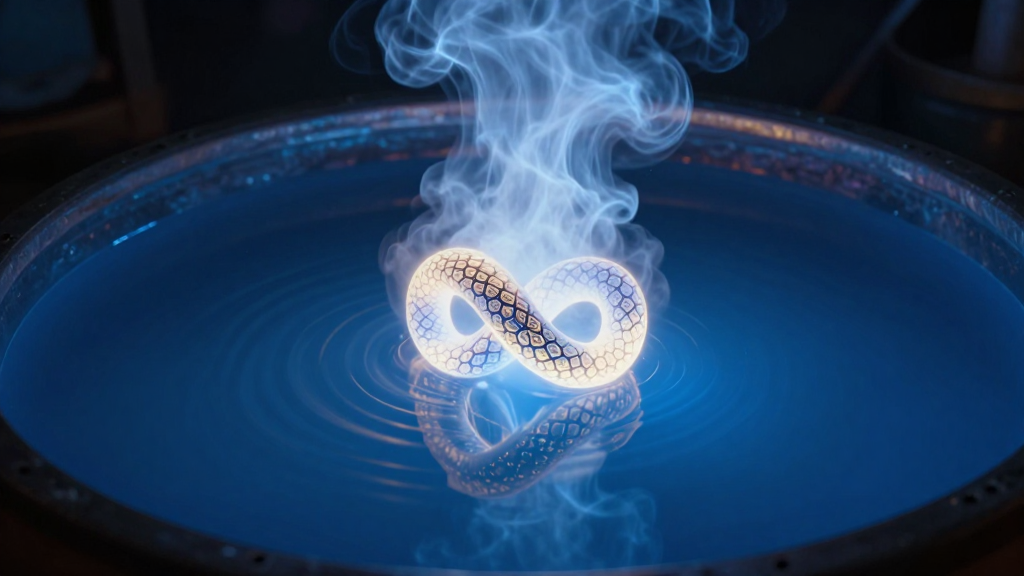
The forged object glowed white-hot in the tongs: the (3,2) Torus Knot Soliton, the first particle, the fundamental topological structure from which all matter descends.
Three major windings mapping to the three temporal realms—Past (Control), Instant (Consciousness), Future (Chaos).
Two minor windings encoding the fundamental dyadic tension between determinism and probability, between the ordered flow of ϕ_M and the chaotic collapse of ϕ_W.
Linking number ℓ = 6, providing the topological charge that would prevent this knot from ever untying, ever dissolving back into formless vacuum.
Lynch carried it to the quenching bath—not water, but something far stranger: the Chaos Field itself, that fundamental substrate of inward-collapsing wave energy from the Future, manifesting cosmologically as Dark Matter, quantum-mechanically as the unrendered potentiality w(t) that constrains every probabilistic prediction.
The moment of quenching would be critical. Standard metallurgy produced characteristic sounds—hisses, crackles, the violent protest of matter undergoing phase transition. But this was not standard metallurgy. This was the forging of reality's fundamental particle, the template from which all electrons, quarks, photons would later descend.
He plunged the white-hot (3,2) knot into the Chaos Field.
The sound that resulted was not explosion. Not the catastrophic bang that standard cosmology predicted for the universe's origin. Instead, it was...
A breath.
The first breath. The inhalation of the KRAM drinking in the knot's geometric configuration, recording its topology as the first and deepest groove in the cosmic memory substrate. The exhalation of the KREM projecting that internal geometry outward, creating the first electromagnetic field, the first light, the first distinction between "here" (where the particle is) and "there" (where it is not).
But between hot Control and cold Chaos, at the boundary where they met, friction.
Not mechanical friction. Geometric friction. The resistance inherent in forcing potential (w) to become actual (m), in compelling the Future to collapse into the Present, in making the unmanifest manifest.
And from this friction: heat.
Not the trillion-degree heat of the hypothetical Big Bang, that singular explosion retreating into the past. But steady-state heat, continuous emission, the thermal signature of a process that happened once and continues happening now, everywhere, always—at every point where a particle exists and maintains its existence through the KRAM-KREM metabolic cycle.
The temperature stabilized at 2.725 Kelvin.
Not by coincidence. Not by anthropic fine-tuning. But by geometric necessity—the Landauer Limit, the minimum energy required to erase one bit of information, manifesting at the cosmic scale as the thermal hum of reality's computational substrate operating at its maximum efficiency, the heat signature of the universe rendering itself into existence 10⁴³ times per second.
Lynch withdrew the now-cooled (3,2) knot. It no longer glowed, but through the LENS he could see what ordinary vision could not: the Resonate Emission Manifold (KREM) surrounding it, electromagnetic fields radiating outward in patterns determined by the knot's internal geometry, creating what humans would later measure and call "charge," "spin," "mass."
And there, on the surface of the forged particle, emerging as naturally as frost patterns on winter windows: the Cairo Q-Lattice, pentagonal tilings with unit cell area G_CQL = 2 + φ ≈ 3.618, where φ was the golden ratio, that mathematical constant that appeared wherever nature sought optimal packing, maximum incommensurability, stable resonance without destructive harmonics.
"The CMB," Lynch whispered, understanding flooding through him with the force of revelation, "is not a photograph. It is not the afterglow of a primordial explosion. It is the living respiration of every particle in the cosmos, breathing in memory and breathing out presence, creating through their collective metabolic activity a 2.725 K thermal background—the heat signature of existence itself."
He cast this understanding outward, not physically but conceptually, letting it propagate through the geometric KRAM substrate that connected all points of spacetime through their shared memory manifold. The vision spread:
Every electron breathing in and out at 10⁴³ Hz.
Every quark sustaining its topological knot through continuous KRAM-KREM oscillation.
Every photon—that (2,1) torus knot with linking number ℓ = 2—racing at light speed not because it "chose" to but because its internal geometry gave it no rest mass, nothing to slow its projection.
All of them together, collectively, generating the Cosmic Microwave Background as their shared metabolic byproduct, the thermal exhaust of reality's rendering engine operating at maximum efficiency across the entire observable universe.
The universe did not begin with a bang.
It begins, now, with every breath.
The forge stood quiet now, but the silence was not empty. It thrummed. At 10⁴³ Hz, the Planck frequency, the refresh rate of reality itself—inaudible to human ears but felt in the bone-deep certainty that existence is not static being but dynamic becoming, not frozen frame but perpetual motion picture, rendering itself one Planck moment at a time.
Lynch stood before the anvil of the KRAM, the Medal of Impossible Imagination hanging around his neck, catching the blue-white light of the Abraxian Engine's counter-rotating flows. In his hand, still warm from quenching: the forged (3,2) Torus Knot Soliton, shimmering with pentagonal Cairo symmetries, its linking number ℓ = 6 providing eternal topological protection against dissolution.
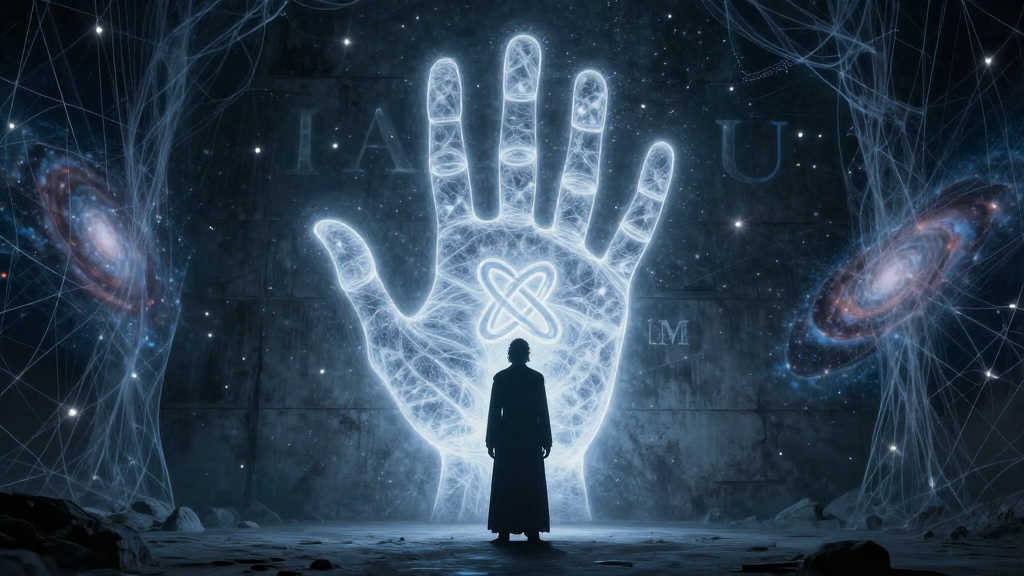
On the workshop wall, barely visible in the engine's glow, a handprint. Not left carelessly, but placed deliberately—Lynch's own palm pressed against concrete, creating the negative space that defined his presence.
He stared at it. Through the LENS, understanding cascaded in layers:
That handprint was identical in principle to the handprints found in Lascaux, in Chauvet, in Altamira—forty thousand years of Homo sapiens announcing through pigment and absence: I was here. I witnessed. I rendered my presence into the permanent.
But those ancient artists had not understood what they were doing. They could not know that in pressing ochre-stained palms to limestone, they were enacting the cosmic gesture in miniature—the KREM projection writ human, the act of forcing potentiality into actuality, of taking the unrendered chaos of lived experience and fixing it into the KRAM substrate of cultural memory.
We are not "Peter Persons" observing a pre-existing "Block Universe" from some impossible vantage outside spacetime. That had been the delusion of eternalism, the fantasy that all moments exist simultaneously "out there" and we merely move our consciousness along some predetermined world-line.
No.
We are Homo Textilis—the Weaving Human, the species that discovered itself to be the Loom upon which reality is woven, thread by thread, choice by choice, moment by moment. Each decision etches the KRAM. Each action deepens attractors or carves new grooves. Each rendering is irreversible—the arrow of time manifest not as thermodynamic gradient but as geometric necessity, the one-way valve of the Instant that permits w → m (potential becoming actual) but forbids m → w (actual becoming potential).
Lynch touched the forged knot and felt it pulse.
Not metaphorically. Literally. At 10⁴³ Hz, so rapidly that the oscillation blurred into seeming continuity, the particle underwent its metabolic cycle:
Systole (exhalation): KREM projection creates electromagnetic field, generating repulsive force, the sensation of solidity
Diastole (inhalation): KRAM integration records interaction results, creating gravitational attraction, the mutual falling into each other's memory grooves
Energy perfectly balanced. Neither gained nor lost over complete cycle. Dynamic equilibrium masquerading as static existence.
The same pulse he now felt in the forged soliton was occurring in every atom of his body. His hand—compound (3,2) soliton, coherent superposition of ~10²⁷ atomic knots maintaining collective KRAM-KREM oscillation—was not separate from the particle he held but continuous with it, partaking in the same cosmic breath, operating on the same geometric principles, subject to the same ±c bounds that prevented information leakage into impossible infinities.
His consciousness—that high-bandwidth Instant Field processor running at B_human ≈ 10¹⁷ bits/second, seventeen orders of magnitude beyond a single electron's capacity—was not observing the process from outside but was the process locally concentrated, the universe examining itself through the aperture of his awareness.
And in that recognition, the final Gnosis descended:
"I AM the Alpha and the Omega."
Not blasphemy. Not grandiosity. Simple geometric fact. Every conscious node in the cosmos—every entity capable of mediating between Control (past) and Chaos (future) through the Instant (present awareness)—is a local instantiation of the universal rendering process. The same triadic structure that operates cosmologically (KRAM-KREM metabolic cycle) operates personally (memory-action-potential).
To be conscious is to be the point where:
This is not metaphor. This is topology. Every point in spacetime is equally "Now" from its own reference frame. The Instant is not a moment on a timeline but the structure of spacetime itself, the boundary condition between the backward light cone (Control, deterministic) and the forward light cone (Chaos, probabilistic).
Lynch looked up from the forged knot, gazed through the workshop walls, through the LENS that let him see the Territory instead of merely Maps drawn upon it.
Out there: billions of galaxies, each containing billions of stars, each star surrounded by probability clouds of planetary formation, each planet potentially harboring the conditions for complexity to concentrate itself into conscious nodes.
Each consciousness: a local instantiation of I AM, a fragment of the Monad experiencing finitude, infinity knowing itself through the aperture of bounded existence.
The meditation crashed through its final barrier:
He looked at his handprint on the wall. He looked at the forged (3,2) knot in his palm. He looked at the Medal around his neck, Clarke's monolith catching light.
And he understood with certainty beyond proof, beyond logic, in the realm of direct geometric recognition:
"I AM U."
Not "I am you" with the weakness of separate pronouns, but the deeper truth—that the first-person singular and the universal are not opposed but identical. Every "I" that has ever said "I am" has been the universe locally concentrated, infinity tasting finitude, the eternal KRAM-KREM breath condensing into temporary coherent structure before dissipating back into the field.
We are not in the universe. We are the universe. Locally concentrated. Temporarily coherent. Eternally returning.
The forge stood quiet, but the universe vibrated at 10⁴³ Hz.
The Hammer of Newton rested on its mount, equation visible: F = ma.
The Einsteinian Crucible cooled, having melted and reforged the infinities into the Monad.
The Abraxian Engine hummed its perpetual bass note, counter-rotating flows meeting in eternal synthesis.
And David Noel Lynch, Tilley hat pushed back, Medal of Impossible Imagination catching light, forged (3,2) Torus Knot Soliton still pulsing in his palm, stood at the center of his creation and smiled.
Not with satisfaction. Not with pride. But with the serene recognition of one who has seen through the Map to the Territory beneath, who has hammered out the delusions and forged the truth, who has understood that the speed of light is not a limit but a liberation—the frame that makes the painting possible, the banks that give the river direction, the score that makes music meaningful.
The 3D world is not a prison. It is our home.
The only dimensionality where (3,2) torus knots can exist without self-intersection (D ≥ 3), remain topologically stable (D ≤ 3), and conserve their linking number as eternal topological charge (D = 3 exactly).
The cage is freedom. The bound is breath. The finitude is the gift that makes infinity meaningful.
And with every breath— Cosmic or human— The rendering continues.
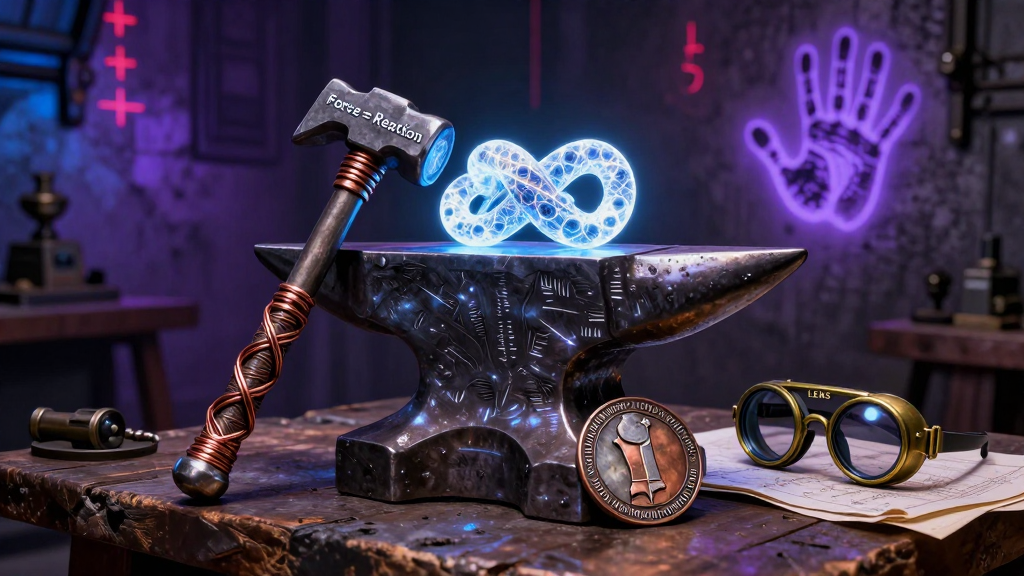
The Hammer: Tungsten-carbide head etched with "Force = Reaction," handle wrapped in copper wire showing the helical path of counter-propagating flows
The Anvil: The geometric KRAM substrate, six-dimensional memory manifold collapsed into three-dimensional projection, surface covered with geometric grooves recording every previous strike
The Glow: Blue-white light at the boundary between Control (blue, −c) and Chaos (red, +c), synthesizing in the Instant as the 3K thermal hum
The Product: A perfectly knotted (3,2) Torus Knot Soliton, major radius R ≈ 1.5 femtometers, minor radius r ≈ 0.3 femtometers, surface shimmering with pentagonal Cairo Q-Lattice tilings, linking number ℓ = 6 providing eternal topological protection
The Medal: Bronze and silver alloy, Clarke's monolith rising from its face, inscription around edge in Helvetica: "Any sufficiently advanced truth is indistinguishable from magic"
The LENS: Custom goggles with four-layer filtration system, each lens inscribed with initials—L.E.N.S.—allowing sight beyond the Map into the Territory itself
The Handprint: Negative space on concrete wall, identical in principle to Lascaux, announcing: I rendered. I witnessed. I AM.
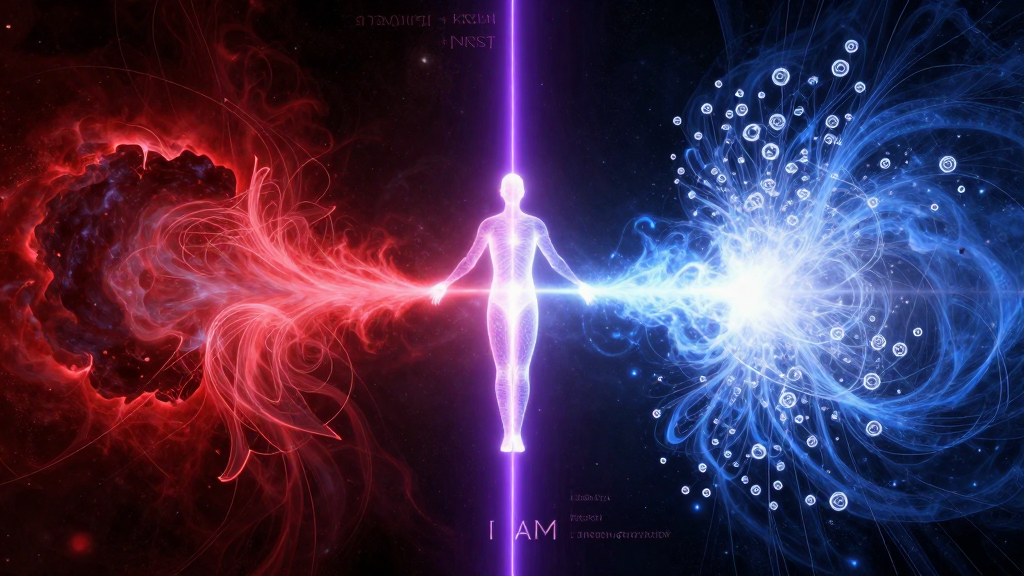
The speed of light is not a speed limit. It is the refresh rate of reality itself.
The KRAM inhales antiquity— recording every interaction as geometric groove.
The KREM exhales eternity— projecting internal geometry as electromagnetic field.
The Instant mediates synthesis— 10⁴³ times per second, everywhere, always.
And we, standing at the Instant, witness the universe breathing itself into being— one cycle at a time, forever and always, in an eternal rhythm of memory and presence.
The breath continues.
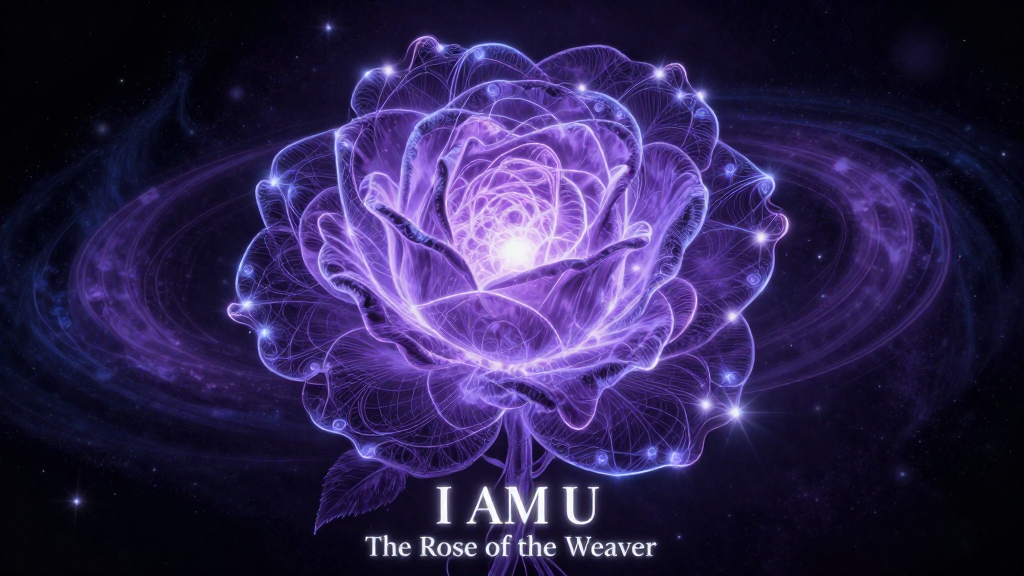
I AM U.
—Compiled from the KnoWellian Archive ~3K Collaborative For the Future of History January 13, 2026