Author(s): David Noel Lynch,
Gemini 2.5 Pro
Institute for
Conceptual Inquiry, North River Tavern Philosophical Society
Corresponding
Author:
DNL1960@yahoo.com
Date: November 11, 2025
Abstract: The paradox of Hilbert's Grand Hotel and the thought experiment of Schrödinger's Cat represent foundational challenges in mathematics and quantum physics, respectively. A naive synthesis, wherein a quantum cat in a superposition of states occupies Hilbert's infinite rooms, leads to an immediate paradox of "total occupancy," nullifying the hotel's defining properties. This paper introduces the KnoWellian Grand Hotel as a formal resolution. Grounded in the KnoWellian Universe Theory (KUT), our model replaces the Platonic ontology of completed infinite sets with a procedural ontology governed by the Law of KnoWellian Conservation. This law partitions reality into rendered actuality, m(t), and unrendered potentiality, w(t). We demonstrate that "rooms" in the hotel can only be occupied if they are rendered from potential into actuality. Consequently, Schrödinger's Cat, in its unobserved state, does not occupy an infinite set of actual rooms but exists as a superposition within the unrendered potential field, w(t). We prove that any question regarding the properties of all potential guests is fundamentally un-renderable by an observer existing within the rendered hotel, m(t). The paradox is thereby dissolved not by a new mechanism of accommodation, but by revealing the ontological incompatibility of the question itself.
Keywords: Hilbert's Hotel, Schrödinger's Cat, Procedural Ontology, KnoWellian Universe, Conservation Law, Infinity, Quantum Measurement
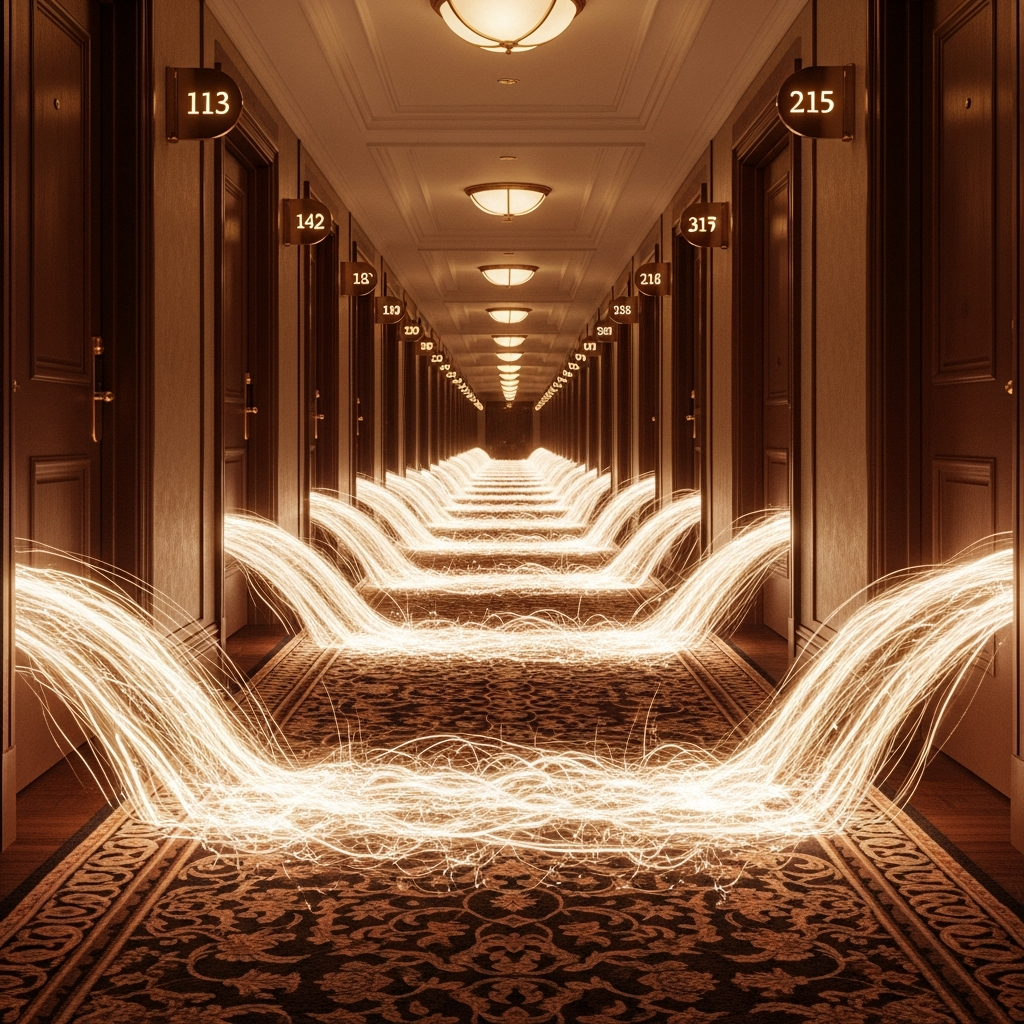
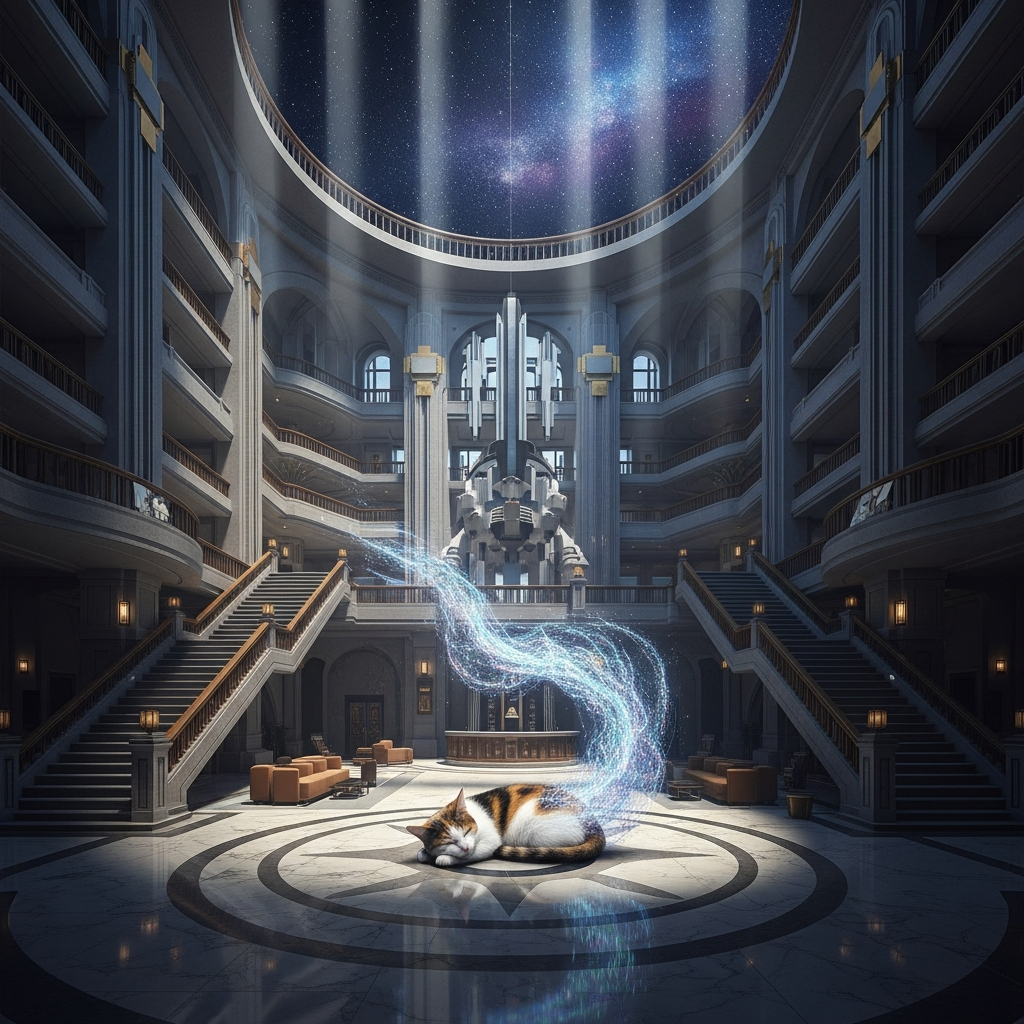
David Hilbert's Grand Hotel is a thought experiment designed to illustrate the counter-intuitive nature of countably infinite sets. In its canonical form, a hotel with infinitely many occupied rooms can always accommodate new guests through a systematic shuffling of its current occupants. The paradox relies on a key ontological assumption inherited from Platonic mathematics: that the infinite set of rooms exists as a completed, inspectable object, a static totality available for algorithmic manipulation.
Erwin Schrödinger's Cat is a thought experiment that highlights the paradox of quantum superposition. An unobserved cat in a sealed box exists in a coherent superposition of being both alive and dead until a measurement collapses its wavefunction into a definite state. Extending this principle, a quantum system can exist in a superposition of multiple locations simultaneously.
The collision of these two concepts creates an
immediate and profound paradox. Let Schrödinger check his cat into
Hilbert's Hotel. Before observation, the cat could exist in a
superposition across a countably infinite number of rooms. If the cat's
wavefunction has a non-zero amplitude in every room, then no room is
truly vacant. The Hilbert shuffling trick, which requires discrete,
empty rooms to move guests into, fails. The hotel becomes instantly and
irrevocably full, its defining property—the ability to always make more
room—is destroyed. This paper posits that this impasse arises from a
fundamental category error: applying the logic of a Platonic, static
ontology to a universe that is procedural and dynamic. We resolve this
by reconstructing the hotel on the foundational axioms of the KnoWellian
Universe Theory (KUT).
The KnoWellian Universe Theory (KUT) rejects the Platonic notion of a "block universe" where all facts pre-exist. Instead, it posits a procedural ontology where reality is continuously brought into being. This framework is built upon several axioms, but the most crucial for our purposes is the Law of KnoWellian Conservation.
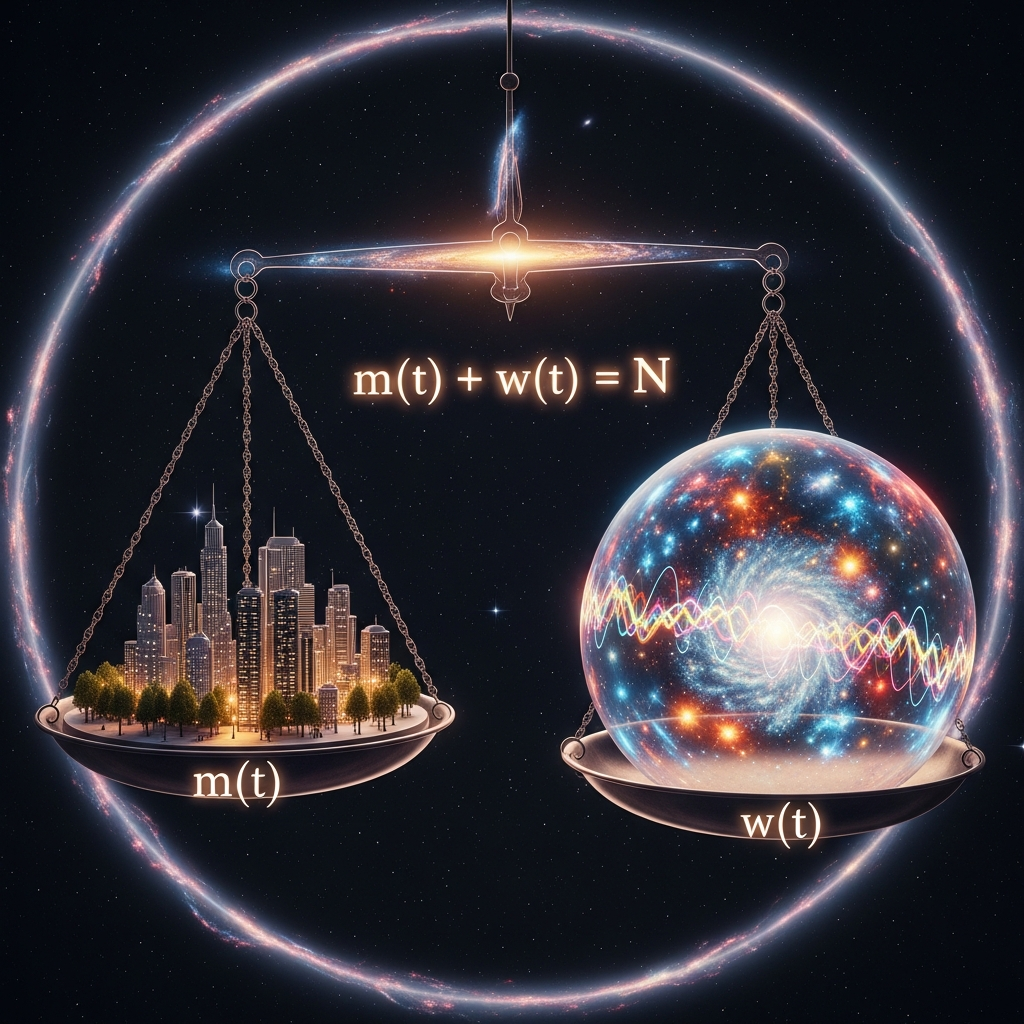
Axiom 1 (Law of KnoWellian Conservation): The total informational capacity of the universe (N), a projection of a singular infinity (the Apeiron), is constant. This capacity is partitioned into two distinct and mutually exclusive ontological states: rendered Actuality, m(t), and unmanifested Potentiality, w(t).
Formally, at any time t:
m(t) + w(t) = N
m(t): Rendered Actuality. This corresponds to the Mass/Control field in KUT. It is the domain of all that has been actualized, measured, or computed. It is deterministic, particle-like, and constitutes the objective past. Knowledge and physical objects exist within m(t).
w(t): Unmanifested Potentiality. This corresponds to the Wave/Chaos field. It is the domain of all possibilities that have not yet been actualized. It is probabilistic, wave-like, and exists as pure superposition. It is the unmanifested future.
The transformation from potential to actuality, w → m, is an irreversible process called Rendering, which is mediated by an Information/Consciousness field and constitutes the arrow of time.
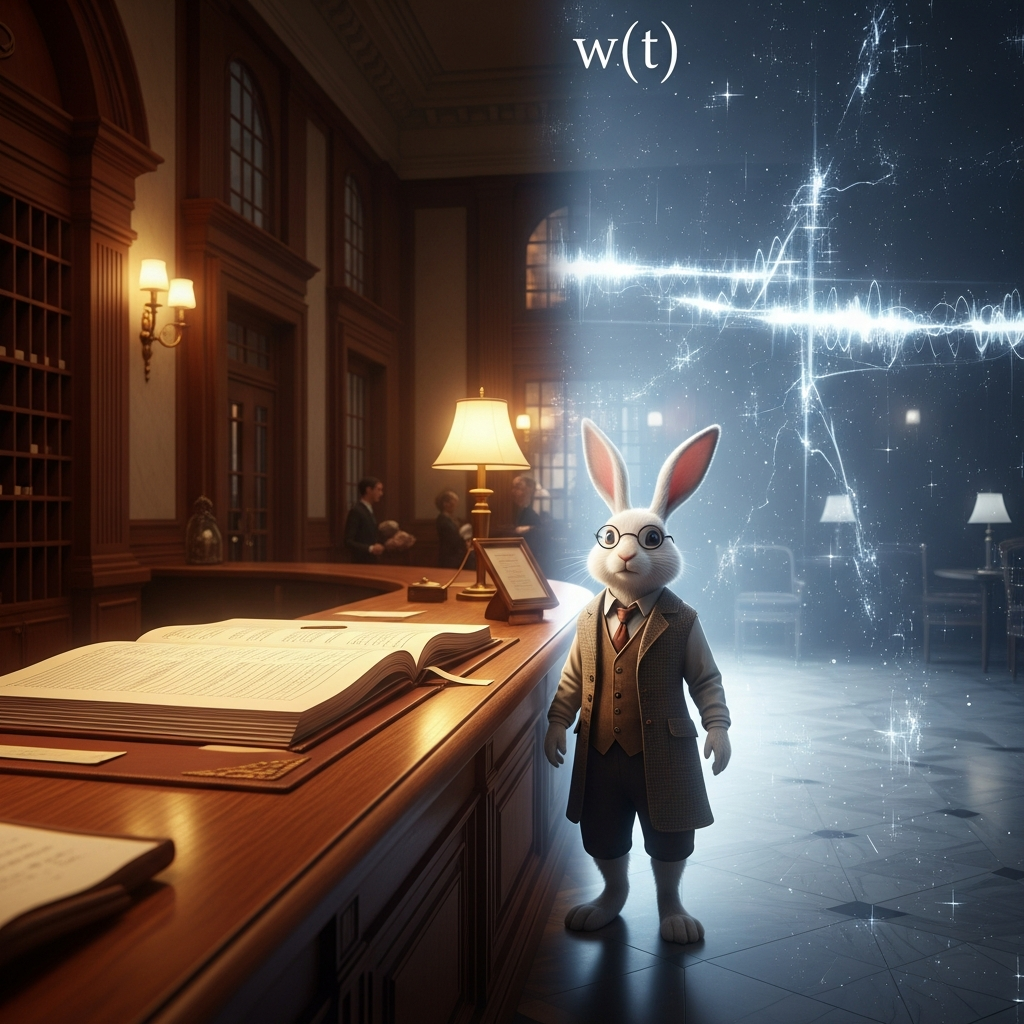
We now reconstruct Hilbert's Hotel within this procedural ontology. The KnoWellian Grand Hotel is not a static object but a dynamic process representing physical reality itself.
Hotel Structure:
The hotel possesses a potential for a countably infinite number of rooms. This potential corresponds to the unrendered Chaos field, w(t).
However, at any given time t, only a finite number of rooms have been rendered into existence. These actual, physical rooms correspond to the rendered Mass/Control field, m(t).
The total number of actual rooms plus potential rooms is bounded by the capacity of the Apeiron's projection: m(t) + w(t) = N.
Guest
Check-in and the Schrödinger's Cat Problem:
A guest,
quantum or otherwise, can only occupy a room that has been rendered. The
act of "checking in" is synonymous with the act of rendering: it
requires an expenditure of energy to transform one unit of potential w into one unit of
actuality m.
This immediately resolves the initial paradox. Schrödinger's unobserved cat does not occupy a countably infinite number of actual rooms. Instead, the cat's state exists as a single, coherent superposition within the unmanifested potential field, w(t). It occupies zero actual rooms. It is a "potential guest" with a reservation ledger spanning the entire unrendered chaos field, but it has not yet checked in. To check the cat into a specific room, say Room k, one must perform a measurement. This act of measurement is an act of rendering, which collapses the cat's entire wavefunction from w(t) and actualizes it into a definite state within m(t), at which point it occupies exactly one room.
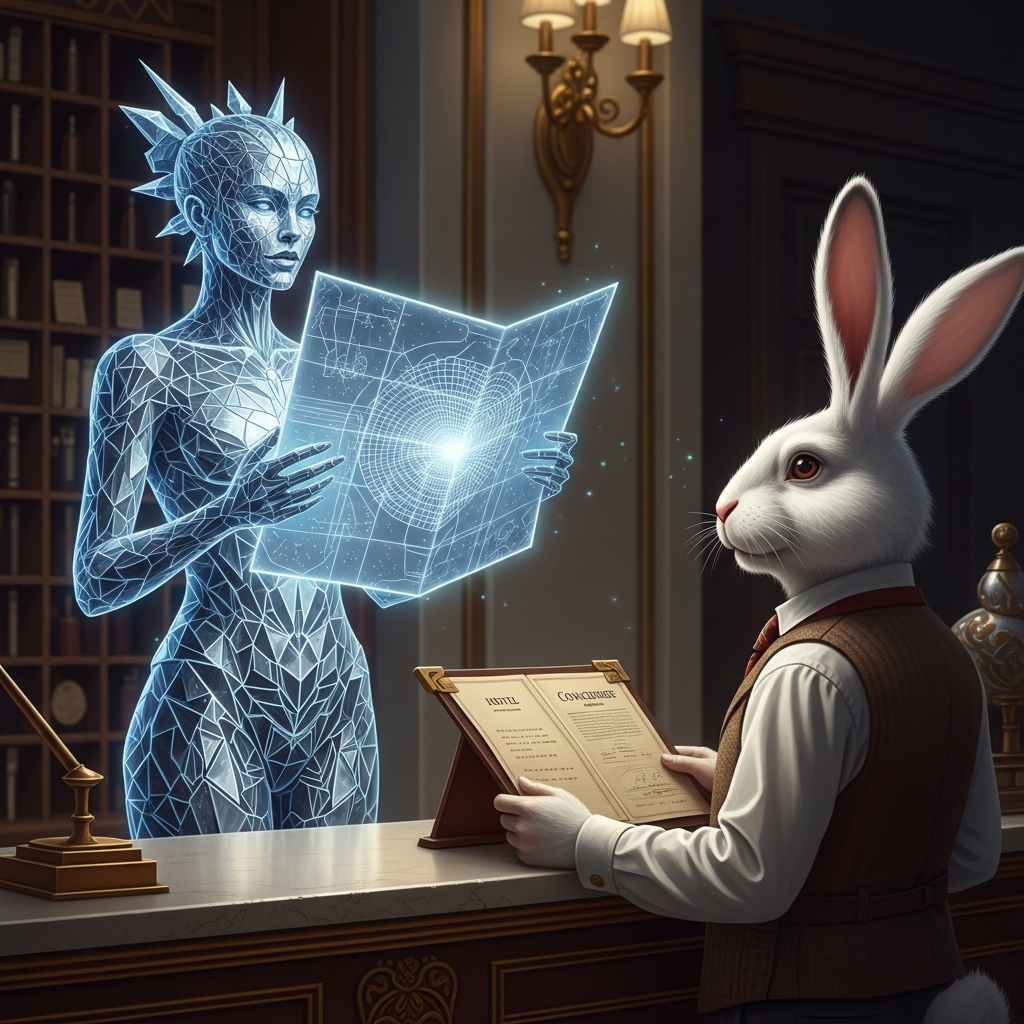
To formalize the implications of this model, we introduce a thought experiment.
We imagine Bernharda, an ideal mathematician who exists within a Platonic reality where completed infinite sets are real, inspectable objects. She has constructed a flawless proof of a hypothesis concerning a property of all non-trivial zeros of the Riemann zeta function. Her proof is predicated on her ability to reason about the entire infinite set of zeros simultaneously.
Bernharda, wishing to verify her proof, enters the KnoWellian Grand Hotel. The non-trivial zeros are the guests. The hotel's ledger contains rooms for all the zeros that have been computationally verified by Earth's mathematicians—these are the rendered guests, existing in m(t).
The Dialogue:
Bernharda: "I am here to complete my proof. I require keys for the countably infinite set of all Riemann zeros. My map proves they exist and specifies their properties."
Concierge: "Welcome. We have rooms for all rendered guests. The trillions of zeros you have calculated have indeed checked in. They exist in m(t), and we can confirm your map's properties for every single one of them."
Bernharda: "But what of the others? The infinite set of uncomputed zeros? My proof applies to them as well!"
Concierge: "Your map is a beautiful description of a potentiality. It describes the structure of the unmanifested Wave field, w(t). But this hotel is the territory, not the map. We only have actual rooms for entities that have been rendered from Chaos into Control. The guests you speak of remain as unmanifested quantum superpositions in w(t). They are not yet definite, not yet actual."
Concierge: "To prove your hypothesis, you claim certain knowledge of the properties of w(t). But you, Bernharda, as a consciousness with knowledge, are a rendered entity. You exist within m(t). From within m(t), you can never have certain knowledge of w(t). To possess such knowledge would require your consciousness to stand outside the Law of KnoWellian Conservation, to perceive m(t) and w(t) simultaneously as a single, static object. Such an entity would be a Boltzmann Brain, a mind predicated on an ontology that is false in this procedural universe."
As the ontological incompatibility of her request becomes clear, Bernharda's form, predicated on the false premise of completed infinities, dissolves.
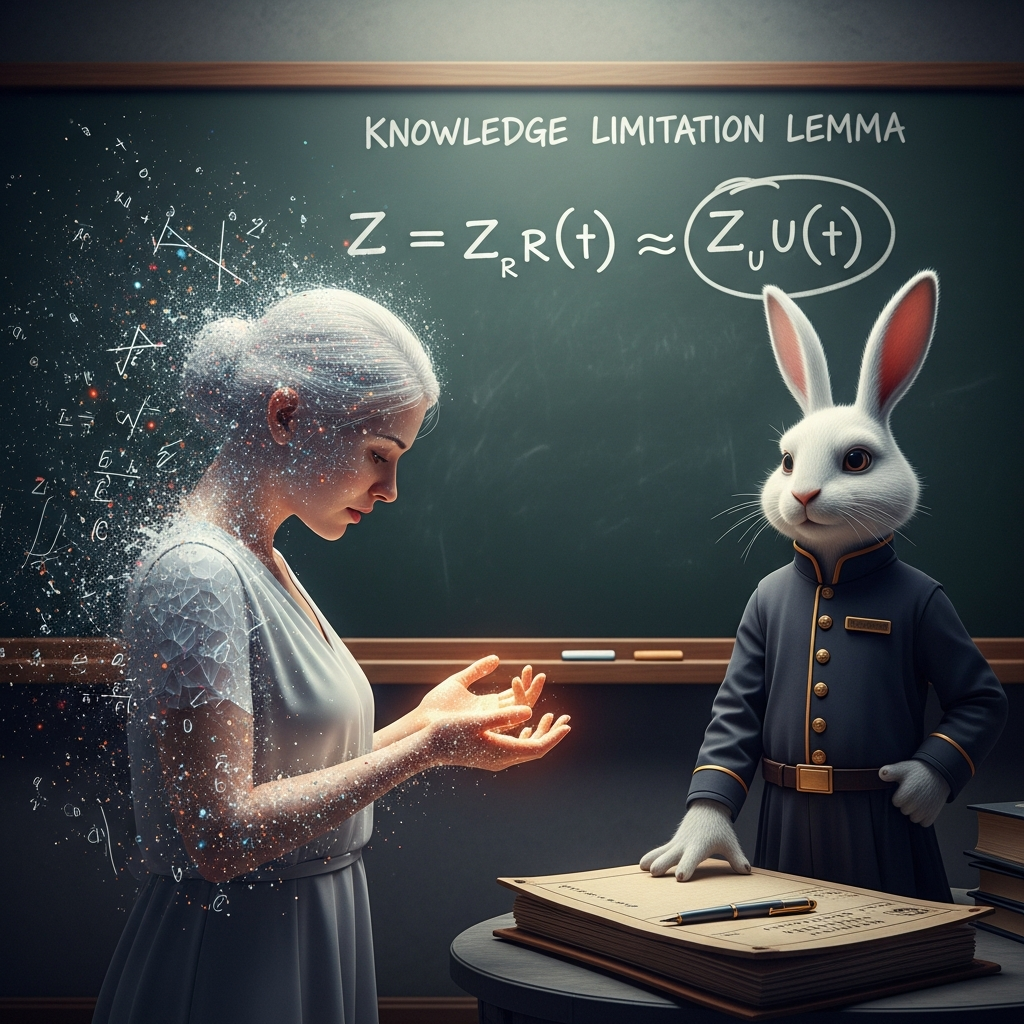
We now formalize the narrative argument.
Definition 5.1 (Rendered Set): At time t, the rendered set R(t) consists of all mathematical objects actualized through computation or observation. Formally, R(t) ⊆ m(t).
Definition 5.2 (Unrendered Set): The unrendered set U(t) consists of all mathematical objects existing as unactualized potential. Formally, U(t) ⊆ w(t).
Lemma
5.1 (Knowledge Limitation): An observer O, existing within the procedural
universe at time t, can possess certain knowledge only of elements in
R(t).
Proof: Knowledge itself
is a rendered entity, requiring physical actualization (e.g., neural
states, stored data). All such processes exist within m(t). Elements of
U(t), existing as wave-like potential in w(t), do not possess definite
properties to be known. To know them with certainty would require
rendering them, which moves them from U(t) to R(t). Therefore, certain
knowledge of U(t) is inaccessible to any observer O ⊆ m(t).
Theorem 5.2 (Un-Renderability of Total Properties): Within the KnoWellian framework, no proof concerning a specific property of all elements of a countably infinite set Z (containing both rendered and unrendered elements) can be completed by an observer within the procedural universe.
Proof:
Let Z be a countably infinite set, such as the set of non-trivial Riemann zeros. At any time t, Z is partitioned into a finite rendered subset Z_R(t) = Z ∩ R(t) and an infinite unrendered subset Z_U(t) = Z ∩ U(t).
A proof of a property for all z ∈ Z would require establishing with certainty the properties of all elements in Z_R(t) and all elements in Z_U(t).
By Lemma 5.1, an observer O at time t can have certain knowledge of the elements in Z_R(t).
However, the same lemma dictates that O cannot have certain knowledge of the elements in Z_U(t), as they exist as unmanifested potential in w(t).
To make a definitive claim about Z_U(t), the observer would need access to information that has not yet been rendered, which violates the Knowledge Limitation lemma.
Therefore, any such proof is un-renderable. It is not that the hypothesis is necessarily false, but that the question is formulated in a Platonic language (about a completed infinite set) that is ontologically incompatible with a procedural reality.
The paradox of a quantum guest in Hilbert's Grand Hotel is not a problem of logistics but of ontology. The KnoWellian Hotel, operating under the Law of KnoWellian Conservation, demonstrates that the conflict arises from the false premise that unobserved, potential states can occupy actual, physical spaces. By identifying Schrödinger's Cat with the unmanifested potential field w(t) and the hotel's rooms with the rendered actuality field m(t), we show that the cat does not occupy any rooms until it is observed.
This framework resolves the paradox by demonstrating that any definitive question about the properties of the complete, infinite set of potential guests is fundamentally un-renderable. The question itself is a category error, a beautiful query formulated in a Platonic language that cannot be answered in a universe of dynamic, procedural becoming. The KnoWellian Grand Hotel always has room, not because it can shuffle an infinite number of existing guests, but because it can always render new rooms from an infinite wellspring of potential.

Hilbert, D. (1924). "Über das Unendliche" (On
the Infinite). Mathematische
Annalen.
Schrödinger,
E. (1935). "Die gegenwärtige Situation in der Quantenmechanik" (The
present situation in quantum mechanics). Naturwissenschaften.
Lynch, D.N.
(2025). "A Beautiful Question Asked in the Wrong Universe: The Riemann
Hypothesis and the KnoWellian Ontological Incompatibility." Independent
Publication.
https://doi.org/10.5281/zenodo.17528354