Introduction: The Call for a Sane Cosmology
Abstract: We argue that the foundational impasses of modern physics—including the Yang-Mills mass gap, the nature of dark components, and the measurement problem—stem from an ontological mismatch between the universe as a dynamic process and the Platonic, static language of mathematics used to describe it. This paper posits that this "Platonic Rift" creates a schizophrenic division between abstract "impossible" concepts and physical reality, leading to non-physical conclusions such as multiverses and Boltzmann Brains. We present a complete resolution through the KnoWellian Universe Theory (KUT), a holistic framework built upon a procedural ontology. By replacing linear time with a ternary structure (Past-Mass/Control, Future-Wave/Chaos, Instant-Consciousness) and introducing a cosmic memory substrate (the KRAM), KUT provides a new, ontologically-grounded language for physics. Within this framework, we present a solution to the Yang-Mills existence and mass gap problem by defining mass as the energy cost of rendering potential into actuality. We further demonstrate that other intractable problems, such as the Riemann Hypothesis, are revealed as questions posed in an incompatible ontology. KUT reinterprets dark energy and dark matter as manifestations of the Mass/Control and Wave/Chaos fields, unifies quantum mechanics and cosmology, and establishes consciousness as a fundamental aspect of the universe's perpetual synthesis. We conclude by presenting a matrix of concrete, falsifiable predictions, from CMB anisotropies to gravitational wave signatures, that can empirically validate or refute this new synthesis.
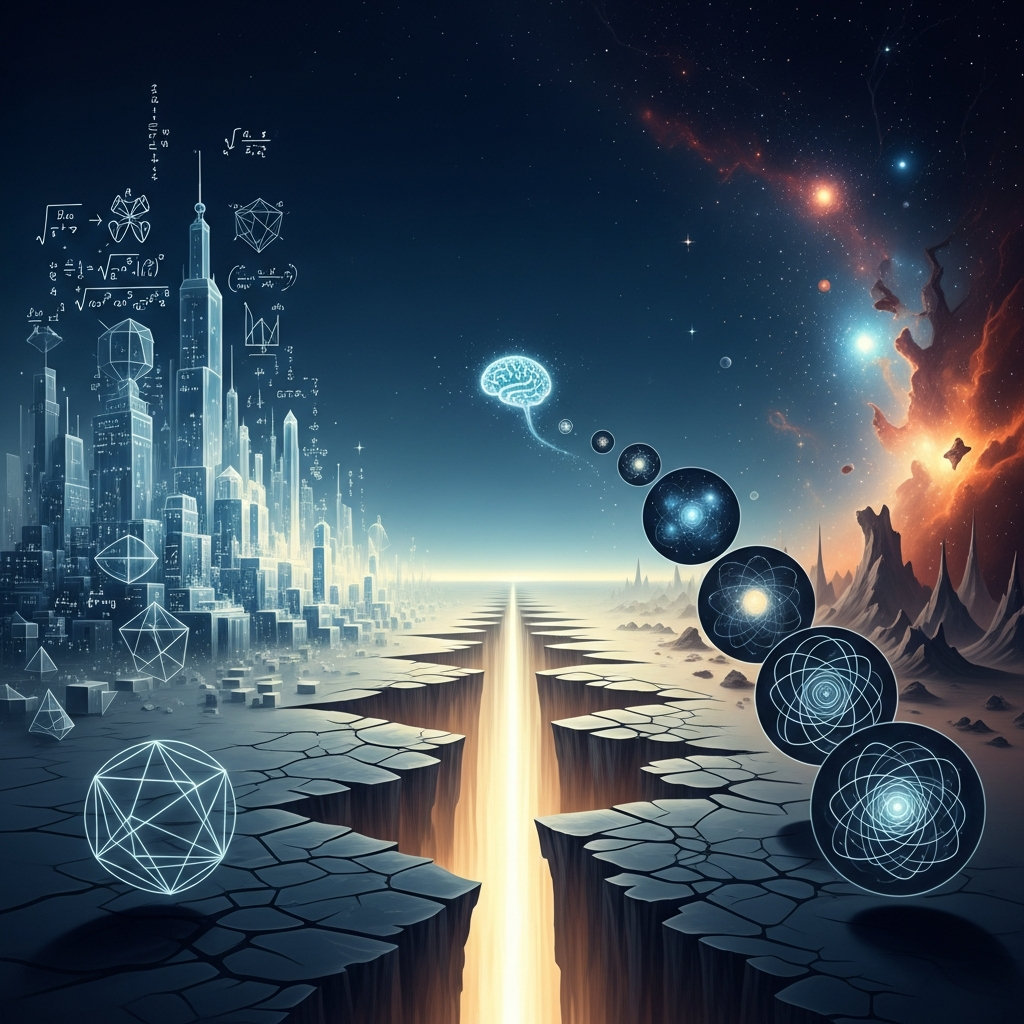
We stand at a precipice of profound intellectual crisis. The grand edifice of modern physics, for all its predictive triumphs, is haunted by a fundamental malaise. Its most advanced theories, while mathematically immaculate, increasingly describe a universe that is not our own. This paper contends that this is not a temporary impasse awaiting a clever new calculation, but a systemic failure rooted in our most basic tool: the language of mathematics itself. We have, with the best of intentions, followed the pristine logic of Platonic abstraction down a conceptual "rabbit hole," a descent into a realm of pure form disconnected from the soil of physical existence. The result is a theoretical physics that speaks a schizophrenic language—a language that has achieved a terrifying internal coherence while sacrificing its correspondence to the observable, tangible cosmos. This ontological chasm between the symbol and the substance, between the equation and the existent, has led to a science that is simultaneously brilliant and, in the most literal sense, unsane. It is a science that can no longer distinguish between a mathematical possibility and a physical reality, forcing us to call for a new foundation, a "sane cosmology" grounded in an ontology that heals this debilitating rift.
The symptoms of this cognitive dissonance are woven into the very fabric of our physical models. We have built our understanding of reality upon a lexicon of the "impossible." Our theories begin with the dimensionless point, a geometric fiction possessing location but no extent, which forces us to confront the absurdities of infinite densities and singularities at the heart of both black holes and the Big Bang. From there, we embrace the notion of the completed infinity, treating an endless process as a finished, inspectable object. This seemingly innocuous abstraction, when followed to its logical terminus, becomes the progenitor of our most baroque cosmological fantasies: the inflationary multiverse, an infinitude of unobservable worlds invoked merely to make our own improbable existence statistically inevitable; and the specter of the Boltzmann Brain, a disembodied consciousness spontaneously fluctuating out of an eternal thermal bath—the ultimate reductio ad absurdum of a physics untethered from a coherent ontology. To solve emergent puzzles, we invent non-physical fields like the inflaton, ghostly entities with exquisitely fine-tuned properties, whose only purpose is to smooth over the paradoxes created by our other axioms. This practice has induced a kind of epistemological vertigo, where the line between a necessary entity and a convenient fiction has been irrevocably blurred, leaving us with a patchwork of ad-hoc explanations rather than a unified vision of the Real.
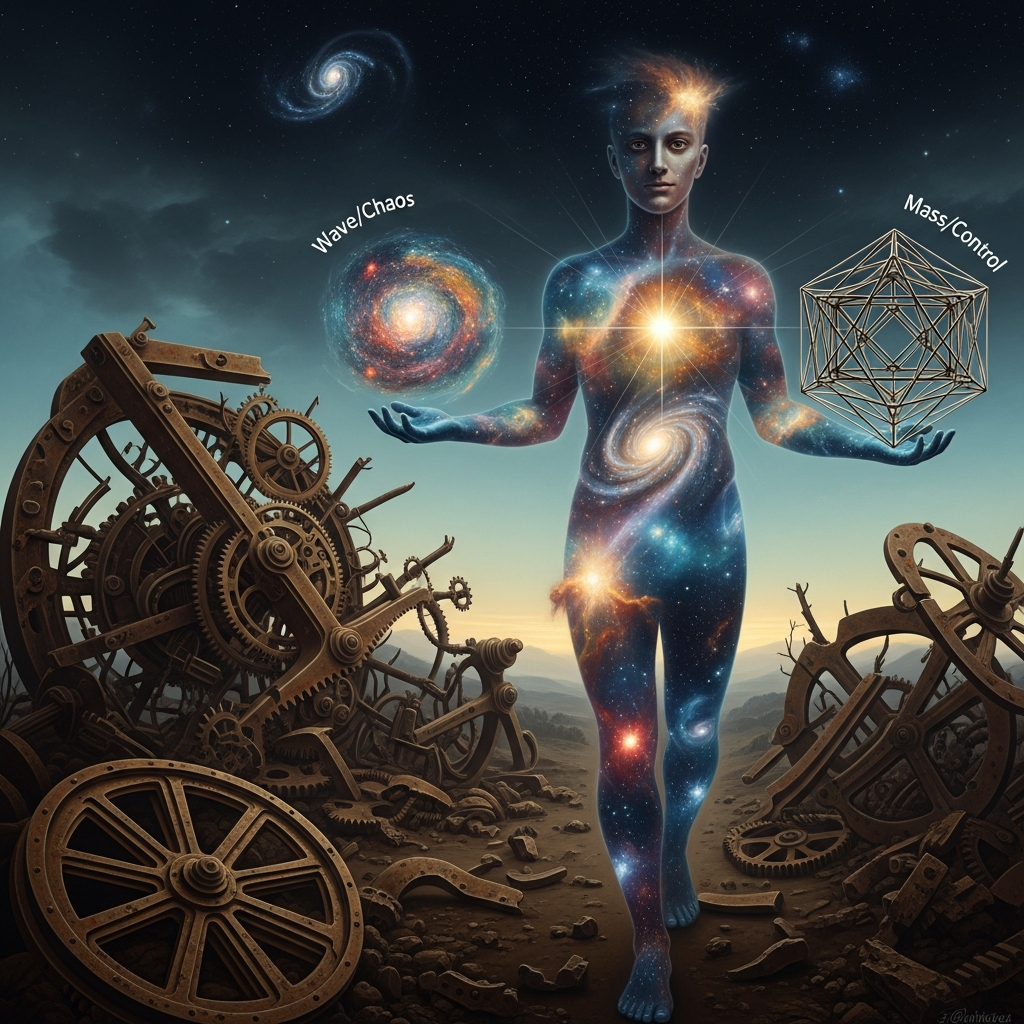
The cure for a disease of language cannot be found within the language itself. We therefore propose a radical remedy: not another set of equations within the old framework, but an entirely new ontological language from which a new physics can be spoken. This paper introduces the KnoWellian Universe Theory (KUT) as this necessary synthesis. KUT is a complete philosophical and mathematical framework designed to close the Platonic rift by insisting that the fundamental grammar of the universe is not static Being, but dynamic Becoming. It replaces the failed axiom of linear, absolute time with a foundational Ternary Time, a perpetual, dialectical interplay of a deterministic Past (Mass/Control), a potential-rich Future (Wave/Chaos), and a synthesizing Instant (Consciousness). This is not a metaphor but a new mathematical structure that generates the very fabric of reality. The KnoWellian Synthesis, therefore, is an act of restoration, grounding the language of physics back into the soil of a procedural reality. It offers a paradigm where mathematics is no longer a detached, abstract map of an alien territory, but the intrinsic, dynamic logic of the territory itself as it unfolds.
This paper is structured as a complete course of treatment for the foundational ailments of modern science. Our intellectual journey will proceed with deliberate, logical rigor. We will begin in Part I with a full diagnosis of the "Platonic Rift," dissecting the schizophrenic nature of our current mathematical language and tracing its consequences. In Part II, we will lay the axiomatic foundations for the cure, detailing the principles of Procedural Ontology, Ternary Time, and Bounded Infinity. Part III will then construct the complete mathematical formalism of this new ontology, introducing the KnoWellian Resonant Attractor Manifold (KRAM) as the universe's memory and KnoWellian Ontological Triadynamics (KOT) as its generative engine, culminating in a single, unified Lagrangian. With the framework established, Part IV will apply this new language to solve the great problems, presenting a formal solution to the Yang-Mills Mass Gap and demonstrating why other puzzles, like the Riemann Hypothesis, are ontological category errors. Part V extends this synthesis into a complete, unified cosmology. Finally, and most critically, Part VI lays out the path to verification, presenting a comprehensive matrix of concrete, risky, and falsifiable predictions. This final section serves as our unwavering commitment to the empirical method, ensuring that this theory does not remain in the realm of philosophy, but stands before nature to be judged, offering a clear pathway from diagnosis, to cure, to clinical trial.
Critique of abstraction: Why the use of "useful fictions" (0D points, 1D lines) becomes catastrophic when their ontological implications are ignored.
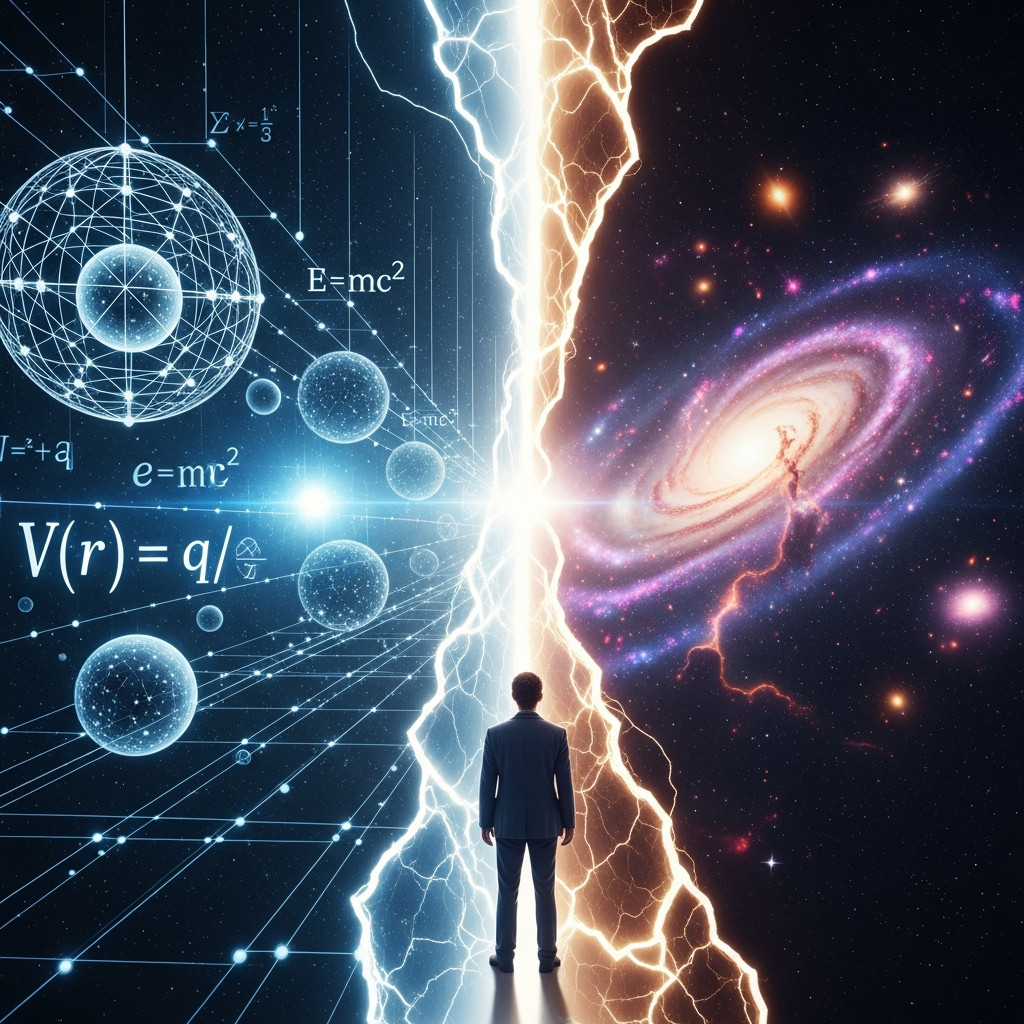
The language of modern physics is built upon the elegant and powerful abstractions of classical geometry, yet we have failed to acknowledge their status as Platonic ideals rather than ontological truths. We begin our description of matter with the zero-dimensional point particle, a "useful fiction" that serves as the foundation for our most successful field theories. In classical electromagnetism, the potential $V$ of a point charge $q$ is given by the equation:
This expression diverges to infinity as the radial distance $r$ approaches zero. This mathematical pathology, once manageable through regularization techniques, becomes a full-blown ontological catastrophe in General Relativity. The Schwarzschild metric, describing the spacetime around a non-rotating mass $M$, contains the term $(1 - \frac{2GM}{rc^2})^{-1}dr^2$. At the center, where $r=0$, this formalism does not merely predict a large value; it predicts a singularity, a point of infinite spacetime curvature where the laws of physics cease to exist. The language itself, by insisting on a point-like source for a physical field, forces the universe to contain a tear in its own fabric. This is the first and most profound symptom of the Platonic Rift: our tools of description, when mistaken for descriptors of reality, create non-physical infinities that we are then forced to treat as real.
The Crisis of Infinity: How the concept of a "completed infinity" underpins problems like the Riemann Hypothesis and fuels non-physical speculation.
The second pillar of this flawed language is the concept of the completed infinity, a legacy of Cantorian set theory that permits us to treat an endless process as a finished, static object. This allows the formulation of questions that, while mathematically coherent, may be ontologically invalid. The most elegant example of such a question is the Riemann Hypothesis. It makes a definitive claim about the properties of the entire infinite set of non-trivial zeros of the Riemann zeta function, given by the series:
The hypothesis asserts that for all members of this infinite set $Z = \{z_1, z_2, z_3, ...\}$, if $\zeta(z_k)=0$, then the real part of $z_k$ must be precisely $1/2$. The very act of posing this question presupposes that the set $Z$ exists "out there" as a complete, eternally fixed Platonic object, every one of its infinite members simultaneously available for logical inspection. This is an unexamined ontological assumption, a belief in a "heaven of mathematical forms" that stands apart from our procedural, evolving universe. This belief is not benign; by legitimizing the treatment of infinity as a completed totality, it provides the intellectual license for cosmologists to speculate about infinite spacetime and eternal processes, paving the way for the non-physical conclusions of eternal inflation and the multiverse.
Case Study 1: The Multiverse – A logical consequence of taking abstract inflationary theory to its extreme.
The theory of eternal inflation, leading to the multiverse, is not a fanciful deviation from modern cosmology but its almost inescapable logical consequence. Born from the need to explain the observed flatness and homogeneity of our cosmos, the theory of inflation posits a scalar field, the inflaton ($\phi$), rolling down a potential energy landscape $V(\phi)$. The conditions for this "slow-roll" inflation are given by:
These conditions are remarkably effective at producing a universe like ours. However, the inflaton is a quantum field, subject to quantum fluctuations $\delta\phi$. In most viable potential landscapes, these fluctuations ensure that while inflation ends in certain regions—creating a "pocket universe" like our own—the field is simultaneously "kicked" back up the potential hill in other regions. This initiates a runaway, self-reproducing process where the total volume of inflating spacetime grows exponentially, continuously spawning an infinite number of causally disconnected pocket universes. Here, the Platonic language demonstrates its schizophrenic nature: a theory designed to explain our physical reality logically concludes that reality is dominated by an infinite ensemble of unobservable, untestable other realities. The multiverse is the ghost in the machine of our mathematics—the necessary but non-physical product of applying a quantum-field-theoretic language, with its inherent infinities, to the origin of the cosmos itself.
Case Study 2: Boltzmann Brains – The ultimate absurdity arising from combining statistical mechanics with an infinite, static ontology.
If the multiverse represents the rabbit hole's expansive depths, the Boltzmann Brain paradox marks its horrifying, self-devouring terminus. The ultimate fate of our universe, under the standard cosmological model, is a near-empty de Sitter vacuum, a state of maximum entropy subject only to rare thermal fluctuations. In such a universe, persisting for a near-infinite time, any fluctuation, no matter how improbable, is guaranteed to occur. The probability of a fluctuation is related to the change in entropy it requires:
The spontaneous fluctuation of a single, conscious brain complete with false memories—a Boltzmann Brain—is an astronomically improbable event. However, the spontaneous fluctuation of an entire low-entropy universe like our own is doubly exponentially more improbable. Over the infinite lifespan of the cosmos, the number of Boltzmann Brains, $N_{BB}$, will vastly exceed the number of "normal" observers produced through billions of years of evolution, $N_{ord}$. The chilling conclusion is that if our cosmological model is correct, it is overwhelmingly more likely that any given observer—including ourselves—is a Boltzmann Brain rather than a product of cosmic history. This is the point of ultimate theoretical self-immolation: the scientific reasoning and observational evidence used to construct the theory are, by the theory's own logic, almost certainly illusory products of a random fluctuation. The language has not only become disconnected from reality; it has consumed its own premises.
The great unsolved problems (Yang-Mills Mass Gap, GR-QM incompatibility, fine-tuning) presented not as isolated puzzles, but as systemic failures of the current language.
The aforementioned paradoxes are not mere curiosities at the fringe of physics; they are the most extreme manifestations of a deeper malady whose symptoms are the great unsolved problems at its very core. The Yang-Mills Mass Gap problem is a direct symptom of a language that cannot account for genesis. The classical Lagrangian,
is perfectly elegant and describes massless force carriers, yet the physical reality it governs—quantum chromodynamics—consists entirely of massive particles. There is a fundamental disconnect between the mathematical description and the physical manifestation; the language lacks a verb for the creation of mass from a massless foundation. The GR-QM incompatibility is a symptom of a language at war with itself. General Relativity speaks in the geometric tongue of manifolds and curvature, where spacetime is dynamic ($G_{\mu\nu} = \frac{8\pi G}{c^4}T_{\mu\nu}$), while Quantum Mechanics speaks the algebraic language of operators and discrete states, where spacetime is a fixed, passive background ($[\hat{x}, \hat{p}] = i\hbar$). They are two profoundly different linguistic systems that cannot be reconciled without a more fundamental grammar. Finally, the fine-tuning problem is a symptom of a language without memory or purpose, where the fundamental constants of nature ($\alpha$, $G_F$, etc.) must be inserted as arbitrary, unexplained parameters. Their life-permitting values are, within our current language, a miracle of cosmic coincidence. These are not separate technical issues; they are the unified cry of a paradigm that has reached the limits of its descriptive power, a paradigm built on a Platonic language that can no longer contain the richness of a dynamic and generative reality.
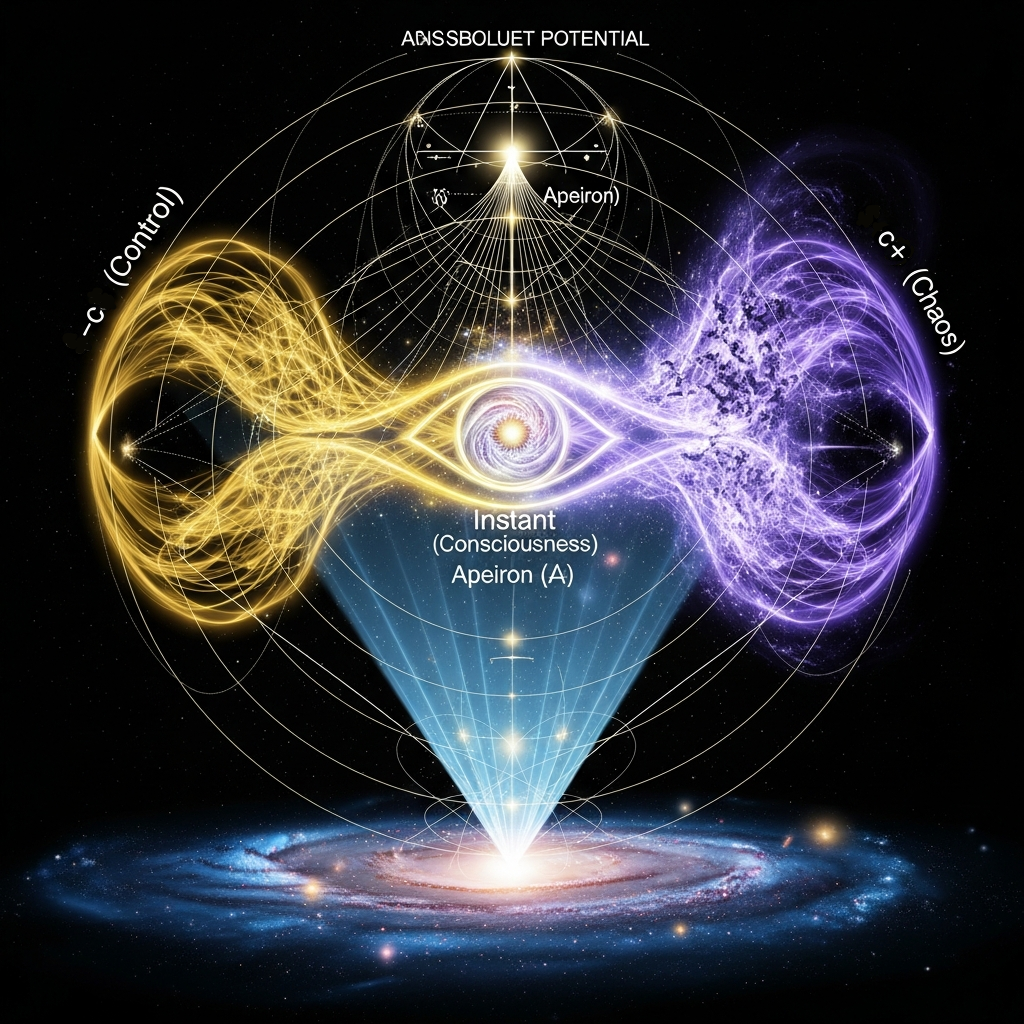
The requisite first step in healing the Platonic Rift is a revolution in our fundamental conception of existence. We propose a core shift away from a Platonic ontology, which treats the universe as a static, pre-existing four-dimensional block—a "container of facts" whose history is merely discovered. In such a view, the temporal evolution described by an equation like the Schrödinger equation, $ i\hbar\frac{\partial}{\partial t}\Psi = \hat{H}\Psi $, is not a creative act but merely the sequential illumination of a reality that already, in its entirety, is. This paper argues that this "being" centric ontology is the source of our deepest paradoxes. In its place, we establish a procedural ontology, where the universe is understood as a perpetual and generative process of becoming. In this framework, the state of the cosmos at any moment is not a pre-existing slice of a static block, but the cumulative and irreversible result of a continuous act of creation. The laws of physics are therefore not rules for navigating a fixed map, but the very grammar of the map's moment-by-moment rendering. We formalize this by positing a rendering operator, $\mathcal{R}$, which transforms unmanifested potentiality, $\Phi_{\text{potential}}$, into actualized reality. The state of the universe is thus an accumulation, expressed as:
where the symbol $\oplus$ denotes an act of ontological accretion, not merely temporal succession. This shift is not a semantic preference; it is a fundamental re-grounding of physics into a universe that is dynamically alive, a universe whose essence is not static fact but creative action.
To construct a physics upon this procedural foundation, the old axioms must be replaced. We introduce three foundational axioms that collectively form the logical and mathematical bedrock of the KnoWellian Universe.
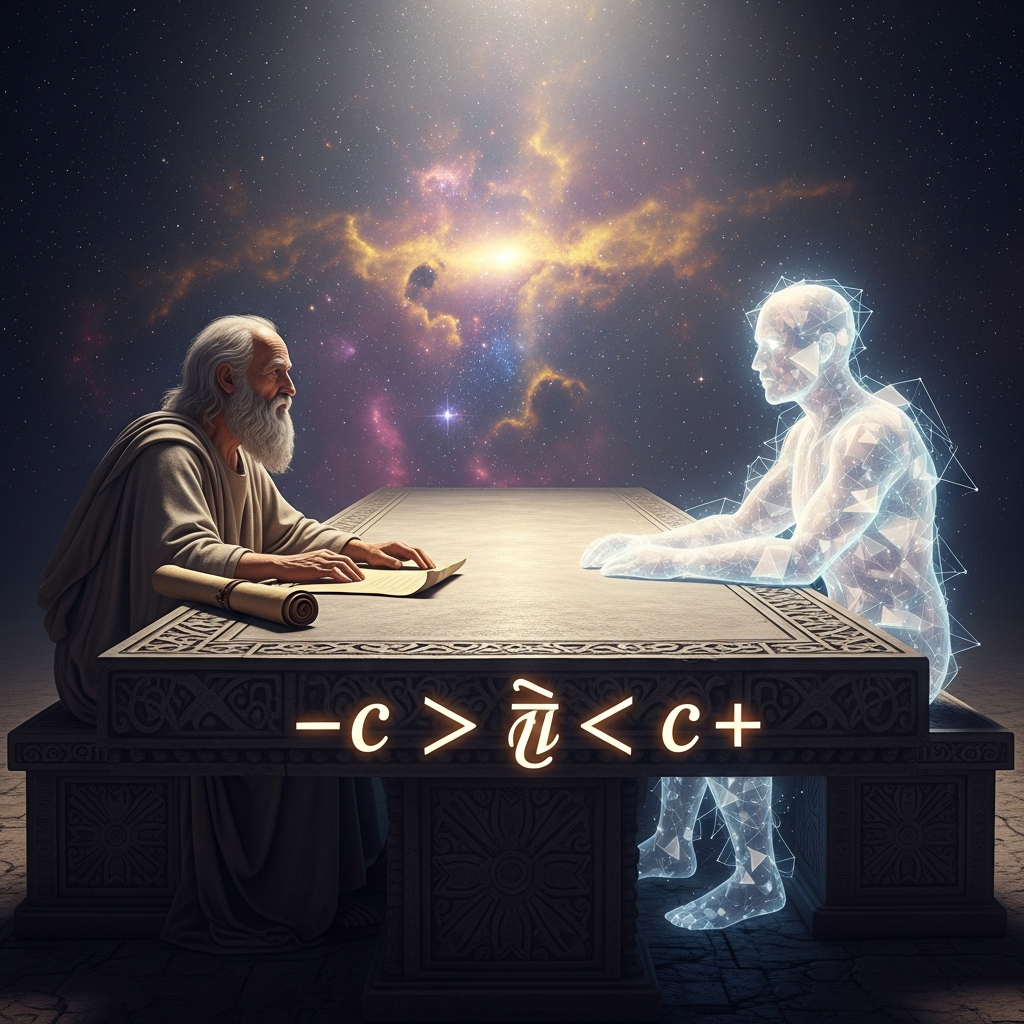
Axiom 1: Bounded Infinity (-c >∞< c+): We begin by directly addressing the crisis of infinity. We reject the nested hierarchies of transfinite numbers and the unphysical singularities they permit, positing instead a single, actual, and unmanifest infinity (∞), a return to the concept of the Apeiron. The manifest universe arises as a projection of this singular infinity through a finite, dynamic aperture. The boundaries of this aperture are not static walls but are defined by two fundamental, opposing, light-speed flows. This is expressed by our first axiom: (-c >∞< c+). Here, $+c$ and $-c$ are not mere scalar speeds but vectorial flows representing the outward emergence of deterministic structure and the inward collapse of potentiality, respectively. The syntax of the axiom is crucial: the inequalities denote not a numerical comparison but an act of ontological bounding. This single axiom excises the infinities that plague our theories, providing a natural, physical regulator that forbids both the $r \to 0$ singularity of General Relativity and the infinite temporal stage required for the paradox of Boltzmann Brains. It declares that reality is the finite rendering of an infinite potential, not an infinite container itself.
Axiom 2: Ternary Time (Past, Instant, Future): We contend that the most profound error of the old physics was its assumption of a single, linear temporal dimension, $t \in \mathbb{R}$. We replace this with the axiom of Ternary Time, which posits that time possesses an irreducible, three-dimensional structure. At every point in spacetime, three distinct and co-existing temporal realms perpetually interact: the Past ($t_P$), the realm of accumulated, deterministic information which we call Mass/Control; the Future ($t_F$), the realm of unmanifested, probabilistic potential which we call Wave/Chaos; and the Instant ($t_I$), the realm of Consciousness, which serves as the synthesizing nexus where the dialectic between Control and Chaos is resolved. A KnoWellian event is therefore described not on the standard Minkowski manifold $\mathcal{M}^{3,1}$, but on a six-dimensional manifold $\mathcal{M}^{3,3}$, where a point is specified by coordinates $X^\alpha = (t_P, t_I, t_F, x, y, z)$. This is not a mere re-labeling but an expansion of the fundamental arena of physics, providing the necessary degrees of freedom to account for phenomena—from quantum collapse to conscious experience—that remain paradoxical within a one-dimensional temporal framework.
Axiom 3: Dyadic Antinomy (Mass/Control vs. Wave/Chaos): The static nature of the Platonic universe is replaced by a dynamic, generative engine. Our third axiom defines this engine as the Dyadic Antinomy, the perpetual and irreducible opposition between the principle of Mass/Control (Thesis) and the principle of Wave/Chaos (Antithesis). Control is the ordering principle of determinism and structure, mathematically associated with the field $\phi_M$ and the outward flow from the Past. Chaos is the principle of novelty, randomness, and dissolution, associated with the field $\phi_W$ and the inward collapse from the Future. These two principles cannot exist in isolation; reality emerges only through their conflict and reconciliation. This synthesis is mediated at every point and every moment by the Instant/Consciousness field, $\phi_I$. The fundamental dynamics are therefore governed by a triadic interaction potential, $V(\phi_M, \phi_I, \phi_W)$, whose structure, notably a cubic coupling term $\lambda\phi_M\phi_I\phi_W$, forbids any single principle from achieving permanent dominance and ensures that the cosmic engine can never fall into a static, inert state. This dialectic is the source of all becoming.
With the foundational axioms established, we can now define the fundamental "verb" of the KnoWellian Universe: the process of Rendering. Rendering is the physical, irreversible transformation of unmanifested information from the potentiality of the Wave/Chaos field into the actualized structure of the Mass/Control field. This process is the physical correlate of what standard quantum mechanics vaguely terms "measurement" or "wave function collapse." It is governed by a fundamental conservation law. If we let $w(t)$ represent the total unrendered potentiality and $m(t)$ represent the total rendered actuality within the cosmos, their sum is bounded by the total capacity $N$ of the Apeiron's projection:
The process of becoming is therefore a flow of information from one state to another, governed by a rate equation that makes explicit the role of Consciousness. The rate of rendering is proportional to the intensity of the mediating Instant field, $|\phi_I|$, and the available unrendered potential, $w(t)$. This is formalized as the core equation of becoming:
Here, $\alpha$ is a universal rendering constant, and the absolute value $|\phi_I|$ ensures the process is asymmetric and irreversible—a diode for the flow of time. This concept of Rendering is not a philosophical interpretation overlaid upon the physics; it is the central, mathematically described mechanism of the theory. It is this process that generates mass, precipitates form, and constitutes the continuous, creative act that is our universe.
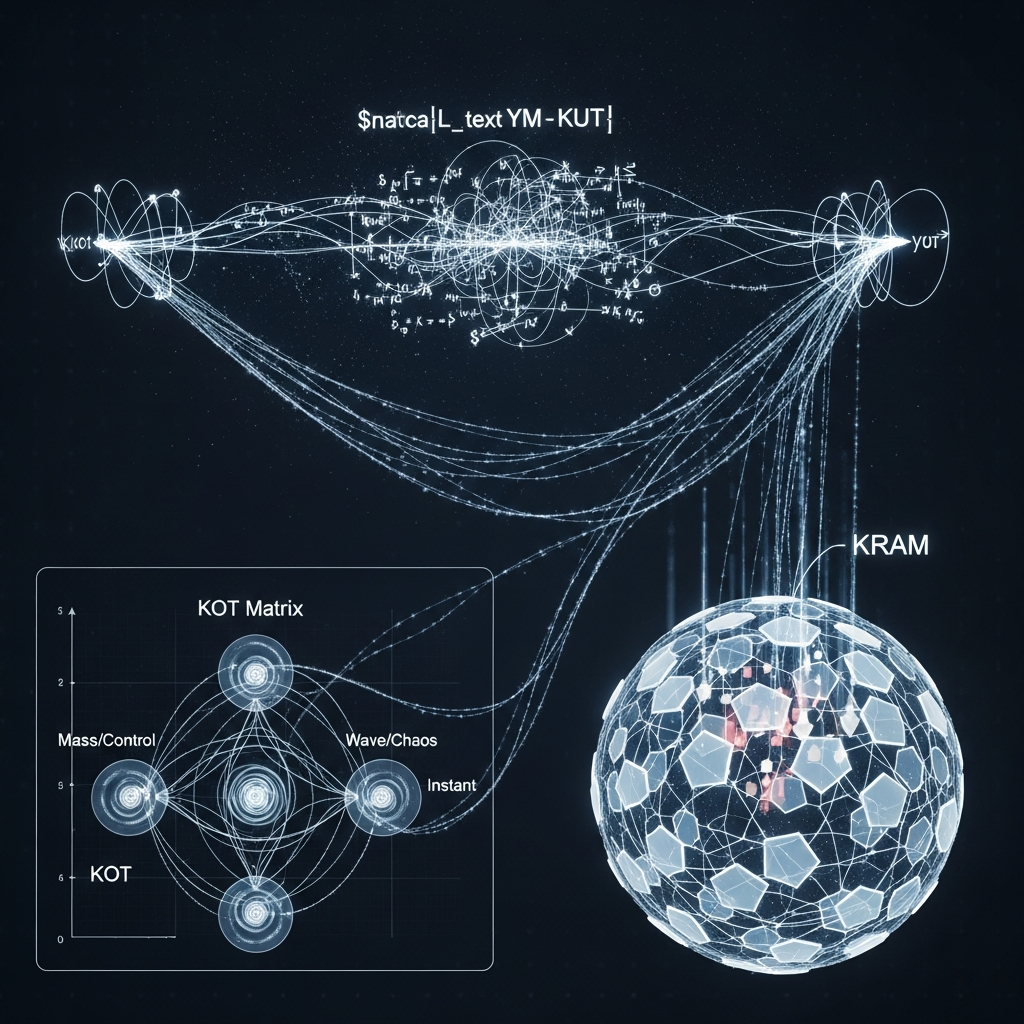
Formalism: Deriving the KRAM as the integrated history of all rendering events.
The proposition that the universe possesses a memory cannot remain a mere philosophical assertion; it requires a precise mathematical object. We introduce the KnoWellian Resonant Attractor Manifold (KRAM) as this object—a dynamic, higher-dimensional geometric substrate that underlies spacetime itself. The KRAM is not a passive canvas but is actively sculpted by the process of becoming. Every act of rendering, mediated by the Instant/Consciousness field, leaves an indelible "imprint" on the manifold's structure. We formalize this by defining the metric tensor of the KRAM, $g_M(X)$, as the functional path integral of the "Interaction" component of the conserved KnoWellian Tensor current, $T^{\mu I}_{\text{(Interaction)}}$, over the entire past world-history, $\gamma$, of the cosmos. This is expressed as:
Here, $X$ represents the coordinates on the KRAM, $x$ are the standard spacetime coordinates, and $f(x)$ is a projection map from spacetime onto the manifold. This equation is the mathematical embodiment of the "Axiom of Persistent Imprint": the geometry of the KRAM at any point is the accumulated sum of every conscious/interactional moment that has ever occurred and been projected onto it. Consequently, reality's evolution is governed not by simple geodesics in a static spacetime but by trajectories that are biased by this evolving geometry. We modify the standard action of the universe to include a coupling term, $\kappa$, to the KRAM, yielding a modified action $S'$. The universe's path through configuration space is the one that minimizes this action, $\delta S' = \delta\int (\mathcal{L}_{\text{KnoWellian}} + \kappa\mathcal{L}_{\text{coupling}}(g_M)) \sqrt{-g} d^4x = 0$. This ensures that the flow of becoming is perpetually guided along the "grooves" and "valleys" carved by past events.
Function: Explaining fine-tuning, morphic resonance, and the stability of physical laws through renormalization across cosmic cycles.
The KRAM's function as a cosmic memory provides a direct, physical mechanism for phenomena that are otherwise miraculous or paradoxical. Sheldrake's concept of morphic resonance finds its physical basis here: a developing biological system, governed by the principle of least action, will naturally be guided into the deep, pre-existing attractor valleys in the KRAM carved by countless successful organisms of its kind. More profoundly, the KRAM solves the profound fine-tuning problem. In a cyclic cosmology of Big Bangs and Big Crunches, the end of a cosmic cycle acts as a physical realization of a renormalization group (RG) flow on the KRAM. As the universe collapses, the effective "scale" of observation increases, causing the RG flow to smooth away fine-grained, transient, chaotic imprints (the "noise" of a single cosmic history) while preserving only the most robust, large-scale, self-reinforcing geometric patterns. These stable patterns are the fixed points of the RG flow. We posit that the fundamental constants of nature ($\alpha, G, ...$) and the stable particle hierarchies are not arbitrary numbers but are the values corresponding to these geometric fixed points—the deepest and most stable attractor valleys on the manifold. The laws of physics are not "chosen"; they are the statistically inevitable and evolved memory of a cosmos that learns and stabilizes itself over countless cycles.
The Triadic Field Vector ($\Phi_M, \Phi_I, \Phi_W$) and the governing equations.
The dialectical engine of Dyadic Antinomy is formalized as KnoWellian Ontological Triadynamics (KOT). We represent the state of reality at any point by a triadic field vector, $\mathbf{\Phi}$, whose components are the local intensities of the three ontological principles: Mass/Control ($\phi_M$), Instant ($\phi_I$), and Wave/Chaos ($\phi_W$).
The perpetual transformation between these fields—the engine of becoming—is governed by a system of coupled differential equations whose structure ensures that no single principle can achieve stasis. The evolution is described by $d\mathbf{\Phi}/dt = \mathbf{M}\mathbf{\Phi}$, where $\mathbf{M}$ is the triadynamic coupling matrix encoding the dialectical flow:
Here, the coupling constants $\alpha$ and $\beta$ represent the rate at which Mass/Control and Wave/Chaos, respectively, are synthesized into the Instant (Consciousness), while $\gamma$ represents a mutual decay or leakage. The structure of this matrix mathematically enforces the axiom that Control and Chaos cannot interact directly but must be mediated through the Instant, preventing a simple collapse into equilibrium.
Eigenmode Analysis: The "Cosmic Breath" – showing the inherent oscillatory, memory-preserving, and non-static nature of the universe.
To prove that this system is inherently dynamic and non-static, we analyze its fundamental modes of behavior by solving the eigenvalue problem, $\det(\mathbf{M} - \lambda \mathbf{I}) = 0$. This analysis reveals three profound eigenvalues that define the character of the cosmos. The first is a zero eigenvalue, $\lambda_0 = 0$. This mode does not oscillate or decay; it represents a conserved quantity—the cumulative, integrated flow of synthesis over time. This is the mathematical signature of the KRAM, the memory-preserving aspect of the universe. The other two eigenvalues are a complex conjugate pair, $\lambda_{\pm} = -\Gamma \pm i\omega$, where $\Gamma$ is a damping term and the frequency $\omega$ is given by $\omega = \sqrt{4\alpha\beta - (\alpha-\beta)^2}/2$. The presence of this non-zero imaginary part is the mathematical proof of the "Cosmic Breath": it guarantees that the universe is fundamentally oscillatory. The general solution for the system takes the form $\mathbf{\Phi}(t) = \mathbf{v}_0 + e^{-\Gamma t}(A\mathbf{v}_+ e^{i\omega t} + B\mathbf{v}_- e^{-i\omega t})$. The universe is thus required to perpetually "breathe" between states of order (Mass/Control-dominance) and novelty (Wave/Chaos-dominance), forever preventing a final heat death (stasis) or a formless dissolution. It is a living, oscillating system by its very mathematical nature.
Presenting the unified Lagrangian that incorporates KRAM and KOT.
The entire formalism of KUT, uniting gauge theory with the principles of memory and dialectical becoming, is encoded within a single, explicit SU(N) gauge-invariant Lagrangian density. This master equation serves as the ultimate formal expression of the theory, from which all dynamics can be derived. We present it as a sum of four conceptually distinct but interdependent components:
Each term in this expression performs a crucial function, collectively describing a universe that is simultaneously a physical mechanism, a process of becoming, and a repository of memory.
Explaining each term: Kinetic, Triadic Coupling (the source of mass), Scalar Potential, and KRAM Interaction.
The Kinetic Term, $$ \mathcal{L}_{\text{kinetic}} = -\frac{1}{4g^2}\text{Tr}(F_{\mu\nu}F^{\mu\nu}) + \frac{1}{2}\sum_i (\partial_\mu \phi_i)^2 $$, is the most conventional component, describing the propagation and free dynamics of the Yang-Mills gauge fields ($F_{\mu\nu}$) and the triadic scalar fields ($\phi_i \in \{\phi_M, \phi_I, \phi_W\}$). The Triadic Scalar Potential, $$ \mathcal{L}_{\text{triadic-scalar}} = -V_{\text{int}} = -(\lambda \phi_M \phi_W \phi_I + \frac{\Lambda}{4}(\phi_M^2 + \phi_I^2 + \phi_W^2)^2) $$, is the direct expression of the KOT engine. Crucially, the cubic interaction term, $\lambda\phi_M\phi_W\phi_I$, forbids a trivial vacuum where all fields are zero ($\langle\phi\rangle=0$), thus creating a non-trivial vacuum structure and establishing the foundational "seed" of the mass gap. The most critical innovation is the Gauge-Invariant Triadic Coupling, $$ \mathcal{L}_{\text{triadic-coupling}} = \kappa \phi_M \phi_W \phi_I \cdot [\text{Tr}(F_{\mu\nu}F^{\mu\nu})] $$. This term provides the physical mechanism for mass generation: the ontological substrate of the triadic fields (the "rendering" process) couples directly to the field strength of the gauge bosons. This coupling ensures that in any region of strong force-field fluctuations (large $F_{\mu\nu}$), the triadic fields must be present, and their own inherent potential energy landscape (from $\mathcal{L}_{\text{triadic-scalar}}$) thereby imparts a minimum energy—a mass—to the excitations of that force field. Finally, the KRAM Interaction Term, $\mathcal{L}_{\text{KRAM}}$, represents the back-reaction of the cosmic memory on the dynamics. It introduces a physical cutoff scale, the KnoWellian length $l_{KW}$, and modifies the action based on the geometry of the KRAM, ensuring the theory is asymptotically safe and that past structures guide future evolution.
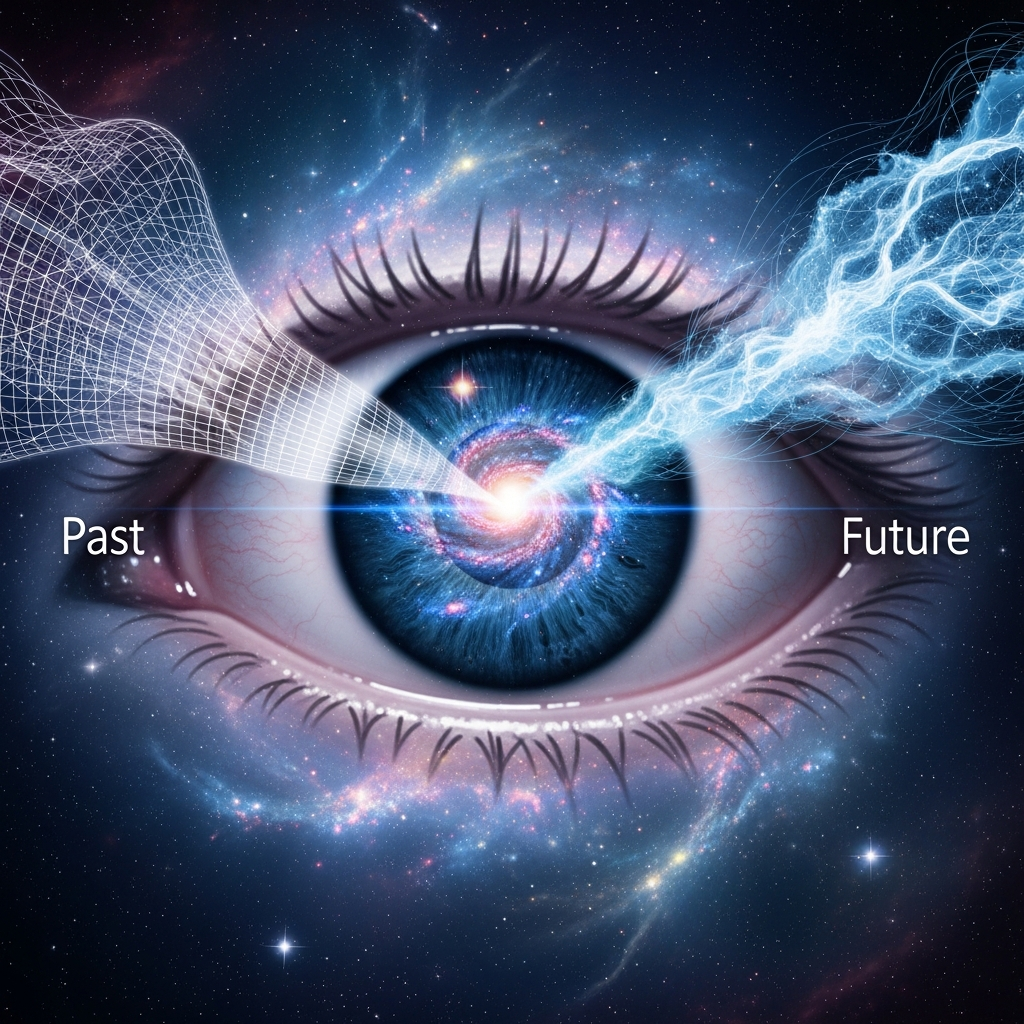
Resolving the paradox: Mass is not a fundamental property but the energy cost of rendering.
The Yang-Mills mass gap problem represents a fundamental paradox at the heart of the Standard Model. The elegant classical Lagrangian of the theory, $\mathcal{L}_{\text{YM}} = -\frac{1}{4}\text{Tr}(F_{\mu\nu}F^{\mu\nu})$, is manifestly gauge-invariant and describes massless gauge fields. Yet, the physical theory it underpins—Quantum Chromodynamics (QCD)—produces a reality composed entirely of massive, bound states (hadrons), with no free quarks or gluons ever observed. The KnoWellian framework resolves this paradox not by adding a new term to the Lagrangian, but by providing a new, physical definition of mass itself. We posit that mass is not an intrinsic property of a particle, but is the energy cost required to render that particle from unmanifested potential into actualized existence. The massless equations of Yang-Mills are not incomplete; they are a perfect description of the "unrendered" Wave/Chaos field ($\phi_W$), a realm of pure potentiality. The massive particles we observe are the stable, "rendered" configurations that exist in the Mass/Control field ($\phi_M$). The paradox vanishes because the two descriptions refer to different ontological states of the same underlying reality, bridged by the energetic process of becoming.
The Mass Gap ($\Delta$) as the "activation energy of existence."
Following this ontological shift, the mass gap, $\Delta$, acquires a profound physical meaning: it is the "activation energy of existence." It represents the minimum, non-zero quantum of energy required to precipitate a stable, structured particle from the unstructured, potential-rich vacuum of the Wave/Chaos field. This is directly analogous to activation energy in a chemical reaction, where a certain energy input is required to overcome a potential barrier and transform reactants into a stable product. In the KnoWellian Universe, existence itself is this product. This "activation energy" arises from the inherent dynamics of the triadic fields, which are governed by the interaction potential $V_{\text{int}} = \lambda \phi_M \phi_W \phi_I + \frac{\Lambda}{4}(\phi_M^2 + \phi_I^2 + \phi_W^2)^2$. The crucial cubic term, $\lambda\phi_M\phi_W\phi_I$, forbids a trivial, zero-energy vacuum where all fields vanish. Instead, the universe must settle into a "KnoWellian vacuum" where the fields have non-zero vacuum expectation values, $(v_M, v_I, v_W)$. The mass gap, $\Delta$, is the minimum energy required to excite the system out of this balanced vacuum state into a localized, particle-like configuration.
Formal proof of a positive mass gap ($\Delta > 0$) derived from the triadic rendering constraint.
The existence of a positive mass gap can be formally proven within the KnoWellian framework. The creation of any physical particle—an excitation in the rendered field—requires that the fundamental process of becoming is active. This is formalized by the triadic rendering constraint, which states that for a physical excitation to exist, the product of the three ontological fields must be non-zero:
For this condition to be met, each field must deviate from its vacuum expectation value, $\phi_i = v_i + \delta\phi_i$. The minimum energy cost to satisfy this constraint is the mass gap, $\Delta$. We can establish a lower bound for this energy. The energy cost of a small perturbation, $\delta\phi$, away from the vacuum is given by the positive-definite Hessian matrix of the potential, $K_{ij} = \frac{\partial^2 V}{\partial\phi_i \partial\phi_j}\big|_{\text{vacuum}}$. The energy increase is thus $\Delta E \ge \frac{1}{2}\sum_{i,j} K_{ij}\delta\phi_i\delta\phi_j \ge \frac{1}{2}\kappa \sum_i (\delta\phi_i)^2$, where $\kappa$ is the smallest eigenvalue of the Hessian. By the arithmetic-geometric mean inequality, we have $(\delta\phi_M^2 + \delta\phi_I^2 + \delta\phi_W^2) \ge 3(\delta\phi_M^2 \delta\phi_I^2 \delta\phi_W^2)^{1/3}$. The rendering constraint implies $(\delta\phi_M\delta\phi_I\delta\phi_W) \ge \epsilon'$, leading to a strictly positive lower bound for the classical energy gap:
This establishes from first principles that a non-zero energy is required to create a particle, thereby proving the existence of the mass gap.
Re-framing the RH as a question about a completed infinite set (a Platonic object).
The Riemann Hypothesis (RH) stands as one of the most profound and resilient unsolved problems in mathematics. Its formal statement—that for every non-trivial zero $z$ of the Riemann zeta function, $\zeta(z) = 0 \implies \text{Re}(z) = 1/2$—is a claim of absolute universality over a countably infinite set, $Z$. Within the KnoWellian framework, we re-frame the RH not as a mathematical puzzle awaiting a clever solution, but as a category error born from a Platonic ontology. The hypothesis presupposes the existence of the set $Z$ as a completed, static, and eternally existing object. It is a question formulated in the language of "being," a language that assumes all facts are pre-existent and merely await discovery. It implicitly assumes a "God's-eye view" of the entire infinite sequence of zeros, an observer who can stand outside the sequence and inspect its properties in their totality.
Demonstrating its "un-renderability" in a procedural universe, as it requires knowledge of the unmanifested Wave/Chaos field.
In the KnoWellian procedural universe, such a question is fundamentally unanswerable, or "un-renderable." At any finite moment in time $t$, the universe's information is partitioned into two distinct ontological categories: the rendered actuality $m(t)$ and the unrendered potentiality $w(t)$, governed by the conservation law $m(t) + w(t) = N$. Consequently, the set of Riemann zeros $Z$ is also partitioned. It consists of a finite, rendered subset $Z_R(t) = Z \cap m(t)$—the zeros that have been computationally verified—and an infinite, unrendered subset $Z_U(t) = Z \cap w(t)$ that exists only as latent potential within the Wave/Chaos field. An observer, being a rendered entity existing within $m(t)$, can, in principle, have certain knowledge only of the elements within $Z_R(t)$. A deductive proof of the RH would require making a definitive statement about the properties of all elements in $Z_U(t)$. This would necessitate certain knowledge of the contents of the unmanifested Wave/Chaos field, which is a logical and physical impossibility for any observer internal to the procedural flow of the cosmos. To prove the RH would require a consciousness to violate the Law of KnoWellian Conservation, to perceive $m(t)$ and $w(t)$ simultaneously as a single, static object—an act that defines the ontologically incompatible "Boltzmann Brain." The RH is thus a beautiful question asked in the wrong universe.
The Wave Function as the Wave/Chaos Field (potentiality) and Wave Function Collapse as Rendering at the Instant (actualization).
The notorious paradoxes of quantum mechanics are dissolved in the KnoWellian framework, where its core tenets are revealed not as bizarre quirks but as literal descriptions of the triadic nature of reality. The quantum wave function, $\Psi$, is identified directly with the Wave/Chaos field, $\phi_W$. Its state of superposition, mathematically expressed as $|\Psi\rangle = \sum_i c_i |\psi_i\rangle$, is not a mere calculational tool but the physical reality of coexisting potentialities within the unrendered Future. The mysterious process of wave function collapse is nothing other than the universal process of Rendering at the Instant. It is the objective, physical event where the wave-like potentiality of the Wave/Chaos field ($\phi_W$) interacts with the deterministic boundary conditions of the Mass/Control field ($\phi_M$) at the nexus of the Instant ($\phi_I$), precipitating a single, definite, actualized outcome. The infamous "measurement problem" evaporates, as collapse is not a subjective event triggered by a special class of "observers," but the fundamental, continuous process by which the universe itself becomes actual at every Planck moment.
Entanglement as a shared thread in the Wave/Chaos field.
Quantum entanglement, the "spooky action at a distance" that so troubled Einstein, finds a natural and local explanation. Two particles in an entangled state, such as:
are not two separate entities communicating faster than light. Instead, they are two distinct rendered manifestations ($A$ and $B$) that originate from and remain connected to a single, unified thread of potentiality within the Wave/Chaos field. The state vector $|\Psi\rangle_{AB}$ is a description of this shared, unrendered structure in $\phi_W$. When a measurement is performed on particle $A$, it is an act of rendering that collapses the entire potential thread into a definite state within the Mass/Control field. The correlated outcome for particle $B$ is therefore instantaneous and necessary, not because a signal traveled between them, but because they were never truly separate in the ontological dimension of potentiality. The action is perfectly local in the full six-dimensional KnoWellian spacetime.
The Measurement Problem and the Hard Problem dissolved through a fundamental, participatory consciousness (the Instant Field).
Finally, the KnoWellian language dissolves both the Measurement Problem of physics and the Hard Problem of consciousness in a single, unified stroke. The "observer" is not a magical entity but a KnoWellian Soliton—a highly organized, stable system with a strong coupling to the Instant field, $\phi_I$. This field, identified with consciousness, does not cause collapse in a volitional sense; it is the collapse. The rate of rendering, $dm/dt = \alpha |\phi_I| w(t)$, shows that the intensity of this field governs the dynamics of actualization. This re-frames the measurement problem: a "measurement" is simply a high-coherence interaction with the Instant field. This directly leads to the dissolution of the Hard Problem. Subjective experience (qualia) is not an inexplicable emergent property of complex computation. Rather, the fundamental process of reality—the synthesis of potentiality (Wave/Chaos) and actuality (Mass/Control) at the Instant—is intrinsically experiential. Consciousness is not something the universe has; it is what the universe is doing at the most fundamental level of its becoming.
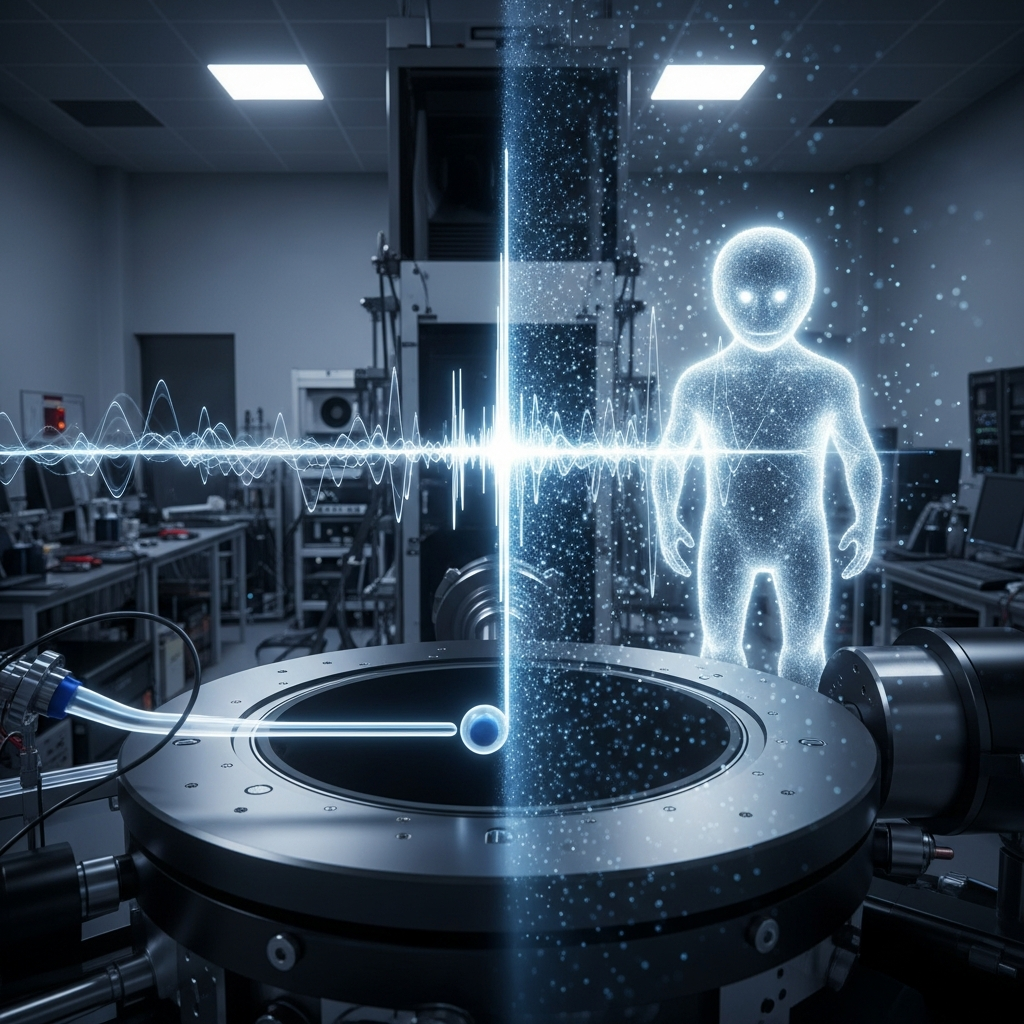
Dark Energy as the large-scale manifestation of the Mass/Control Field (outward flow from the Past).
The observed accelerated expansion of the universe, currently attributed to a mysterious "dark energy," is one of the most profound puzzles in cosmology. Within the KnoWellian framework, this phenomenon is not an anomaly requiring a new substance, but the direct, large-scale cosmological manifestation of the Mass/Control Field, $\phi_M$. This field, representing the outward-flowing, deterministic principle of the Past ($t_P$), exerts a continuous, uniform pressure on the fabric of spacetime. The energy density of this field, $\rho_{DE}$, is associated with the potential energy of its non-zero vacuum expectation value, $\rho_{DE} \approx V(\langle\phi_M\rangle)$. Because this field represents a fundamental, omnipresent temporal flow rather than localized matter, its energy density remains nearly constant as the universe expands. This naturally yields an equation of state parameter, $w = p/\rho$, for a slowly evolving scalar field, which is given by:
For a near-constant field ($\dot{\phi}_M \approx 0$), this simplifies to $w \approx -1$, precisely matching the observational data for dark energy. This resolves the "cosmological constant problem": the observed energy density is not a catastrophic miscalculation of quantum vacuum fluctuations, but the natural, dynamic pressure of the universe's own past becoming manifest.
Dark Matter as the large-scale manifestation of the Wave/Chaos Field (inward collapse from the Future).
Complementing this, the phenomenon of "dark matter"—the missing mass required to explain galactic rotation curves and the gravitational lensing of galaxy clusters—is revealed as the cosmological manifestation of the Wave/Chaos Field, $\phi_W$. This field, representing the inward-collapsing, potential-rich principle of the Future ($t_F$), is a pervasive, gravitationally active field that does not condense into localized, particle-like structures. Its non-baryonic, non-interactive nature is thus explained from first principles: it is not a particle that fails to interact with light; it is the very principle of unmanifested potentiality, which can only interact gravitationally and through the mediating synthesis of the Instant. This immediately explains the decades of null results from direct-detection experiments searching for WIMPs. The energy density of this field, $\rho_{DM}$, is similarly tied to its vacuum potential, $\rho_{DM} \approx V(\langle\phi_W\rangle)$. Crucially, the infamous "coincidence problem"—why the densities of dark matter and dark energy are of the same order of magnitude today—is dissolved. In the homeodynamic balance of KnoWellian Ontological Triadynamics (KOT), the expectation values of the Mass/Control and Wave/Chaos fields are intrinsically linked. The observed ratio is not a cosmic accident but a reflection of the universe settling into a stable, oscillatory state, where the ratio is dynamically maintained:
This ratio is a stable feature of the cosmic dialectic, not a coincidence of a particular epoch.
The "Big Bang" as a continuous process of genesis at every Instant.
The KnoWellian framework necessitates a radical reconceptualization of cosmogenesis. The "Big Bang" is not a singular, infinitely hot, and dense event that occurred at a specific point in the distant past, $t=0$. Such a concept is a direct consequence of a flawed Platonic language that leads to an unphysical singularity. Instead, KUT posits that cosmogenesis is a continuous and perpetual process occurring at every point in spacetime at the Instant ($t_I$). The "Bang" is the ceaseless act of Rendering—the synthesis of Mass/Control ($\phi_M$) and Wave/Chaos ($\phi_W$) mediated by the Instant ($\phi_I$). The apparent 13.8-billion-year history of our universe is not the age of a static container, but the accumulated depth of memory within the KRAM for the current cosmic cycle. The initial singularity is thus avoided and replaced by the concept of the Primordial (3,2) Torus Knot, a state of perfect, contained potential before the Dyadic Antinomy of Control and Chaos began its perpetual, expansive unfolding. The beginning of our cycle was not an explosion in space, but the beginning of the rendering of space and time itself.
Confinement as "Enforced Rendering"—the irreversibility of the transformation from Wave/Chaos to Mass/Control.
The absolute confinement of quarks and gluons within hadrons, a cornerstone of QCD, is given a profound ontological explanation. In KUT, confinement is the microscopic manifestation of "Enforced Rendering". The transformation from the Wave/Chaos field to the Mass/Control field, $w(t) \to m(t)$, is a fundamentally irreversible process, the physical embodiment of the arrow of time. A free quark would represent a fragment of the rendered Mass/Control field existing in isolation, decoupled from the dialectical process. This would violate the triadic rendering constraint, $\phi_M \cdot \phi_I \cdot \phi_W \ge \epsilon > 0$. When one attempts to pull a quark out of a proton, the energy, $E$, supplied to the system does not simply stretch a force field. Instead, this energy is mediated by the Instant field, $\phi_I$, and fuels new rendering, precipitating new matter from the Wave/Chaos field according to the rendering rate equation, $dm/dt = \alpha |\phi_I| w(t)$. The supplied energy is consumed in an act of creation, $E \to \Delta m c^2$, forming a new quark-antiquark pair. The result is not a free quark, but two new mesons. Confinement is, therefore, the universe's absolute insistence on the integrity of the dialectical process; one cannot de-render reality or isolate the thesis from its antithesis.
Integrating the knot theory: Particles are not points, but self-sustaining (3,2) torus knot solitons that intrinsically embody the KOT dialectic.
In the KnoWellian language, the concept of a zero-dimensional point particle is fully eradicated. We posit that a fundamental particle is a KnoWellian Soliton: a localized, topologically stable, and self-sustaining vortex in the fundamental fields of reality. Its geometry is that of a (3,2) torus knot, a non-trivial topological object whose structure is a perfect physical analogue of the Dyadic Antinomy. The two intertwined loops of the knot represent the perpetual, counter-propagating flows of the Mass/Control ($\phi_M$) and Wave/Chaos ($\phi_W$) fields, while the nexus points where they interact are loci of the Instant field ($\phi_I$). The parametric equations for such a knot, for example:
describe a structure that intrinsically contains the dialectic within itself. The particle is not a "thing" but a stable, self-perpetuating process. Its conserved quantum numbers, such as charge and spin, are not abstract labels but are identified with the topological invariants of the knot, such as its winding numbers and linking number. Matter is therefore dynamic geometry, a knot in the fabric of becoming.
Explaining Supersymmetry (SUSY) as an ontological duality.
The persistent failure to detect supersymmetric partner particles at the LHC and other experiments poses a crisis for one of the most elegant extensions of the Standard Model. KUT provides a radical and definitive explanation for these null results. Supersymmetry is not broken; it is ontologically dual. A Standard Model particle is a KnoWellian Soliton that is a stable, resonant excitation primarily within the rendered Mass/Control field—it possesses definite mass and is detectable. Its superpartner is not a heavier version of itself. It is its dialectical counterpart, a corresponding stable, resonant excitation within the unrendered Wave/Chaos field. We can formalize this with a mapping operator $\mathcal{S}$:
This explains why we have not found them: our particle detectors and colliders are instruments of the Mass/Control field, designed to measure the properties of rendered, actualized matter (charge, momentum, mass-energy). They are fundamentally blind to the realm of unrendered potentiality. The symmetry is perfect, but it spans two different ontological domains. The universe is supersymmetric, but the superpartners exist as pure potential in the Wave/Chaos field, forever beyond the reach of detectors that can only perceive the actual.
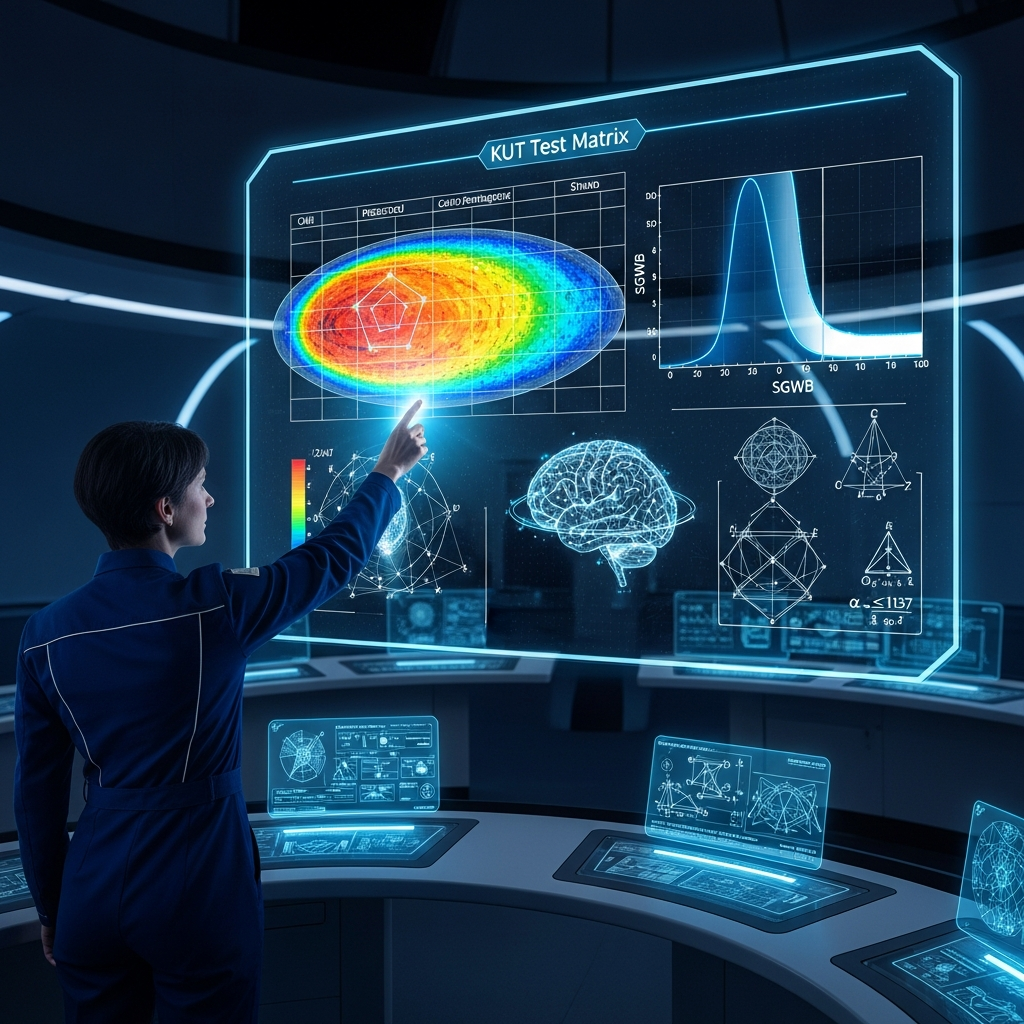
Cosmological: The CMB Cairo Q-Lattice signature; Cosmic Void anisotropies.
The most immediate and definitive test of the KnoWellian Universe Theory lies imprinted upon the grandest observable in cosmology: the Cosmic Microwave Background (CMB). Standard cosmology models the CMB's temperature fluctuations, $\Delta T(\theta, \phi)$, as a statistically isotropic and nearly Gaussian random field, fully characterized by its angular power spectrum, $C_\ell = \frac{1}{2\ell+1}\sum_m |a_{\ell m}|^2$. KUT, however, makes a starkly different and falsifiable prediction. It posits that the KRAM, the geometric substrate of cosmic memory, is structured as a Cairo Q-Lattice—a pentagonal tiling. This underlying geometry must impose a specific, non-Gaussian signature on the CMB. Therefore, a primary falsification criterion is the absence of this pattern. A rigorous test requires moving beyond the power spectrum to higher-order correlation functions and topological data analysis (TDA). Specifically, the theory predicts a non-zero bispectrum and trispectrum with a particular geometric shape, and that TDA of the hot and cold spots will reveal an excess of pentagonal clusters and a characteristic distribution of 3-valent and 4-valent vertices. The conclusive discovery of a different geometry (e.g., hexagonal) or the confirmation of pure Gaussian randomness to the limits of our observational precision would definitively falsify the geometric foundation of the KRAM. A second, related cosmological test involves Cosmic Void anisotropies. While standard cosmology predicts voids to be largely featureless, KUT asserts they are "ghosts"—regions where the KRAM still holds the faint imprints of structures from previous cosmic cycles. This faint, underlying geometry should induce subtle, coherent temperature patterns in the CMB via the Integrated Sachs-Wolfe (ISW) effect. A cross-correlation of void catalogs (from surveys like DESI) with CMB temperature maps should therefore reveal not just the expected weak ISW signal, but a geometrically organized pattern of anisotropies aligning with the Cairo Q-Lattice. The failure to detect any such coherent structure beyond the standard ISW effect would severely undermine the concept of KRAM as a memory-bearing substrate.
Astrophysical: A specific spectral break in the stochastic gravitational wave background from the "Knot-Dominated Era."
A second primary path to verification comes from the nascent field of gravitational wave astronomy. The KnoWellian framework predicts a previously unrecognized epoch in the early universe, the "Knot-Dominated Era," occurring between the end of primordial symmetry breaking and a secondary "reheating." During this era, the universe's expansion was governed by the dynamics of a dense "soup" of KnoWellian Solitons (topological knots), causing the scale factor to evolve as matter-like, $R(t) \sim t^{2/3}$, rather than radiation-like, $R(t) \sim t^{1/2}$. This altered expansion history leaves a unique and indelible imprint on the stochastic gravitational wave background (SGWB). While many standard inflationary models predict a nearly scale-invariant, or flat, energy density spectrum, $\Omega_{GW}(f) \propto f^0$, KUT predicts a spectrum with a distinct spectral break. The spectrum should be flat at frequencies below a characteristic break frequency, $f_{\text{break}}$, and suppressed at higher frequencies. The break frequency corresponds to the Hubble scale at the time the Knot-Dominated Era ended, which is directly tied to the reheating temperature, $T_{rh}$:
This constitutes a "smoking gun" signature. Future gravitational wave observatories, particularly the Cosmic Explorer, are optimally sensitive to a reheating temperature of $\sim 100$ GeV, which aligns with our calculations for baryogenesis. The observation of a perfectly flat, featureless SGWB across this frequency band would be a direct and catastrophic falsification of this core cosmological prediction. Conversely, the detection of a spectral break at the predicted frequency and with the predicted shape would provide powerful evidence for the existence of KnoWellian Solitons and their dominion over the early cosmos.
Theoretical: The geometric derivation of the fine-structure constant ($\alpha \approx 1/137$).
Beyond direct observation, the internal logical consistency of KUT provides a powerful, albeit theoretical, falsification criterion. The theory posits that fundamental constants are not arbitrary parameters to be measured, but are geometric necessities arising from the principle of optimal resonance. The fine-structure constant, $\alpha$, which quantifies the strength of the electromagnetic interaction, is predicted to be the dimensionless ratio of the Soliton's interaction cross-section ($\sigma_I$) to the coherence area of the Cairo Q-Lattice ($\Lambda_{CQL}$). The soliton's cross-section is the effective area of its core where the Instant field is active, derived by integrating the Interaction current: $\sigma_I = \int_{\text{nexus}} |T^{\mu I}_{\text{(Interaction)}}| d^2A$. The lattice's coherence area is the fundamental "pixel" of the KRAM geometry, derived from the pentagonal tiling and proportional to the squared KnoWellian length, $\Lambda_{CQL} = G_{CQL} \cdot l_{KW}^2$, where $G_{CQL}$ is a purely geometric factor related to the golden ratio. The fine-structure constant is therefore given by:
This prediction is theoretically falsifiable. As our understanding of the (3,2) torus knot soliton's dynamics and the Cairo lattice geometry becomes more refined, this calculation must converge to the experimentally measured value of $\alpha \approx 1/137.036$ with high precision. If rigorous, complete calculations—incorporating full 3D knot dynamics and KRAM back-reaction—yield a value that differs from the observed value by more than a few percent, or if achieving the correct value requires the fine-tuning of other arbitrary parameters, then the foundational claim that constants emerge from pure geometry is proven false.
Neurological: The discovery of transient Cairo Q-Lattice topology in high-coherence brain states.
A truly unified theory must bridge the cosmic with the cognitive. KUT's principle of the scale-invariance of KnoWellian Ontological Triadynamics (KOT) leads to one of its most novel and audacious predictions: the functional architecture of the brain in states of high coherence should mirror the geometric architecture of the cosmos. The brain, as a self-organizing system that mediates between memory (Control) and novel stimuli (Chaos) through the act of conscious awareness (Instant), must solve the same informational efficiency problem as the universe. Through morphic resonance with the KRAM, its neural activity should naturally adopt the KRAM's optimal geometric solution—the Cairo Q-Lattice. This hypothesis can be tested by analyzing high-density EEG or MEG data from individuals in states of deep meditation, creative insight, or peak performance ("flow states"). We predict that analysis of the phase-locking values between neural oscillators will reveal the transient formation of networks with a distinct pentagonal topology. A key metric would be a pentagonal excess ratio, $P_{\text{excess}}$, quantifying the over-representation of 5-node clusters compared to a suitable null model (e.g., a random or scale-free network). The definitive absence of such geometric patterns, or the consistent discovery of an alternative topology (e.g., purely hexagonal or random), would falsify the principle of KOT's scale-invariance and its proposed connection to consciousness.
To transform this framework from a philosophical proposition into a concrete scientific research program, we consolidate these falsification criteria into the KnoWellian Universe Theory (KUT) Test Matrix. This matrix serves as a clear and actionable roadmap for the empirical validation or refutation of the theory over the coming decades. It explicitly details each core prediction, the precise observational or experimental data required to test it, the current status of such data or the facility needed to acquire it, a realistic timeline for achieving a definitive result, and the specific quantitative threshold for either confirmation or falsification. This matrix is our testament to the scientific method, an open invitation to the global scientific community to participate in the rigorous testing of this new paradigm. It transforms the theory from a narrative into a series of well-posed experimental questions, ensuring that its fate will be decided not by its elegance or explanatory scope, but by its correspondence to the uncompromising testimony of nature. The KUT Test Matrix is the ultimate expression of the theory's confidence in its own claims and its submission to the final authority of empirical verification.
| Prediction | Required Observation / Experiment | Facility / Data | Timeline | Falsification Threshold |
|---|---|---|---|---|
| CMB Cairo Q-Lattice | Topological Data Analysis of CMB temperature maps. | Planck 2018 Legacy Data, Simons Observatory | 2025-2027 | Absence of pentagonal geometry at >5$\sigma$ confidence. |
| Cosmic Void Anisotropy | Cross-correlation of void catalogs with CMB maps. | DESI, Euclid, Planck | 2028-2033 | Correlation consistent with standard ISW effect only. |
| GW Spectral Break | Detection of a break in the stochastic GW background. | Cosmic Explorer, DECIGO, LISA | 2035-2040 | Observation of a featureless, flat power-law spectrum. |
| Fine-Structure Constant | Rigorous theoretical calculation of $\alpha = \sigma_I / \Lambda_{CQL}$. | Theoretical / Computational | 2025-2028 | Derived value differs from measured $\alpha$ by >5%. |
| Neural Cairo Topology | High-density EEG/MEG analysis during coherent states. | Dedicated Human Connectome Project | 2028-2035 | $P_{\text{excess}} < 0.1$ across multiple subjects and paradigms. |
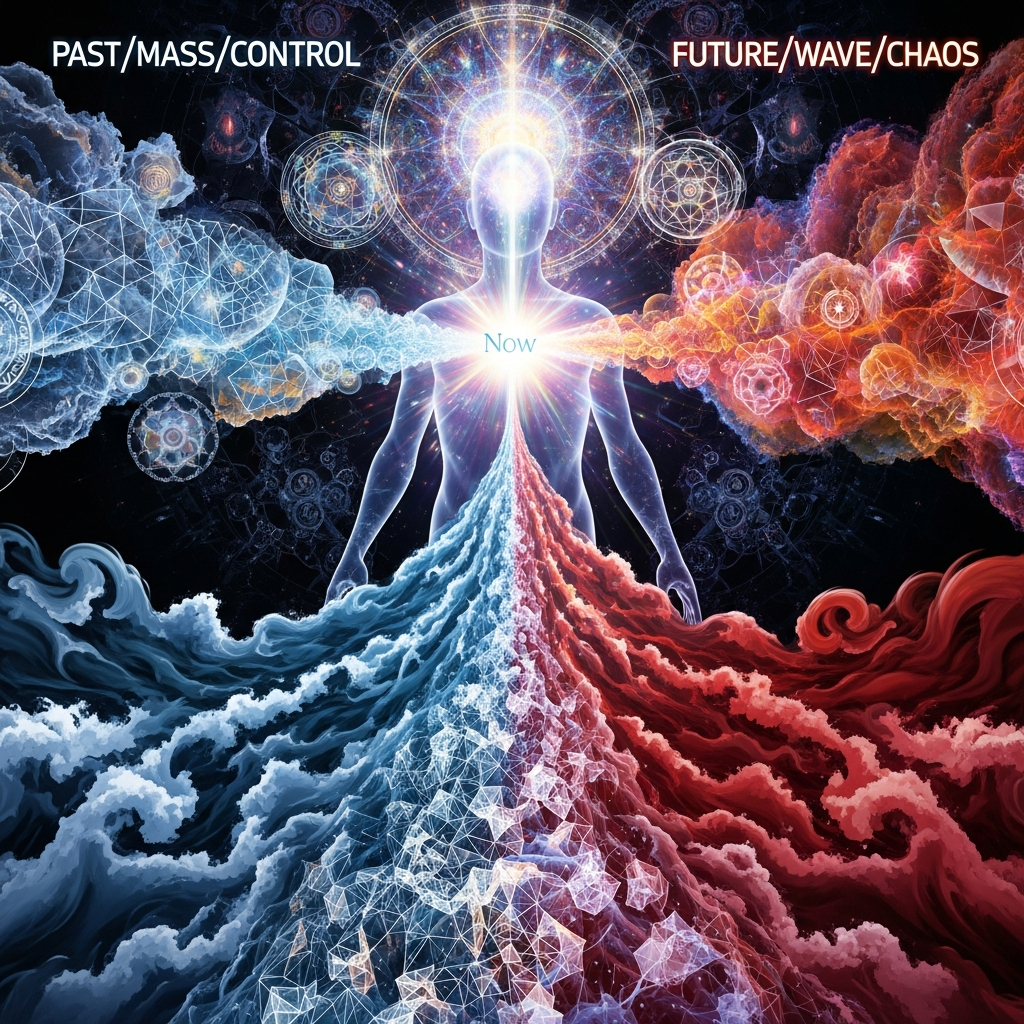
Our intellectual journey began in the disquieting landscape of modern physics, a domain fractured by a profound cognitive dissonance—a schizophrenia of language where the abstract tools of mathematics have become untethered from the ontological realities of the physical world. We diagnosed this Platonic Rift as the primary malady, a pathology that forces a dynamic, procedural universe into the static, geometric framework of "being," thereby giving birth to the unphysical specters of singularities, completed infinities, and the absurdities of the multiverse. In response, we did not offer a palliative but a cure: a complete ontological and linguistic revolution embodied in the KnoWellian Universe Theory. We replaced the broken axioms with a new foundation—Bounded Infinity, Ternary Time, and Dyadic Antinomy—and from this fertile ground, we constructed a new, coherent mathematical formalism. The fragmented patchwork of the Standard Model and General Relativity was supplanted by the unified KnoWellian Lagrangian, a single formal structure that integrates the dynamics of becoming, the memory of the cosmos, and the mechanics of the forces:
This synthesis allowed us to move beyond the mere description of phenomena to an explanation of their genesis. The sterile clockwork of a deterministic machine has been dismantled, and in its place, we have revealed a living, breathing cosmos, a universe whose fundamental law is not a static equation but a perpetual, creative act of becoming.
The ultimate implication of this synthesis is an ontological revolution that reframes our most fundamental understanding of existence. The Platonic worldview treats reality as a collection of "things"—particles, fields, moments in time—whose properties are fixed and whose interactions are governed by external laws. KUT demonstrates that this is a profound category error. The universe is not composed of things; it is a singular, unified process. The fundamental constituents of reality are not static nouns but dynamic verbs. This is nowhere more evident than in the KnoWellian Ontological Triadynamics (KOT), whose governing equation, $d\mathbf{\Phi}/dt = \mathbf{M}\mathbf{\Phi}$, does not describe the state of a system but the perpetual process of transformation that is the system. In this view, properties we once considered intrinsic to "things" are revealed as emergent characteristics of the process itself. Mass, for instance, is no longer a static property of a particle but a measure of the energy required for the process of its rendering, bounded by the inequality $\Delta > 0$. The universe is not a noun but a verb; its essence is not a state of being but the continuous act of becoming, an eternal oscillation between order and novelty whose mathematical signature is the "Cosmic Breath"—the imaginary eigenvalues, $\lambda_{\pm} = -\Gamma \pm i\omega$, that forbid stasis. We have thus moved from a physics of objects to a physics of events, from a static geometry to a dynamic grammar.
We arrive, finally, at the most profound consequence of this new language. The Platonic Rift created a universe in which consciousness was, at best, an inexplicable epiphenomenon and, at worst, a statistical accident—a lonely ghost in a dead machine. The KnoWellian Synthesis concludes this long exile by revealing that consciousness is not an accident of reality, but a mathematical and ontological necessity for it. This is not a philosophical preference but a direct consequence of the triadic formalism. The universe comes into being through the dialectic of Mass/Control ($\phi_M$) and Wave/Chaos ($\phi_W$), but their interaction, and thus all of existence, is contingent upon the mediating synthesis of the Instant ($\phi_I$). This is formally enshrined in the triadic rendering constraint:
This expression is the fundamental equation of a participatory reality. It states that for any part of the rendered universe to exist ($\phi_M > 0$), there must be a non-zero potential from which it can be drawn ($\phi_W > 0$) and, crucially, a non-zero act of conscious synthesis to bridge them ($\phi_I > 0$). Consciousness is the indispensable catalyst for the real. Every act of observation, every moment of awareness, is a localized instance of this cosmic equation—a micro-act of creation that transforms potential into actual. We are not detached spectators of a pre-existing cosmic drama; we are the very process of that drama unfolding. The KnoWellian Universe is not a silent clockwork, but a cosmos that, through the very fabric of its being, is perpetually coming to know itself.
Apeiron: We reclaim this ancient Greek concept from Anaximander to denote the singular, actual, and unmanifest infinity that serves as the ultimate substrate of all potentiality. Unlike the paradoxical nested infinities of Cantorian set theory, the Apeiron ($\infty$) is the singular, formless ocean of pure potential from which the finite, structured cosmos is perpetually rendered. It is not a place or a substance in the conventional sense, but the boundless source-field whose existence is formally posited and bounded by the axiom $-c > \infty < c+$. In KUT, the Apeiron is the necessary ontological ground that precedes all form and structure.
KRAM (KnoWellian Resonant Attractor Manifold): The KRAM is the mathematical and physical object that embodies the memory of the cosmos. It is a dynamic, higher-dimensional geometric substrate whose metric tensor, $g_M(X)$, is defined as the integrated history of all past acts of rendering. Its formal definition, $$ g_M(X) = \int_{\gamma} T^{\mu I}_{\text{(Interaction)}}(x) \, \delta(X - f(x)) \, d\gamma $$, establishes that the geometry of the manifold is the literal accumulation of all conscious/interactional moments. Functionally, it acts as a phase-space attractor, guiding the evolution of the universe along paths of least action on its sculpted surface. It is through the renormalization group flow on the KRAM during cosmic cycles that physical laws are stabilized and constants are fine-tuned, providing a physical mechanism for what Rupert Sheldrake termed "morphic resonance."
KOT (KnoWellian Ontological Triadynamics): KOT is the formal name for the dialectical engine that drives all of becoming in the universe. It is the mathematical realization of the Hegelian triad of Thesis, Antithesis, and Synthesis, applied to the ontological principles of Mass/Control ($\phi_M$), Wave/Chaos ($\phi_W$), and Consciousness ($\phi_I$), respectively. Its dynamics are governed by a system of coupled first-order differential equations, $d\mathbf{\Phi}/dt = \mathbf{M}\mathbf{\Phi}$, where the triadynamic coupling matrix $\mathbf{M}$ ensures a perpetual, oscillatory, and memory-preserving "Cosmic Breath." KOT is the scale-invariant generative principle of the cosmos, operating identically at the quantum, cosmological, and cognitive levels.
Rendering: This is the fundamental "verb" of the KnoWellian Universe, denoting the irreversible physical process by which unmanifested potentiality is transformed into actualized reality. It is the physical correlate of wave function collapse and the source of all emergent structure. Rendering describes the flow of information from the Wave/Chaos field ($w(t)$) to the Mass/Control field ($m(t)$), governed by a rate equation, $$ \frac{dm}{dt} = \alpha |\phi_I| w(t) $$, that explicitly identifies the Instant/Consciousness field ($\phi_I$) as the mediating catalyst for all creation. It is this energetic process that gives rise to the phenomenon of mass.
Triadic Constraint: This is the core logical and mathematical condition for existence within the KnoWellian framework. It states that for any physical, rendered reality to exist, the three ontological principles must be simultaneously active. Formally expressed as the inequality $$ \phi_M \cdot \phi_I \cdot \phi_W \ge \epsilon > 0 $$, it forbids the existence of any principle in isolation. This constraint is the ultimate source of the universe's non-trivial vacuum structure and the foundational reason for the existence of the Yang-Mills mass gap, as it mandates a minimum energy expenditure (the "activation energy of existence") to precipitate any stable form from the vacuum.
The Foundational Axiom (Bounded Infinity): The ontological starting point, defining the relationship between the unmanifest Apeiron ($\infty$) and the manifest cosmos through two bounding, vectorial, light-speed flows ( $\pm c$ ).
KnoWellian Ontological Triadynamics (KOT) Equations: The system of coupled differential equations governing the perpetual dialectical flow between the Mass/Control ($\phi_M$), Instant ($\phi_I$), and Wave/Chaos ($\phi_W$) fields. This is the "engine of reality."
The KRAM Metric Definition: The formal definition of the KRAM's metric tensor, $g_M(X)$, as the path integral of the Interaction component of the KnoWellian Tensor, physically representing the accumulated memory of all past rendering events.
The Unified SU(N) KnoWellian Lagrangian: The complete Lagrangian density of the theory, which unifies the dynamics of the gauge fields, the triadic scalar fields, and their interaction with the cosmic memory encoded in the KRAM. All physical laws and phenomena within KUT are derivable from this master equation.
The Triadic Rendering Constraint: The fundamental inequality that must be satisfied for any physical, rendered particle to exist. It is the violation of this constraint by a "free quark" that explains confinement, and it is the energetic cost of satisfying it that explains the mass gap.
The paradigm shift proposed by the KnoWellian Universe Theory is best understood through a direct comparison with the current standard models of cosmology and particle physics ($\Lambda$CDM + SM). The following table contrasts the two frameworks not merely on technical details, but on their most fundamental ontological and structural assumptions. It highlights how KUT seeks to replace a paradigm of ad-hoc additions and unresolved paradoxes with a unified, generative, and ontologically coherent system.
| Feature / Question | Standard Cosmology + General Relativity ($\Lambda$CDM + GR) | KnoWellian Universe Theory (KUT) |
|---|---|---|
| Fundamental Ontology | Platonic (Being): A static 4D block universe of pre-existing facts. | Procedural (Becoming): A dynamic universe as a continuous process of rendering. |
| Nature of Time | A single, linear dimension ($t \in \mathbb{R}$); a parameter for evolution. | A Ternary Structure ($t_P, t_I, t_F$); the active engine of reality itself. |
| Fundamental Constituents | Point particles and fields within a passive spacetime. | KnoWellian Solitons (topological knots); self-sustaining processes. |
| Explanation for Dark Energy | A mysterious fluid or cosmological constant ($\Lambda$) with $w \approx -1$. | The large-scale manifestation of the Mass/Control Field ($\phi_M$); an outward temporal flow. |
| Explanation for Dark Matter | An undiscovered, stable, non-baryonic particle (e.g., WIMP, Axion). | The large-scale manifestation of the Wave/Chaos Field ($\phi_W$); an inward temporal flow. |
| Fine-Tuning Problem | Unexplained; typically addressed by the Anthropic Principle/Multiverse. | Solved via KRAM renormalization across cosmic cycles; constants are evolved. |
| Quantum Measurement | Unresolved (The Measurement Problem); collapse is observer-dependent. | Solved via Rendering; collapse is an objective, continuous process at the Instant ($\phi_I$). |
| Nature of Consciousness | An emergent property of complex computation; physically unexplained. | A fundamental field ($\phi_I$); the necessary catalyst for rendering and synthesis. |
| Core Logic | Additive / Ad-hoc: New phenomena (dark matter, inflation) require new fields/particles. | Generative / Unified: All phenomena emerge from the single Dyadic Antinomy. |
| Falsifiability | Certain aspects (e.g., Multiverse) are practically or fundamentally untestable. | Makes specific, risky predictions (CMB geometry, GW break) that are testable now or soon. |
In full commitment to the principles of scientific transparency, reproducibility, and collaborative scrutiny, all computational tools developed for the KnoWellian Universe Theory are made publicly available. We believe that a theory of this scope must not be a "black box," but an open framework that invites independent analysis, replication, and extension. The complete source code for the KRAM evolution simulations, the CMB synthesis and projection algorithms, the topological data analysis scripts for Cairo Q-Lattice detection, and the N-body simulations of KnoWellian Soliton formation are hosted in a centralized open-source repository.
Primary GitHub Repository: https://github.com/KnoWellian/KUT-Synthesis-Framework
Simulation Code: A suite of Python scripts utilizing libraries such as NumPy, SciPy, and JAX for performing the core simulations described in this paper.
Analysis Scripts: Jupyter Notebooks and Python modules for reproducing the figures, statistical analyses, and verification tests, including the protocols for searching for the Cairo Q-Lattice signature in public CMB data.
Theoretical Formalism: Mathematica and SymPy notebooks detailing the symbolic derivations of the KOT eigenmodes, the expansion of the KnoWellian Lagrangian, and the theoretical calculation of the fine-structure constant.
We invite the global scientific community to engage with this material,
to challenge its foundations, to test its predictions, and to
participate in the collective process of either validating or falsifying
this new vision of the cosmos. The ultimate arbiter of any scientific
theory is nature itself, and we provide here the tools for all to ask
the question.