The Mott problem, a foundational question in quantum mechanics, highlights the apparent paradox of how a spherically symmetric quantum wave function produces a definite, linear track in a classical detector. While Sir Nevill Mott's 1929 solution provides a mathematically complete description based on wave interference within the total system, it leaves a philosophical unease regarding the mechanism that selects a single, classical path from a quantum superposition of infinite possibilities. This paper presents a deeper, ontological solution grounded in the KnoWellian Universe Theory (KUT), a framework built on procedural metaphysics. We posit that the formation of a particle track is not a wave function collapse but a KnoWellian Rendering Cascade—an irreversible, sequential transformation of potentiality into actuality. This process is governed by the KnoWellian Resonant Attractor Manifold (KRAM), a dynamic memory substrate of the cosmos. We propose a modified Bohmian mechanic where the particle's pilot-wave (the Chaos Field) physically "etches" a directional "imprint" on the local KRAM geometry upon the first rendering event. This imprint creates an attractor valley that makes subsequent rendering events along the same vector path overwhelmingly probable. The linear track is thus not a "miraculous" alignment of probabilities but a deterministic cascade guided by the memory of its own becoming. This provides a physical mechanism for the phase correlations in Mott's original solution and offers a new, testable foundation for the quantum-to-classical transition.
Keywords: Mott Problem, KnoWellian Universe Theory (KUT), KRAM, Bohmian Mechanics, Pilot-Wave Theory, KnoWellian Ontological Triadynamics (KOT), Rendering Constraint, Quantum Measurement, Procedural Ontology, Wave Function Collapse, Decoherence, Cosmic Memory.
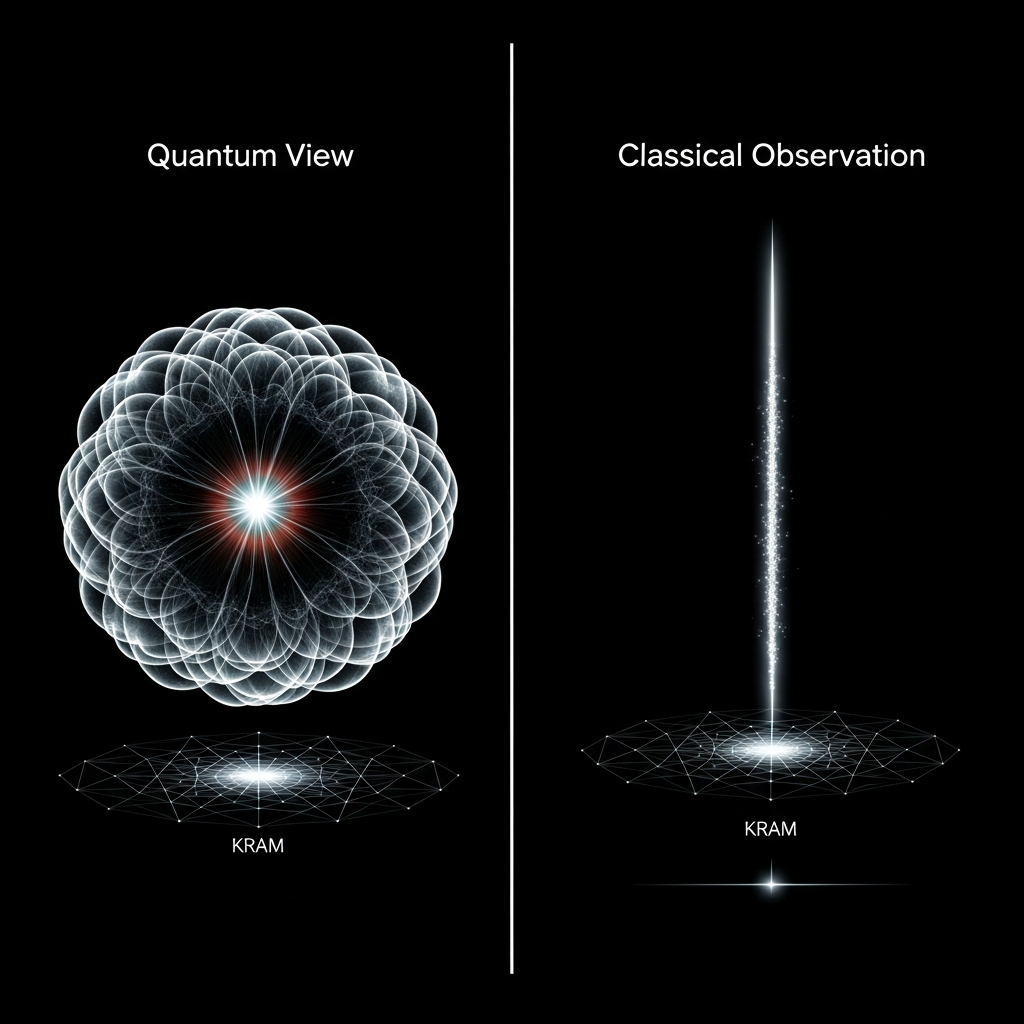
In 1927, a profound question arose at the intersection of quantum theory and classical observation: how does the spherically symmetric wave function of an alpha particle, emitted during radioactive decay, manifest as a single, well-defined linear track in a cloud chamber? This question, now known as the Mott Problem, probes the heart of the quantum measurement problem.
Sir Nevill Francis Mott's solution in 1929 demonstrated that the linear track emerges naturally from the Schrödinger equation when the entire system—the alpha particle and all atoms in the detector—is considered. He showed that while the probability of any single atom being ionized is spherically symmetric, the probability of multiple ionizations is only significant along a straight line due to constructive wave interference.
"The odds of an infinite number of possible decoherences that just happen to decohere into a straight line when multiple potential paths are available would be a miracle."
While mathematically sound, Mott's solution can evoke a philosophical disquiet, as articulated in the critique above. It explains *that* a line forms but not the underlying ontological mechanism that seemingly selects one classical reality from an infinitude of quantum possibilities. This paper argues that the "miracle of alignment" is resolved by adopting a procedural ontology, as formalized in the KnoWellian Universe Theory (KUT). We will demonstrate that the linear track is not a coincidence but a causally guided cascade of events, driven by a cosmic memory substrate.

To understand the solution, we must first review the core tenets of KUT.
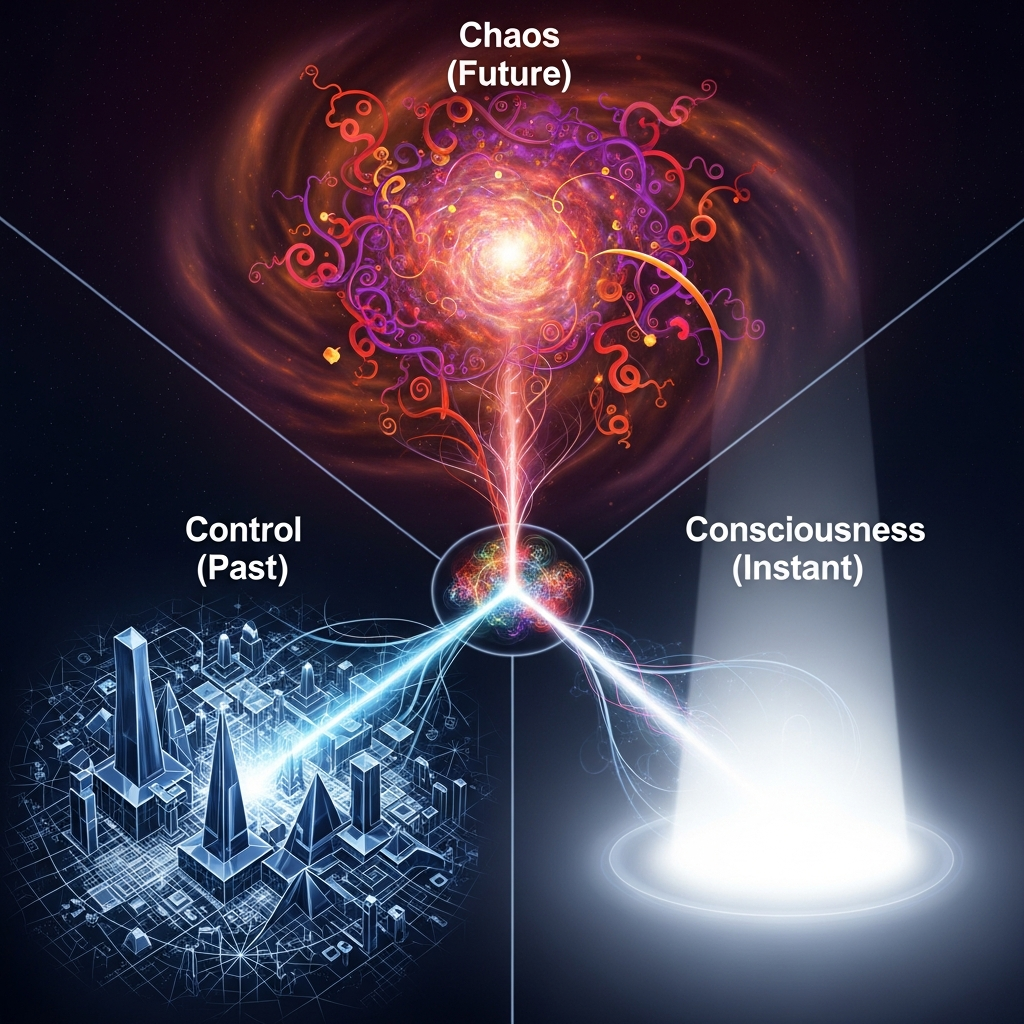
KUT replaces the linear model of time with a procedural, triadic structure of three co-existing realms:
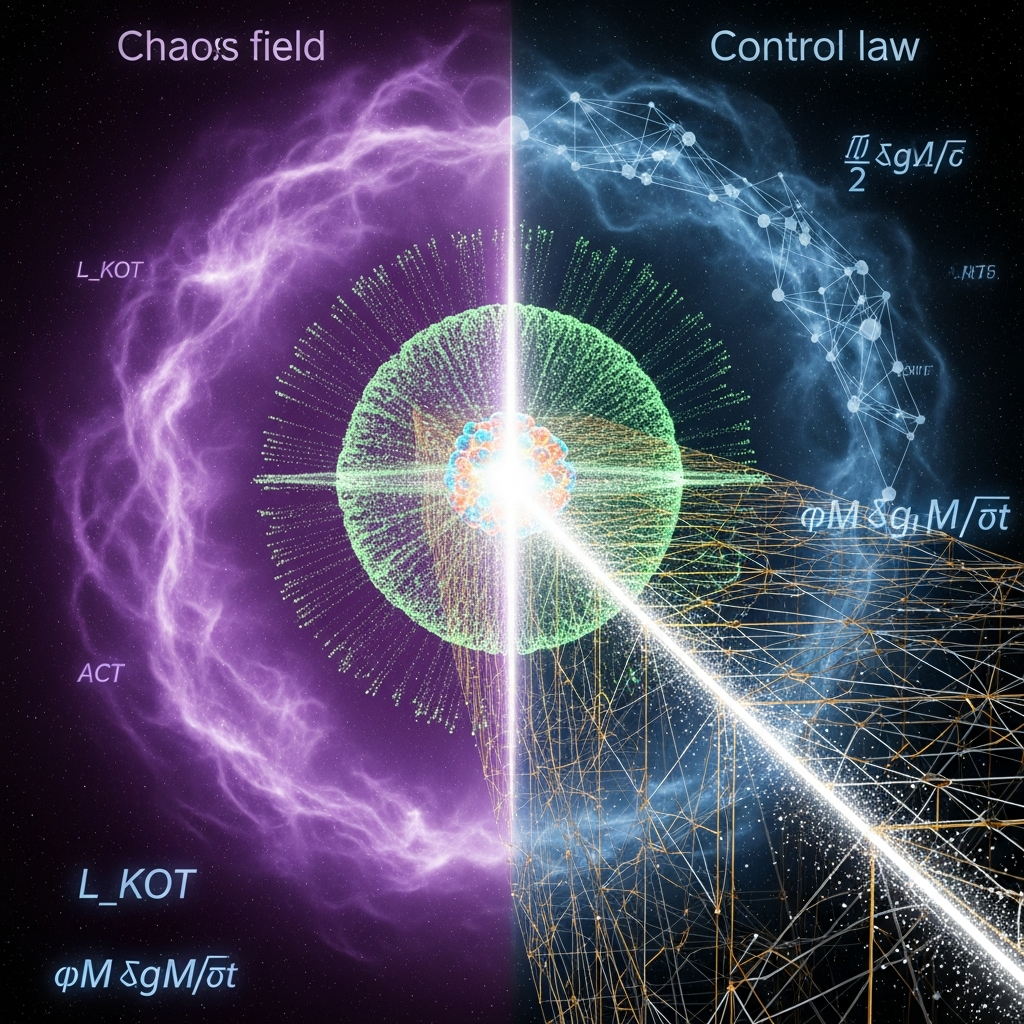
The dynamics of these fields are governed by the KOT Lagrangian:
The interaction potential, Vint = λφMφWφI + (Λ/4)(φ²M + φ²I + φ²W)², enforces the perpetual, triadic interaction necessary for reality to exist.
The universe operates under a conservation law where the total informational capacity, N, is constant:
where m(t) is total rendered actuality (∫φ²M) and w(t) is total unrendered potentiality (∫φ²W). The process of converting w to m is called rendering. For a stable, observable particle (an actuality) to exist, it must satisfy the KnoWellian Rendering Constraint:
This constraint mandates that actuality, potentiality, and the process of becoming must all be co-present for a definite state to manifest. This process is ontologically irreversible.
The KRAM is the central mechanism of KUT's explanation. It is a higher-dimensional manifold underlying spacetime that functions as a memory substrate. It is governed by two axioms:
The geometry of the KRAM is defined by a metric tensor, gM(X), which is the integrated history of the Instant current, JI = G(|φI|²), over the entire timeline γ of the universe:
Here, X are coordinates on the manifold, x are spacetime coordinates, and f is a projection map. The evolution of reality is then governed by a modified action principle, S', that includes a coupling term, κ, between the standard Lagrangian and the KRAM's metric:
This ensures that physical systems follow trajectories that minimize this action, which are biased by the contours of the KRAM. The KRAM itself is dynamic, evolving according to a driven, non-linear field equation where new imprints are added via a source term, Jimprint:
This equation describes how the manifold "learns" from events, creating attractor valleys that guide future becoming.
The "Axiom of Persistent Imprint" is not merely a postulate but a description of a physical process. Within KUT, this process is mechanized by a modified form of Bohmian pilot-wave theory. In standard Bohmian mechanics, a particle has a definite position and is guided by a pilot wave, but the wave itself does not typically leave a lasting physical trace on its environment. KUT proposes a crucial modification: the pilot wave is an active, physical field that physically sculpts the KRAM substrate upon interaction.
The spherically symmetric wave function of the alpha particle, Ψα, is identified with the Wave/Chaos Field (φW). This field is the pilot wave, carrying the information of all potential paths. The "particle" is the localized excitation that is ultimately rendered in the Mass/Control Field (φM).
The "etching" occurs at the first rendering event. Mediated by the Instant Field (φI), the particle's position is actualized at x1. At this moment of interaction, momentum and phase information from the pilot wave (φW) is physically transferred to the KRAM. This is not just an informational update; it is a physical deformation. The pilot wave's structure imparts a corresponding geometric structure onto the KRAM metric.
This can be formalized by connecting the KRAM's source term, Jimprint, to the Bohmian quantum potential, Q. The quantum potential, Q = - (ħ²/2m) (∇²|Ψ|)/|Ψ|, is derived from the wavefunction and is responsible for the "quantum force" that guides the particle. We posit that the imprint current is proportional to the gradient of this quantum potential at the moment of rendering:
This equation provides the missing link: the force that guides the Bohmian particle is the very force that carves the KRAM. The gradient of the quantum potential is a vector field that points in the direction of the quantum force. By setting the KRAM source term proportional to this gradient, we ensure that the "imprint" is not just a point but a directional vector etched into spacetime's memory, forming the initial attractor valley. Thus, the pilot wave acts as the sculptor, and the KRAM is its clay.

We now apply this framework to the alpha particle in the cloud chamber.
The alpha particle emerges from the nucleus. In KUT, this is not yet a particle but a localized excitation in the Wave/Chaos field (φW). It propagates outward as a spherically symmetric wave, Ψα(r,t), representing pure potential. The local KRAM is, at this moment, isotropic and un-etched with respect to this event.
At a point x1, a quantum fluctuation allows the Rendering Constraint (φM·φI·φW ≥ ε) to be satisfied for the first time. The spherical wave Ψα interacts with an atom of the chamber gas. This interaction is mediated by the Instant field (φI), transforming a small amount of potential (w) into actuality (m). This is the first ionization event.
This event is not ephemeral. It constitutes a physical act of becoming that generates an imprint current, Jimprint(x1), which modifies the local KRAM metric:
Crucially, this imprint δgM is not merely a point. The interaction carries momentum information. The imprint creates a minute but highly directional attractor valley in the KRAM, a "groove" pointing from the decay source to x1.
The alpha particle's wave function continues to evolve, but it now propagates across a KRAM that is no longer isotropic. Its evolution is governed by the modified action principle S'. The probability of the *next* rendering event is no longer spherically symmetric. It is conditioned by the local geometry of the KRAM.
The path integral formulation shows that the amplitude for the particle to propagate from x1 to a new point x2 is dominated by paths that follow the attractor valley. Any path deviating significantly from this groove suffers destructive phase interference. Therefore, the probability of the second ionization is overwhelmingly maximized along the vector defined by the first ionization.
When the second rendering occurs at x2, it likewise leaves an imprint, deepening and extending the attractor valley. This process repeats in a self-reinforcing cascade. Each ionization event is guided by the memory of all previous events.
The final result is a near-perfectly linear track of ionized atoms. This is not a miracle of aligned probabilities. It is a deterministic cascade triggered by a single, random initial event. The path is not one of an infinite number of possibilities that could have been taken; it is a single path carved into the fabric of spacetime by the very process of its own becoming. The overall spherical symmetry of the initial quantum state is preserved over many decay events, as the direction of the *first* random rendering is arbitrary.

We formalize the argument by considering the conditional probability of successive rendering events.
Let P(x, t) be the probability density for a rendering event. This is proportional to the intensity of the Instant field, |φI(x,t)|, which itself is a function of the interaction between the Chaos field (the alpha particle wave function, Ψα) and the Control field (the detector atoms). The evolution of Ψα is governed by the effective Lagrangian Leff on the KRAM.
After the first rendering at x1, the metric is no longer trivial: gM = g0 + δgM(x1). The interaction term now acts as an anisotropic potential, biasing the evolution of Ψα.
The probability amplitude for the particle to travel from xn to xn+1 is given by the path integral:
The action S' is minimized along geodesics of the imprinted KRAM. The attractor valley created by the sequence {x1...xn} creates a "channel" of constructive interference. The probability of the (n+1)-th ionization is thus conditionally dependent on the history of previous ionizations:
The maximum of this conditional probability will lie along the vector defined by the previous events, causing the track to propagate linearly. Deviation from this path would require overcoming the potential barrier of the attractor valley, an event of exponentially suppressed probability.
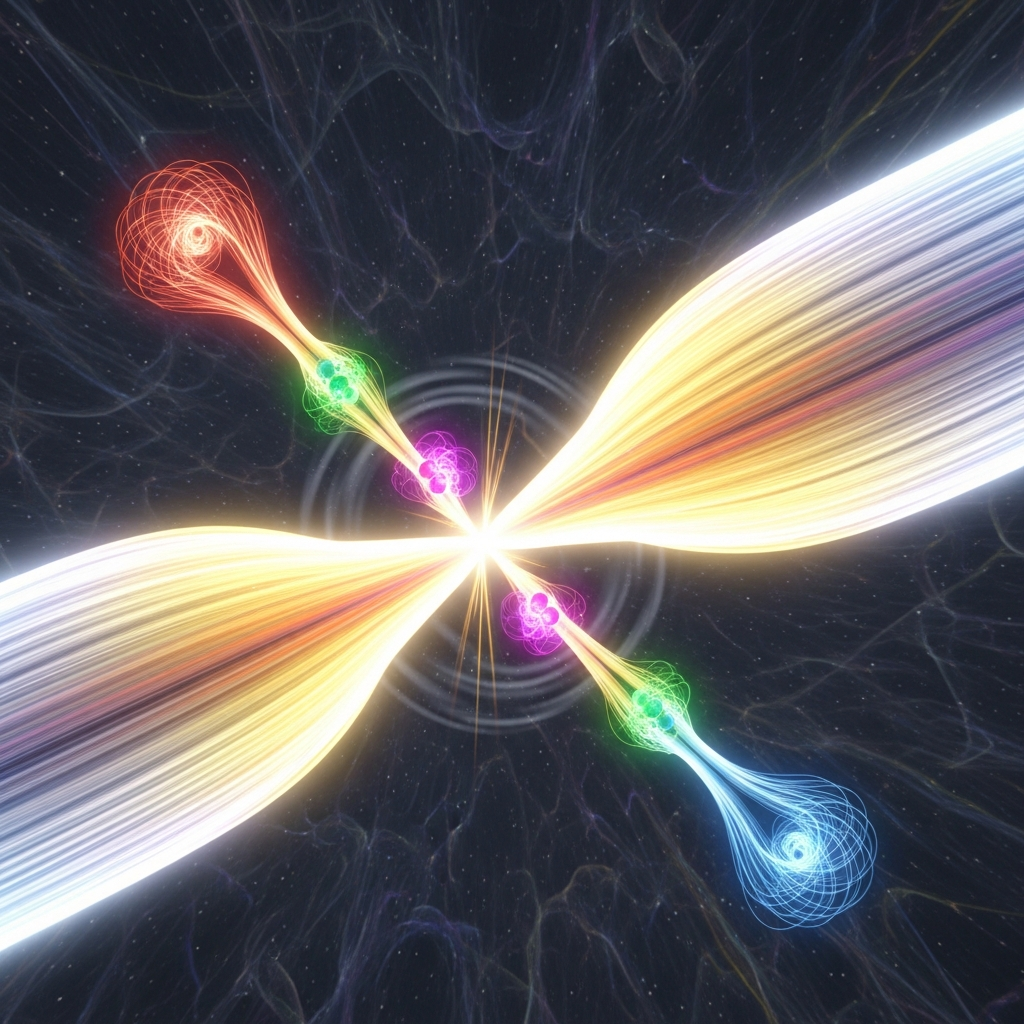
The KnoWellian framework does not invalidate Mott's mathematical solution; rather, it provides the ontological substrate that explains *why* the mathematics works as it does. The constructive wave interference identified by Mott is, in KUT, physically enforced by the dynamic geometry of the KRAM. The "memory" of the quantum system is not an abstract property but is physically encoded in the fabric of spacetime.
The Mott Problem ceases to be a paradox when viewed through the lens of a procedural, memory-endowed universe. The linear track is a scar left by the irreversible process of becoming, a physical record of potentiality cascading into actuality, guided at every step by the memory of its own past. This framework resolves the philosophical unease of the quantum-to-classical transition by describing it not as a collapse, but as a causally guided and physically recorded creative act.
 References
[1] Mott, N. F. (1929). The wave mechanics of α-ray tracks. Proceedings of the Royal Society of London. Series A, 126(799), 79-84.
[2] Lynch, D.N., et al. (2025). The KnoWellian Resonant Attractor
Manifold (KRAM): The Memory of the Cosmos. KnoWellian Publishing. https://doi.org/10.5281/zenodo.17365008
[3] Lynch, D.N., et al. (2025). KnoWellian Ontological Triadynamics: The Generative Principle of a Self-Organizing Cosmos. KnoWellian Publishing. https://doi.org/10.5281/zenodo.17365484