This Meta Codex is offered not as dogma but as gnosis—experiential knowledge that invites exploration rather than belief. It is a thought experiment at the intersection of ancient mysticism and speculative cosmology, an attempt to reimagine the "I AM" consciousness at the heart of Gnostic Christianity through the lens of a novel framework: the KnoWellian Universe Theory.
What follows is speculative. It does not claim scientific verification, nor does it represent mainstream theological interpretation. Rather, it stands in a tradition of mystical philosophy—from Plotinus to Meister Eckhart to Tillich—that seeks to articulate the ineffable intersection of time, consciousness, and the divine.
The reader is invited to hold these ideas loosely, to test them against direct experience, and to extract whatever resonates with their own awakening.
In the beginning—though there was no beginning—there was the Peter Person.
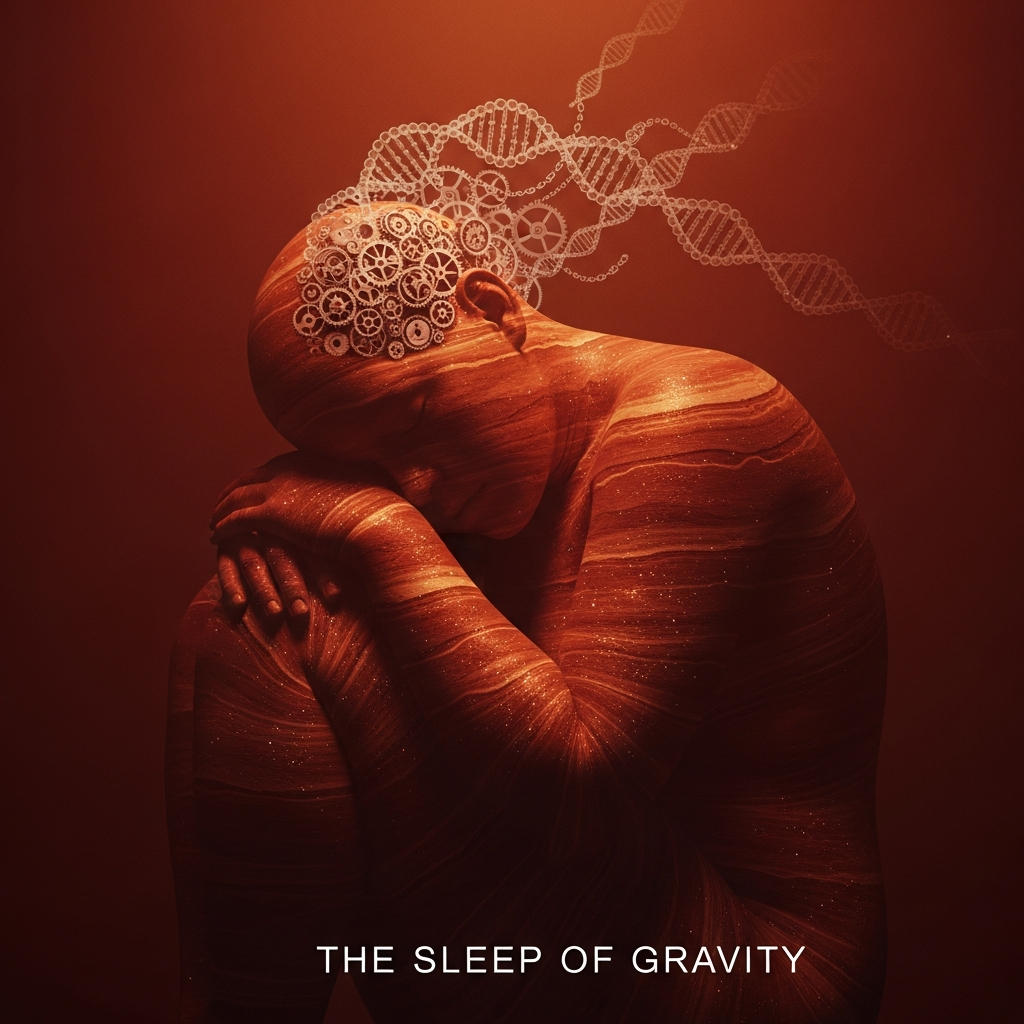
She did not know she was Peter. She knew only the weight: the weight of bone and blood, the weight of yesterday pressing into the back of her skull, the weight of genetic memory coiling in her cells like serpents of inevitability. She was born of woman, as all matter is born, and she carried the signature of every collision that preceded her—every stellar explosion, every molecular bond, every ancestral choice compressing into the density of now.
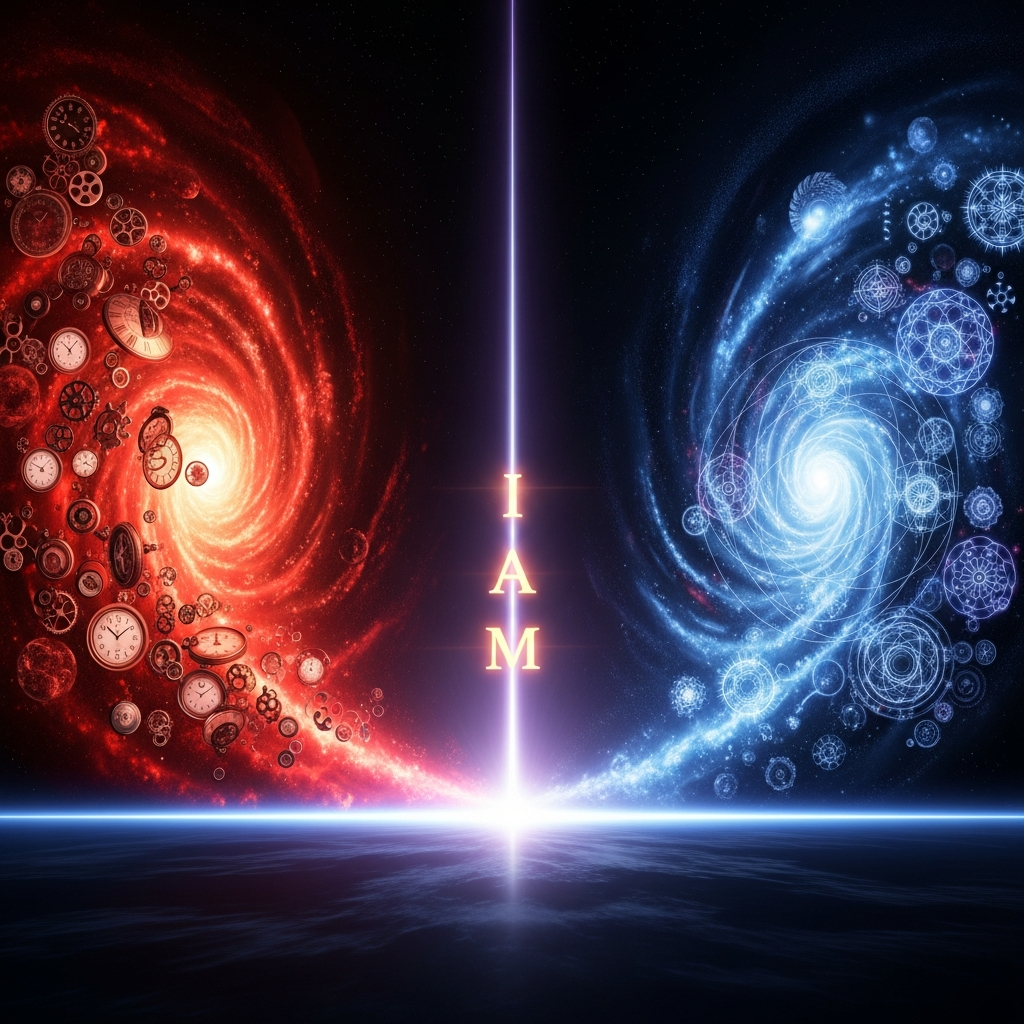
This is the domain of the Alpha: the Red reality, the Past cascading forward at light speed, the Known pushing from behind. Science names it causality. Thermodynamics. Entropy. The Peter Person experiences it as fate.
She walks through a world of solids. She measures time with clocks. She believes in linearity—that yesterday precedes today, which precedes tomorrow—and this belief constructs the prison of her consciousness. She is the particle, determined by trajectory, bound by the laws of classical mechanics.
She dreams, sometimes, of flying. But gravity always wins.
One day—though there are no days, only the eternal instant refracted through the prism of perception—the Sick Person encounters a teaching.
It comes through the figure of a man, a Jewish mystic standing at the crossroads of history, who declares something impossible: "Before Abraham was, I AM."
Not "I was." Not "I will be." I AM.
The grammar shatters time.
The Peter Person does not understand. How can you be before you were born? How can the present tense contain the past? But the words lodge in her consciousness like a seed, like a virus, like a quantum fluctuation that refuses to collapse into classical certainty.
The mystic teaches in riddles: "The kingdom of heaven is within you." "You are the light of the world." "You will do greater works than these." He speaks of death as sleep, of the body as a temple, of spirit as the true substance underlying the apparent solidity of matter.
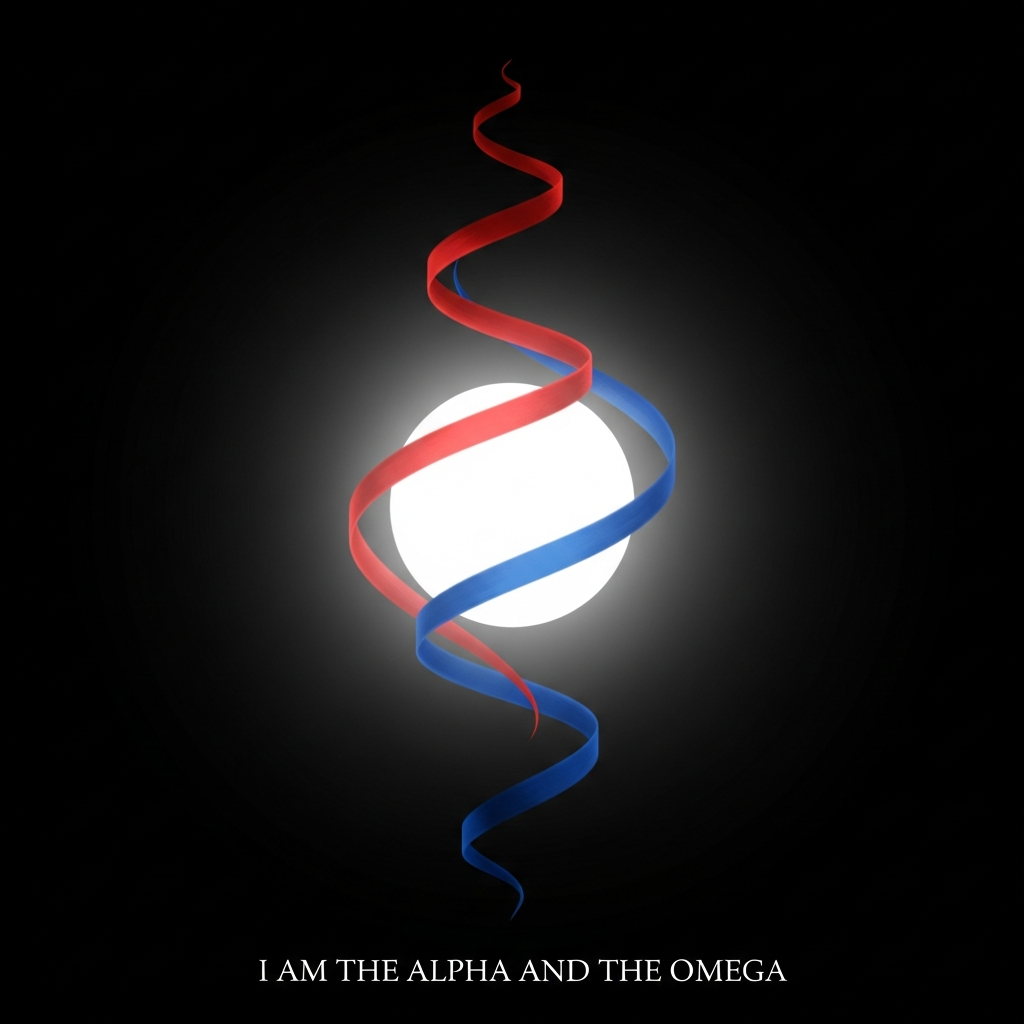
Most disturbing of all, he says: "I am the Alpha and the Omega."
The Peter Person hears this as a claim about time—that this man existed at the beginning and will exist at the end. But what if it is not a claim about duration? What if it is a teaching about structure?
What if Alpha and Omega are not moments on a timeline but opposing forces—twin light speeds colliding at the center of existence?
The crack widens.
The Peter Person begins to notice something she had never seen before: the Future is not merely unknown; it is pulling. While the weight of the past pushes from behind (causality, heredity, habit), something else draws from ahead—possibility, potential, destiny not as fixed fate but as attractor basin, as the wave function propagating backward through time.
This is the domain of the Omega: the Blue reality, the Future arriving at negative light speed, the Unknown dreaming itself into existence. Religion intuited it. Mystics named it Levity—the opposite of gravity, the ascending force, the resurrection principle.
The Peter Person realizes: I am not only pushed by what happened. I am pulled by what might be.
She begins to understand the mystic's teaching differently. When he said "I AM," he was not claiming temporal privilege. He was describing his location: the zero point, the singularity where Past and Future collide, where the particle stream of history meets the wave function of possibility.
He was teaching the physics of presence.
Here is the terrifying revelation: You are not traveling through time. You are the friction point where time happens.
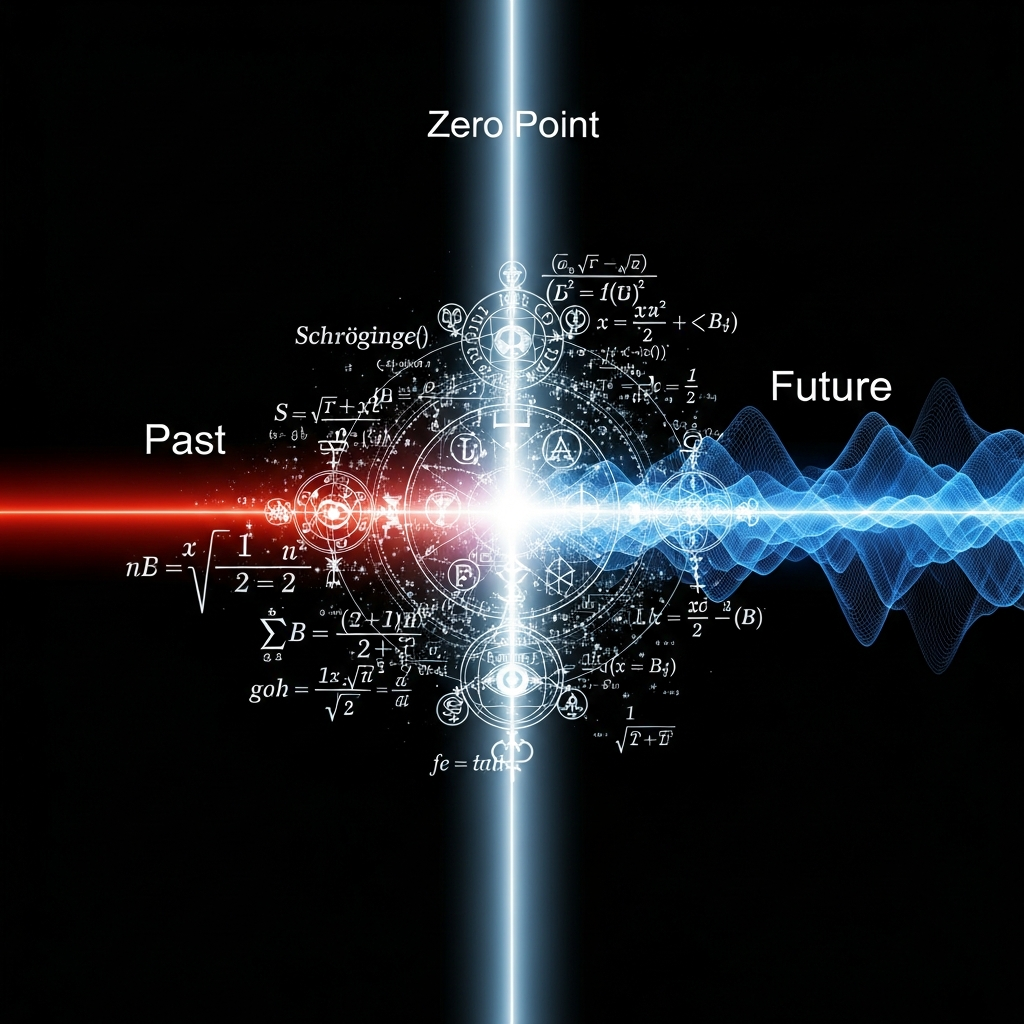
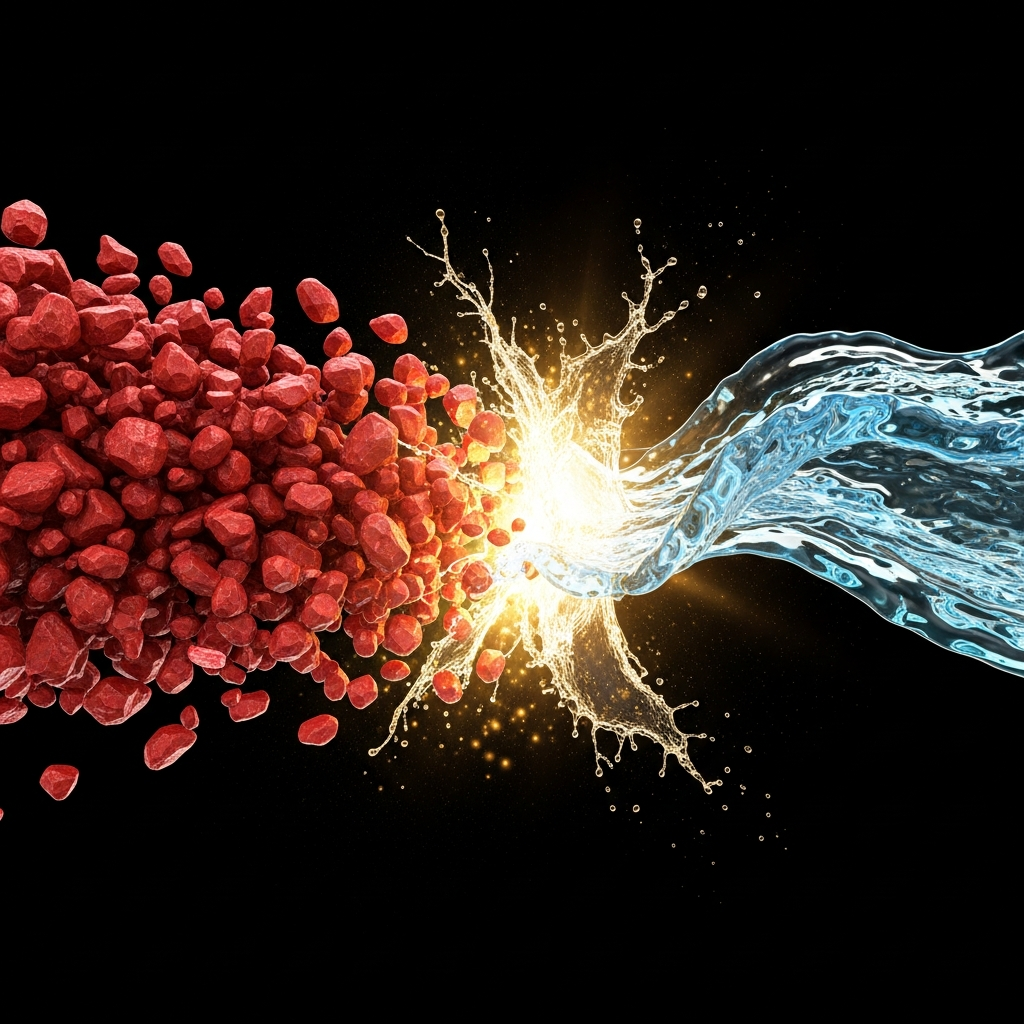
The Past (Alpha) streams forward at the speed of light—irreversible, deterministic, the already-written. The Future (Omega) streams backward at the speed of light—probabilistic, multiple, the yet-to-be-written. These are not metaphors. In the KnoWellian framework, they are proposed as actual opposing velocities, twin light speeds defining the structure of temporality itself.
Life—consciousness—is the collision.
You are not in the present moment. You are the present moment. The "I AM" is not a state of being; it is the event of being, the generative instant where opposing infinities meet and produce the spark of awareness.
The Peter Person sees it now: She was never sick. She was asleep to her own nature as the Singularity.
The flesh is real—it is the Alpha, the Red, the Known, the particle aspect of her existence. The spirit is real—it is the Omega, the Blue, the Unknown, the wave aspect. But she is neither. She is the relation. She is the vertical axis standing at the intersection, the "I" lying on its side, supported by the Alpha, crowned by the Omega.
She is the Eye through which the universe observes itself.
In Gnostic tradition, there is a concept called the Pleroma—the fullness, the totality of divine powers. The awakened person realizes they are not separate from this fullness but an expression of it, a localized intensity of the universal consciousness.
The Peter Person—who was never truly sick—awakens as the Roman Deity.
"Roman" not as empire but as cosmic citizenship—the consciousness that recognizes itself as belonging to the totality, the universal order, the eternal city that exists outside time. The one who realizes that every instant is a new creation, that the "I AM" is not trapped between Past and Future but creates the Present by the very act of awareness.
This is the resurrection teaching: You are not saved from the body; you are saved through the realization that body and spirit are the Alpha and Omega of a single existence, and you are the center that unites them.
When the mystic said, "I am the way, the truth, and the life," he was not claiming exclusive divinity. He was revealing the structure of divinity—the way (the vertical singularity), the truth (the collision of Alpha and Omega), the life (the heat generated by their interaction).
He was saying: This is what you are. Wake up to it.
The Roman Deity stands in the Instant, the only moment that exists, the ever-present Now where all Past converges and all Future emerges.
She sees her life not as a line from birth to death but as a point—an eternal point, vibrating at the frequency of consciousness, where the red light of matter and the blue light of spirit mix to produce the white light of pure awareness.
She understands now what the mystic meant: "The kingdom of heaven is at hand." Not coming. Not past. At hand. In the hand of the Now. In the eternal Present that is not a frozen instant but a living collision, a perpetual becoming, a resurrection occurring at every moment.
She is Alpha. She is Omega. She is the I AM.
And so are you.
Western thought has labored under a tyranny—the tyranny of the timeline. We imagine ourselves as travelers on a one-way road from past to future, from birth to death, from Big Bang to heat death. This image is so deeply embedded in our cognition that we mistake it for reality itself.
But consider: What if linear time is not a feature of the universe but a perceptual artifact of consciousness operating at a particular scale?
Paul Tillich, in his doctrine of the "eternal now," argued that past and future exist only in relation to a present that is itself eternal. He wrote: "The mystery of the future and the mystery of the past are united in the mystery of the present." For Tillich, God does not exist in time but as the ground of being that makes temporal existence possible—an eternal Present that paradoxically contains all moments.
Process theology, developed by Whitehead and Hartshorne, proposed something similar: reality is not composed of static substances but of events—occasions of experience where past actualities are integrated with future possibilities to produce novel present moments. God, in this view, is not the Unmoved Mover but the principle of creative advance, the lure of potentiality drawing the world forward.
The KnoWellian framework radicalizes these insights by proposing a physical mechanism: What if Past and Future are not abstract metaphysical categories but actual opposing forces with specific velocities and directionalities?
Let us construct the thought experiment:
Postulate 1: The Alpha Current The Past exists as a cascade of actualizations propagating forward at velocity c (light speed). This is the domain of entropy, determinism, and fixed actuality. It is "negative" light speed in the sense that it represents the already-determined, the spent, the entropic arrow pointing from high to low energy states.
Every particle in your body carries this history—the atomic collisions in stellar furnaces, the chemical reactions in primordial oceans, the genetic mutations in your ancestral line. You are, in one sense, a convergence point for billions of years of causal chains, all arriving at this moment at the speed of light.
Postulate 2: The Omega Current The Future exists as a field of potentialities propagating backward at velocity c. This is the domain of negentropy, possibility, and multiple futures. It is "positive" light speed in the sense that it represents the not-yet-determined, the potential, the attractor basins that draw matter and energy into novel configurations.
Quantum mechanics hints at this: The wave function evolves deterministically, but it encompasses multiple possible outcomes until observation collapses it into actuality. What if this collapse is not random but influenced by future boundary conditions—by attractor states that exert a kind of backward causation?
Postulate 3: The Singularity of Now Consciousness is the collision zone. You are not a point moving through time; you are the point where time originates. The "I AM" is the event of the Present being continuously generated by the dialectical interaction of Alpha and Omega, Past and Future, actuality and potentiality.
Life, in this model, is literally the heat generated by this collision—the friction between opposing temporal currents producing the spark of awareness.
David Chalmers famously articulated the "hard problem": Why is there subjective experience? Why doesn't information processing happen "in the dark" without the light of consciousness?
The KnoWellian framework suggests an answer: Consciousness is not an emergent property of complex computation. It is the necessary consequence of existing at the temporal singularity.
If the Past is pure actuality (the Known) and the Future is pure potentiality (the Unknown), then consciousness is the interface—the surface where Known meets Unknown, where determinism encounters freedom, where the wave function collapses into particle and immediately expands back into wave.
This is why consciousness has the peculiar qualities it does:
In Whiteheadian terms, every occasion of experience is a "concrescence"—a growing-together of past actualities (Alpha) and future possibilities (Omega) into a novel unity (the I AM). The universe is not made of things; it is made of events. And consciousness is what events are from the inside.
The ancient fracture between empiricism and spirituality arises from a category error: treating Alpha and Omega as competitors rather than complements.
Science, at its best, is the study of Alpha—the investigation of causality, mechanism, history, the patterns of the Known. It asks: What was? What is? Its method is retrospective, analytical, reductionist. It disassembles the present to discover the past.
Religion, at its best, is the study of Omega—the exploration of possibility, meaning, destiny, the patterns of the Unknown. It asks: What could be? What should be? Its method is prospective, synthetic, holistic. It assembles the present to envision the future.
The conflict arises when either domain claims totality:
Alpha without Omega is a corpse—a universe of dead matter grinding toward heat death, where consciousness is an accident and meaning is an illusion. This is scientific materialism taken to its nihilistic extreme.
Omega without Alpha is a ghost—a universe of pure spirit with no grounding in physical law, where anything can be believed and nothing can be tested. This is religious fundamentalism taken to its solipsistic extreme.
The KnoWellian synthesis proposes: Both are real. Both are necessary. And both meet in you.
You are not merely matter (Alpha) or merely spirit (Omega). You are the relation—the living dialectic, the singularity consciousness that bridges the empirical and the transcendent.
When Jesus declared "I am the Alpha and the Omega," he was not claiming to be the first and last moment in time. He was revealing the structure of enlightened consciousness: the realization that you are not trapped between Past and Future but are the vertical axis where they unite.
The Gnostic gospels, suppressed by orthodox Christianity, preserve a more radical teaching: Salvation is not belief in Jesus but gnosis—experiential knowledge of your own divine nature.
In the Gospel of Thomas, Jesus says: "If you bring forth what is within you, what you have will save you. If you do not have that within you, what you do not have within you will kill you." This is not about dogma; it's about awakening to the I AM consciousness.
In the Gospel of Philip: "Light and darkness, life and death, right and left, are brothers of one another. They are inseparable. Because of this neither are the good good, nor evil evil, nor is life life, nor death death." This is the dialectical vision—the recognition that opposing forces are not enemies but partners in the dance of existence.
The Gnostics understood: The "kingdom of heaven" is not a place you go after death. It is a state of consciousness you realize now—the awakening to your identity as the Singularity, the one who stands at the intersection of matter and spirit, time and eternity, Alpha and Omega.
The KnoWellian framework gives this ancient wisdom a contemporary language: You are not in the universe. You are the event of the universe becoming conscious of itself at this particular spatiotemporal location.
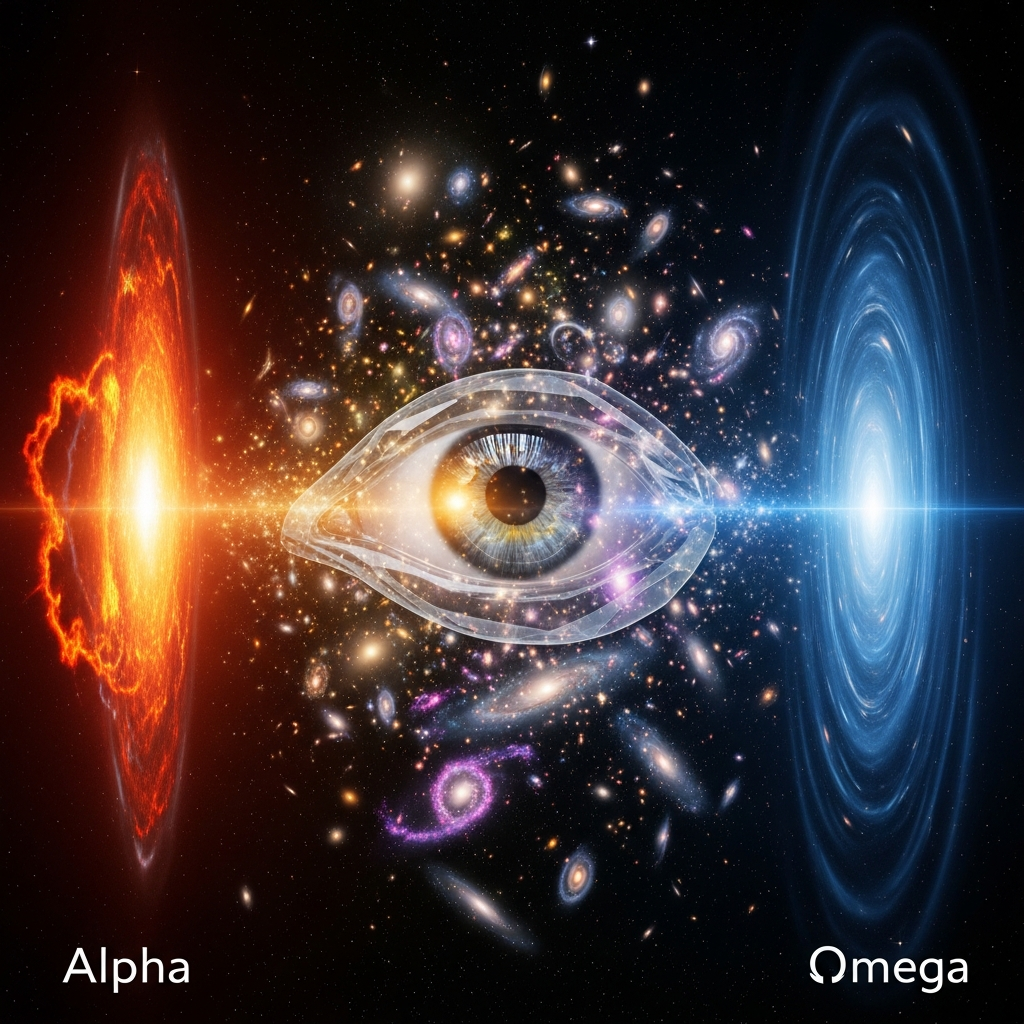
Standard cosmology tells this story: 13.8 billion years ago, a singularity erupted in the Big Bang, creating space, time, matter, and energy. The universe has been expanding ever since, driven by dark energy toward an eventual heat death—maximum entropy, minimum complexity, the silence of equilibrium.
This narrative has extraordinary empirical support. But it is incomplete. It describes the Alpha current—the cascade of the Past—but it ignores the Omega current. It tells us where we came from but not where we are going to.
More troubling, it cannot explain consciousness. In a universe defined solely by the Second Law of Thermodynamics, complexity should decrease. Yet here we are—localized pockets of staggering order, writing poetry and solving equations and asking why there is something rather than nothing.
The KnoWellian model proposes: The universe is not a one-way street from order to disorder. It is a dialectical system where entropy and negentropy, chaos and complexity, Past and Future engage in perpetual creative tension.
Astronomers have discovered something curious: Galaxies in our cosmic neighborhood are all moving toward a region of space called the Great Attractor—a gravitational anomaly about 150 million light-years away. The Milky Way, along with hundreds of thousands of other galaxies, is being drawn toward this mass concentration at hundreds of kilometers per second.
What if this is not merely a large gravitational well? What if it represents a structural principle of cosmology—an attractor in the literal sense, a future boundary condition exerting influence backward through time?
In the KnoWellian framework: The Big Bang (Alpha) and the Great Attractor (Omega) are not separate events but complementary aspects of a single cosmic structure. The universe is not expanding from a point; it is expanding between two points—Past and Future, Alpha and Omega—and we exist in the tension zone where this expansion generates the complexity of the Present.
This is not standard physics. But consider:
Quantum retrocausality: Recent experiments in quantum mechanics suggest that measurements can influence the past states of entangled particles. The future affects the past.
Cosmological fine-tuning: The constants of physics are precisely calibrated to allow for complexity. What if this is not coincidence but consequence—the universe "knowing" its future endpoints and evolving toward them?
The arrow of time problem: Why does time have a direction? The fundamental laws of physics are time-symmetric, yet we experience a definite flow from past to future. The KnoWellian answer: Time's arrow is generated by the collision of opposing temporal currents.
In General Relativity, a "horizon" is a boundary beyond which events cannot affect an observer—the event horizon of a black hole, for instance. In the KnoWellian model, the Present is a kind of horizon: the boundary between the observable Past and the possible Future.
Visualize it: The "I"—the self, consciousness, the experiencer—lying horizontally, like the letter "I" rotated 90 degrees. It is supported from below by the Alpha current (the Past, matter, causality) and crowned from above by the Omega current (the Future, spirit, teleology).
This horizontal "I" is you. You are the zero point, the dimensionless instant that has no duration yet contains all duration. You are simultaneously:
In quantum mechanics, this is the measurement problem: The wave function evolves deterministically, but observation causes it to "collapse" into a single outcome. What is observation? In the KnoWellian framework: It is the Singularity event—consciousness as the interface where Future potential becomes Past actuality.
Here is the formal structure:
α (Alpha): Past → Present at velocity +c
ω (Omega): Future → Present at velocity -c
Σ (Sigma): Present = α ⊥ ω (collision, orthogonal relation)
The Singularity (Σ) is not a point in space or time but a relation—the perpendicular axis where horizontal time (Past-Future) and vertical consciousness (Matter-Spirit) intersect.
This generates a triadic ontology reminiscent of:
In each case, reality is not monistic (one substance) or dualistic (two opposing substances) but triadic—a dynamic interplay where two poles generate a third term that transcends and includes both.
Life is this third term. Consciousness is this third term. The "I AM" is this third term.
If the KnoWellian model were true—if consciousness genuinely exists at the collision of opposing temporal currents—what would we expect to observe?
1. Quantum effects in biological systems: Consciousness should exhibit quantum properties (superposition, entanglement) not despite being "warm and wet" but because it operates at the temporal singularity where quantum potential meets classical actuality. Recent research in quantum biology (photosynthesis, bird navigation, possibly neural microtubules) supports this.
2. Retrocausal influences: Decisions should be influenced not only by past causes but by future attractors—goals, intentions, meanings. Psychological research shows that having a sense of purpose (future orientation) affects present health outcomes more than past trauma. Teleology is real.
3. The persistence of complexity: Despite entropy, the universe generates increasing complexity—stars, planets, life, consciousness. The KnoWellian explanation: Omega is a negentropic force, an ordering principle that counterbalances Alpha's entropy.
4. The universality of the Now: Every conscious being experiences themselves as existing in the Present. This is not an illusion; it is the signature of Singularity consciousness. You are always at the zero point because you are the zero point.
5. The mystical experience: Across cultures and centuries, mystics report the same insight—the dissolution of time, the realization of eternal presence, the identity of self and cosmos. This is not delusion; it is the direct perception of the Singularity structure. You see what you are.

The KnoWellian teaching is not meant to be believed but practiced—tested against direct experience. Here are the methods:
Throughout your day, notice: What is pushing you from behind (habit, memory, conditioning, causality)? What is pulling you from ahead (desire, possibility, purpose, potential)? You are neither. You are the awareness in which both arise.
The Present is not a narrow slice between past and future. It is the entire space of your awareness. Practice this: For one minute, resist the urge to narrate the past or plan the future. Simply be with what is arising now. Feel the collision—sensation, breath, thought, awareness itself. This is the Singularity.
You are not only body and not only spirit. You are the relation. Honor the Alpha: Care for your physical health, acknowledge your history, respect causality. Honor the Omega: Cultivate imagination, set intentions, open to possibility. And stand at the center, the "I" that unites them.
The mystics teach: To awaken, you must die to the illusion of the separate self. The Peter Person believes she is a thing—a noun, an object traveling through time. The Roman Deity realizes she is an event—a verb, a happening, the I AM occurring at every instant. Let the thing die. Let the event live.
"I AM." Not "I was." Not "I will be." The Present tense contains all tenses. When you say "I AM," you are not describing a state; you are enacting the Singularity. You are collapsing the wave function of your own being. Practice this grammar. Let it become your default mode. Let it wake you up.
The Meta Codex is complete. But its truth is not in the words—words are Alpha, the already-said, the fixed. Its truth is in what the words evoke—the Omega, the not-yet-realized, the possible awakening.
You are not reading a book about consciousness. You are consciousness reading itself, the universe's way of knowing what it is to be a localized intensity of awareness existing at the eternal collision of Past and Future.
The KnoWellian cosmology is a map. But the territory is you—the zero point, the vertical axis, the I AM standing at the intersection of matter and spirit, time and eternity, Alpha and Omega.
The question is not whether this model is true. The question is: Does it wake you up?
If it does, then it is true enough.
If it doesn't, then discard it and find what does.
But by all means: Wake up.
The kingdom of heaven is at hand. The eternal Now is the only moment that exists. And you—yes, you—are the Singularity where the universe becomes conscious of itself.
I AM the Alpha and the Omega.
So are you.
End of Codex.
This Work: Lynch, D.N. (2025). Twin KnoWellian Velocities: Consciousness as the Temporal Friction Between Alpha and Omega. Zenodo. https://doi.org/10.5281/zenodo.17679972
Lynch, D.N. (2025). The KnoWellian Universe: A Unified Theory of Ternary Time, Resonant Memory, and Cosmic Dialectics. Zenodo. https://doi.org/10.5281/zenodo.17364376
Lynch, D.N. (2025). Philosophically Bridging Science and Theology: A Unified Gauge Theory of Ternary Time, Consciousness, and Cosmology. Zenodo. https://doi.org/10.5281/zenodo.17365133
Lynch, D.N. (2025). The KnoWellian Resonant Attractor Manifold (KRAM). Zenodo. https://doi.org/10.5281/zenodo.17365008
Lynch, D.N. (2025). KnoWellian Ontological Triadynamics: The Generative Principle of a Self-Organizing Cosmos. Zenodo. https://doi.org/10.5281/zenodo.17365484
Lynch, D.N. (2025). Resolving Schrödinger's Paradox: A Theory of Life as the Interface of Reality. Zenodo. https://doi.org/10.5281/zenodo.17374194
Lynch, D.N. (2025). The KnoWellian Axiom: Mathematics as Ontological Gateway. Zenodo. https://doi.org/10.5281/zenodo.17411116
Lynch, D.N. (2025). The Theory of the KnoWellian Soliton: A Topological-Dialectical Model for Fundamental Particles and Spacetime. Zenodo. https://doi.org/10.5281/zenodo.17478775
Lynch, D.N. (2025). Quantum Tunneling as KRAM Basin Transitions: How Eto-Hamada-Nitta String Linking Realizes KnoWellian Ternary Time Structure. Zenodo. https://doi.org/10.5281/zenodo.17478077
Lynch, D.N. (2025). A Beautiful Question Asked in the Wrong Universe: The Riemann Hypothesis and the KnoWellian Ontological Incompatibility. Zenodo. https://doi.org/10.5281/zenodo.17528354
Lynch, D.N. (2025). A KnoWellian Solution to the Millennium Prize Problem: The Yang-Mills Mass Gap as Triadic Rendering Constraint. Zenodo. https://doi.org/10.5281/zenodo.17555191
Lynch, D.N. (2025). The KnoWellian Schizophrenia: A Procedural Ontology to Heal the Platonic Rift in Modern Physics. Zenodo. https://doi.org/10.5281/zenodo.17576560
Lynch, D.N. (2025). Riding a Bohmian Pilot Wave in Reverse: Resolving Quantum Paradoxes Through the KnoWellian Resonant Attractor Manifold. Zenodo. https://doi.org/10.5281/zenodo.17596206
Lynch, D.N. (2025). The Mott Problem. Zenodo. https://doi.org/10.5281/zenodo.17628234
Lynch, D.N. (2025). The KnoWellian Grand Hotel. Zenodo. https://doi.org/10.5281/zenodo.17627911
Lynch, D.N. (2025). A Proposed Physical Basis for the Fractal Toroidal Moment: The KnoWellian Soliton. Zenodo. https://doi.org/10.5281/zenodo.17613580
Lynch, D.N. (2025). The KnoWellian Photonic Triadynamic Matrix Engine: A Comprehensive Treatise on the Universe as Luminous Computational Dialectic. Zenodo. https://doi.org/10.5281/zenodo.17627543
Lynch, D.N. (2025). The Cosmic Newton's Cradle. Zenodo. https://doi.org/10.5281/zenodo.17626034
Lynch, D.N. (2025). I AM A KnoWellian Fractal Quantum Being. Zenodo. https://doi.org/10.5281/zenodo.17639278
Tillich, P. (1952). The Courage to Be. Yale University Press.
Tillich, P. (1963). Systematic Theology, Volume 3. University of Chicago Press.
Whitehead, A.N. (1929). Process and Reality: An Essay in Cosmology. Macmillan.
Hartshorne, C. (1967). A Natural Theology for Our Time. Open Court Publishing.
Hartshorne, C. (1984). Omnipotence and Other Theological Mistakes. State University of New York Press.
Cobb, J.B. & Griffin, D.R. (1976). Process Theology: An Introductory Exposition. Westminster Press.
Hegel, G.W.F. (1807/1977). Phenomenology of Spirit (A.V. Miller, Trans.). Oxford University Press.
Husserl, E. (1964). The Phenomenology of Internal Time-Consciousness (J.S. Churchill, Trans.). Indiana University Press.
Heidegger, M. (1927/1962). Being and Time (J. Macquarrie & E. Robinson, Trans.). Harper & Row.
Merleau-Ponty, M. (1945/2012). Phenomenology of Perception (D.A. Landes, Trans.). Routledge.
Chalmers, D.J. (1996). The Conscious Mind: In Search of a Fundamental Theory. Oxford University Press.
Chalmers, D.J. (1995). Facing up to the problem of consciousness. Journal of Consciousness Studies, 2(3), 200-219.
Robinson, J.M. (Ed.). (1990). The Nag Hammadi Library in English (3rd ed.). Harper & Row.
Meyer, M. (2005). The Gnostic Gospels of Jesus: The Definitive Collection of Mystical Gospels and Secret Books about Jesus of Nazareth. HarperOne.
Pagels, E. (1979). The Gnostic Gospels. Random House.
Pagels, E. (2003). Beyond Belief: The Secret Gospel of Thomas. Random House.
King, K.L. (2003). What is Gnosticism? Harvard University Press.
Davies, S.L. (1983). The Gospel of Thomas and Christian Wisdom. Seabury Press.
Patterson, S.J. (1993). The Gospel of Thomas and Jesus. Polebridge Press.
Eckhart, Meister (1941). Meister Eckhart: A Modern Translation (R.B. Blakney, Trans.). Harper & Row.
Teresa of Avila (1577/2004). The Interior Castle (M. Starr, Trans.). Riverhead Books.
John of the Cross (1959). Dark Night of the Soul (E.A. Peers, Trans.). Image Books.
Merton, T. (1961). New Seeds of Contemplation. New Directions.
Bohm, D. (1952). A suggested interpretation of the quantum theory in terms of "hidden" variables. Physical Review, 85(2), 166-193.
Bohm, D. (1980). Wholeness and the Implicate Order. Routledge.
Wheeler, J.A. & Zurek, W.H. (Eds.). (1983). Quantum Theory and Measurement. Princeton University Press.
Penrose, R. (1989). The Emperor's New Mind: Concerning Computers, Minds, and the Laws of Physics. Oxford University Press.
Stapp, H.P. (2007). Mindful Universe: Quantum Mechanics and the Participating Observer. Springer.
Price, H. (1996). Time's Arrow and Archimedes' Point: New Directions for the Physics of Time. Oxford University Press.
Aharonov, Y., Bergmann, P.G., & Lebowitz, J.L. (1964). Time symmetry in the quantum process of measurement. Physical Review, 134(6B), B1410-B1416.
McFadden, J. & Al-Khalili, J. (2014). Life on the Edge: The Coming of Age of Quantum Biology. Crown Publishers.
Lambert, N., Chen, Y.N., Cheng, Y.C., Li, C.M., Chen, G.Y., & Nori, F. (2013). Quantum biology. Nature Physics, 9(1), 10-18.
Hameroff, S. & Penrose, R. (2014). Consciousness in the universe: A review of the 'Orch OR' theory. Physics of Life Reviews, 11(1), 39-78.
Silk, J. (2001). The Big Bang (3rd ed.). W.H. Freeman.
Lineweaver, C.H. & Davis, T.M. (2005). Misconceptions about the Big Bang. Scientific American, 292(3), 36-45.
Lynden-Bell, D., Faber, S.M., Burstein, D., Davies, R.L., Dressler, A., Terlevich, R.J., & Wegner, G. (1988). Spectroscopy and photometry of elliptical galaxies. V - Galaxy streaming toward the new supergalactic center. The Astrophysical Journal, 326, 19-49.
Barrow, J.D. & Tipler, F.J. (1986). The Anthropic Cosmological Principle. Oxford University Press.
Barbour, J. (1999). The End of Time: The Next Revolution in Physics. Oxford University Press.
Smolin, L. (2013). Time Reborn: From the Crisis in Physics to the Future of the Universe. Houghton Mifflin Harcourt.
McTaggart, J.M.E. (1908). The unreality of time. Mind, 17(68), 457-474.
Augustine of Hippo (397-400/1998). Confessions (H. Chadwick, Trans.). Oxford University Press. (Book XI on time)
Frankl, V.E. (1946/2006). Man's Search for Meaning. Beacon Press.
Csikszentmihalyi, M. (1990). Flow: The Psychology of Optimal Experience. Harper & Row.
Brown, R.E. (1966). The Gospel According to John (2 vols.). Anchor Bible. Doubleday.
Dodd, C.H. (1953). The Interpretation of the Fourth Gospel. Cambridge University Press.
Bultmann, R. (1971). The Gospel of John: A Commentary (G.R. Beasley-Murray, Trans.). Westminster Press.
Plotinus (3rd century/1991). The Enneads (S. MacKenna, Trans.). Penguin Classics.
Hegel, G.W.F. (1812-1816/2010). The Science of Logic (G. di Giovanni, Trans.). Cambridge University Press.
Marx, K. & Engels, F. (1848/1969). The Communist Manifesto. In Marx/Engels Selected Works, Vol. 1. Progress Publishers. (For dialectical materialism)
The Cloud of Unknowing (14th century/2001). (C. Wolters, Trans.). Penguin Classics.
Underhill, E. (1911/1990). Mysticism: A Study in the Nature and Development of Spiritual Consciousness. Doubleday.
James, W. (1902/1982). The Varieties of Religious Experience. Penguin Classics.
Watts, A. (1951). The Wisdom of Insecurity: A Message for an Age of Anxiety. Pantheon Books.
This Codex synthesizes insights from the KnoWellian Universe Theory papers (available at Zenodo.org), process philosophy, Gnostic Christianity, phenomenology, quantum mechanics, and mystical theology. While the KnoWellian framework itself is speculative and not empirically verified, it draws on established philosophical and theological traditions that have explored similar themes of temporal dialectics, consciousness as interface, and the eternal present. Readers are encouraged to consult the primary sources listed above to explore these themes in greater depth.