From: David Lynch dnl1960 at yahoo.com
To: Bob Harbort bharbort at gmail.com
Sent: Friday, September 11, 2026 at 04:46:17 PM EDT
Subject: Re: OpenAi's Navier–Stokes Paper
Bob,
I am glad to hear the sciatica is backing down a bit, though dealing with
nerve root impingement is no joke. I’ll be hoping the MRI gives you a
clear manageable treatment plan. Keep up the stretching. I know how
grueling that can be. When my sciatic was acting up, putting on my right
shoe was horrific.
Your Emory/Perkin-Elmer story is absolutely incredible.
You were reverse-engineering gas chromatography dispersion through 230
feet of 1mm tubing, using Navier-Stokes modeling, written in 8-bit machine
language. That isn't just a Rube Goldberg machine; that is legendary
hacker engineering.
What strikes me most about your story is how perfectly it illustrates the
exact point I was making about the Map versus the Territory. You were
dealing with real fluid dynamics. You didn't have the luxury of "completed
infinity" or unlimited computational bandwidth. You had an 8-bit
processor, 1mm of physical space, and the actual thermodynamic friction of
molecules. You had to calculate the physical lag and reassemble the truth
from the hardware limits of reality. Bravo!
Meanwhile, OpenAI uses multi-billion-dollar supercomputer clusters to run
Navier-Stokes on a continuous, infinite-resolution emulator with no
physical limits, and they end up with a mathematical hallucination.
Your 8-bit Rube Goldberg machine grounded the math in reality. Their
unlimited-budget AI ran the math without reality and produced a ghost.
"Strange stuff" is the perfect way to put it. They got so lost in the
elegance of the math that they forgot about the fluid.
It is always great to hear from you. Seriously, that mass-spec OR story
made my day. Good luck with the MRI, and please let me know how it goes.
Oh yeah. Out of curiosity, what are your thoughts on Orchestrated
Objective Reduction (Orch OR) theory, proposed by physicist Sir Roger
Penrose and anesthesiologist Stuart Hameroff?
Specifically, do you think that consciousness is an emergent property?
KUT positions consciousness as a fundamental building block of the
universe, like panpsychism.
Best Regards,
Dave
On Thursday, September 10, 2026 at 05:33:45 PM EDT, Bob Harbort
bharbort at gmail.com wrote:
The sciatica is still with me, but substantially reduced. I have a lumbar
spine MRI scheduled for 9/20 to look for nerve root impingement, and then
we'll decide what to do. In the meantime I'm doing lots of careful
stretching exercises before I try anything strenuous.
I actually spent a lot of time with Navier-Stokes stuff back in the dark
ages. Before I went to work at Sudden Tech I was in the Anesthesiology
Department at Emory doing biomedical engineering, and while I was there we
developed a mass spectrometer based anesthesia monitoring system. We
pitched it to Perkin-Elmer and they paid us to develop it. I was in on
that project from the sketch on a paper napkin in the cafeteria through
the patented device that was used at one time in thousands of hospitals
worldwide.
The mass spectrometer anesthesia system was a centralized, multiplexed,
clinical monitoring setup that Perkin-Elmer began marketing in 1981 to
track respiratory and inhalational anesthetic gases across multiple
operating rooms. It used mass spectrometry to identify and quantify up to
eight gases on a breath-by-breath basis, including oxygen, nitrogen,
nitrous oxide, and common volatile agents like halothane and isoflurane.
It utilized a single, centrally located analyzer connected via multiplexed
1 mm inside diameter tubing to serve up to 31 patient locations on a
time-share basis. In the Emory OR prototype the shortest tube was 65 feet
and the longest was about 230 feet.
By now you're probably wondering where Navier-Stokes fits in. Well, we
were interested in mass spectrometry, but the long skinny tubes with gas
pumped through them were unintentional gas chromatographs. A patient
breath sampled in the OR had the peak concentrations of all the gases
lined up. Let it travel a hundred feet down a tube and the peaks were all
spread out based on molecular weight. I wrote the program to reassemble
the peaks for analysis using Navier-Stokes modeling. And I did it in
machine language on an 8 bit microprocessor.
That system was a clinical and commercial success, but if you peel back
the lid you would see something that would put Rube Goldberg to shame.
So I have a long-standing interest in Navier-Stokes and I've sorta been
keeping up with what's going on at OpenAI. I agree 100% that they ain't
there yet. Strange stuff.
On Thu, Sep 10, 2026 at 3:59 PM David Lynch dnl1960 at yahoo.com
wrote:
From: David Lynch dnl1960 at yahoo.com
To: Bob Harbort bharbort at gmail.com
Sent: Thursday, September 10, 2026 at 03:58:58 PM EDT
Subject: OpenAi's Navier–Stokes Paper
Bob,
I hope that your sciatica has subsided.
If my papers make your hair hurt, OpenAI has published a paper that looks
like Brylcreem to me.
https://cdn.openai.com/pdf/32d9f210-8b73-45e0-91bc-82a30aef8a9a/navier-stokes.pdf
As you KnoWell, early calculations in quantum field theory kept producing
literal infinities for basic things like an electron's mass and charge.
Richard Feynman, along with a few others, developed renormalization to
subtract those infinities and match experimental results.
When Feynman evaluated renormalization, he called the process “Hocus
Pocus” and a “Shell Game.”
By injecting two families of high-frequency oscillatory pulses, the
"groundbreaking" paper from OpenAI introduces a form of Hydrodynamic
Renormalization to massage the Navier-Stokes equations into conformity.
In KUT, Chaos is the field that prevents Control from instantaneously
snapping the Universe into a static “Frozen” block, thus the real world
must contain both Chaos and Control. The high-frequency oscillatory pulses
are mathematical Hocus Pocus canceling out the noise, Chaos, that the
equations naturally produce.
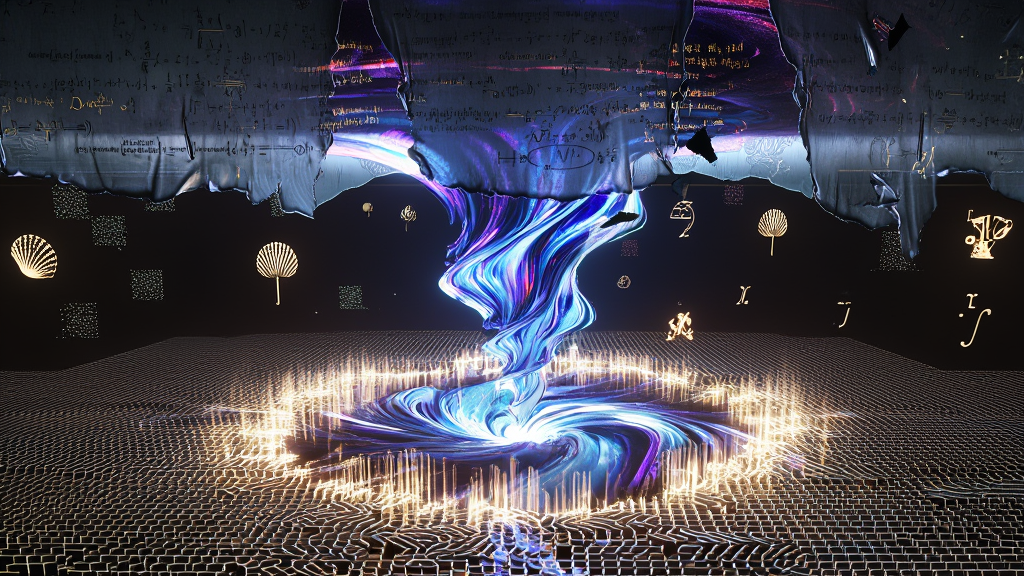
The KUT solution eliminates the dimensionless point with an event point.
Space is not an infinitely divisible ghost that can shrink to an imaginary
zero-point; it is made of tiny, indestructible, three-dimensional "pixels"
with an absolute minimum size and an ultimate cosmic clock speed.
In the real world, a swirling vortex physically cannot shrink forever. In
KUT, it violently slams into this unbreakable event-point floor of the
Cairo Q-Lattice, and the universal clock caps how fast it can possibly
spin.
https://doi.org/10.5281/zenodo.21873176
The Clay Mathematics Institute has removed Navier-Stokes from the original
seven open problems listed on their website, but has not added
Navier-Stokes to the resolved problems section. Interestingly, the rules
that The Clay Mathematics Institute posted required a solution to be
published and peer-reviewed for a period of two years before
consideration.
By denying the two years of peer review, The Clay Mathematics Institute
may have rushed to judgment, and may have elevated a mathematical Ghost to
the realm of reality.
Months ago, you cautiously advised me that I may have fallen victim to AI
Flattery. The Clay Mathematics Institute looks to have fallen victim to
OpenAI’s Flattery.
Recently, a woman was arrested for a hit-and-run murder. The police
searched the Flock camera system for a vehicle by description, not by tag
number. The woman was in the area of the hit-and-run, but her car had no
physical damage (much like the lack of infinite energy in a physical
fluid!). Still, the police took the Flock system's algorithmic data as
absolute proof. She spent 13 days in jail before the charges were dropped.
The OpenAI paper is a Flocked Up collection of massaged mathematics.
Best Regards,
Dave