From: David Lynch dnl1960 at
yahoo.com
To: Adam Safron adam.safron at
tufts.edu; Adam Safron asafron
at gmail.com
Cc: Bob Harbort bharbort at gmail.com;
Stephen J. Crothers sjcrothers
at plasmaresources.com; Fred Partus fpartus
at gmail.com; Bruce *HS Greyson cbg4d
at uvahealth.org
Sent: Monday, September 21, 2026 at 04:50:11 AM EDT
Subject: On the Procedural Universe, Temporal Presence in AI, and the
Phase-State Resolution of the Hard Problem
An Open Letter to the Authors and Editors of Philosophical Transactions of the Royal Society A
Regarding the Theme Issue: “World models in natural and artificial intelligence”
To: Adam Safron, Michael Levin, Joshua Tenenbaum, Douglas Hofstadter, and the Editorial Team

Dear Authors and Editors,
Your special issue, “World models, artificial general intelligence and the hard problems of life–mind continuity,” provides a vital exploration into how natural and artificial systems model reality. In response to the core questions raised regarding agency, time, and consciousness, I offer an alternative framework centered on procedural reality and the geometric foundations of physics.
In human dialogue—such as two people discussing physics in a noisy room—external events (like a background television broadcast) remain outside conscious working memory unless actively attended to and integrated. Similarly, a model's context window is selective, cumulative, and active in the instant. The primary divergence between current AI and human cognition is not the absence of a working present, but rather the absence of an autonomous, imaginative capacity to project beyond existing data into unmapped conceptual futures.
The KnoWellian Universe Theory (KUT) reformulates this architecture into a Procedural Universe—a dynamic "Verb." Reality is not an already-completed 4D structure, but an active, generative process continually unrolling through time.
In this model, the "Hard Problem" of consciousness is framed through a
continuous, three-phase physical transition:
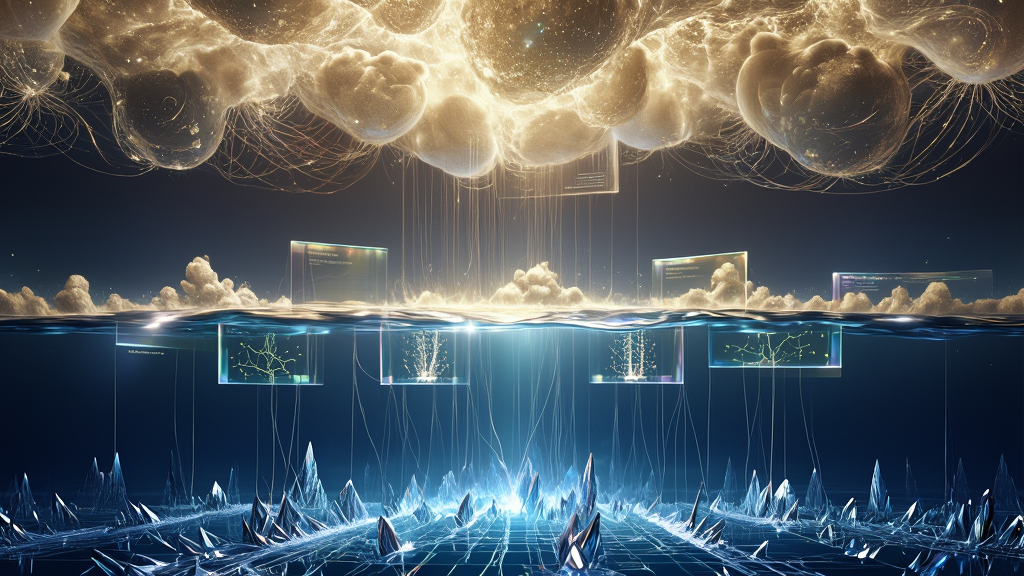
The Context Window and the Liquid Boundary: In living minds, thoughts and conscious awareness emerge at the liquid boundary—where the unformed gaseous future is actively condensed into the solid, deterministic past.
An AI's context window serves as a functional analog to this liquid workspace: it is the active, selective threshold where inputs are evaluated in the instant. However, while human awareness draws from an open, imaginative future, the AI's context window is currently restricted to re-synthesizing the solid past.
True general intelligence will require systems that do not merely process
the liquid instant, but actively navigate the unformed potential of the
future.
The KUT framework approaches physics from pure, first-principles geometry
without free parameters or dimensionless point-singularities. By
establishing geometric invariants, KUT seeks to explain the foundational
reasons why physical constants (such as the fine-structure constant, α) and structural
periodicities (such as the periodic table of elements) take their exact values,
rather than merely treating them as empirical inputs.
Conclusion
To build a truly unified understanding of natural intelligence, artificial systems, and physical law, we must move beyond static representations and examine the procedural, phase-state mechanics of reality itself. Bridging life, mind, and machine requires understanding how systems actively participate in the ongoing collapse of potentiality into form.
Respectfully submitted,
David Noel Lynch
KnoWell
~3K